
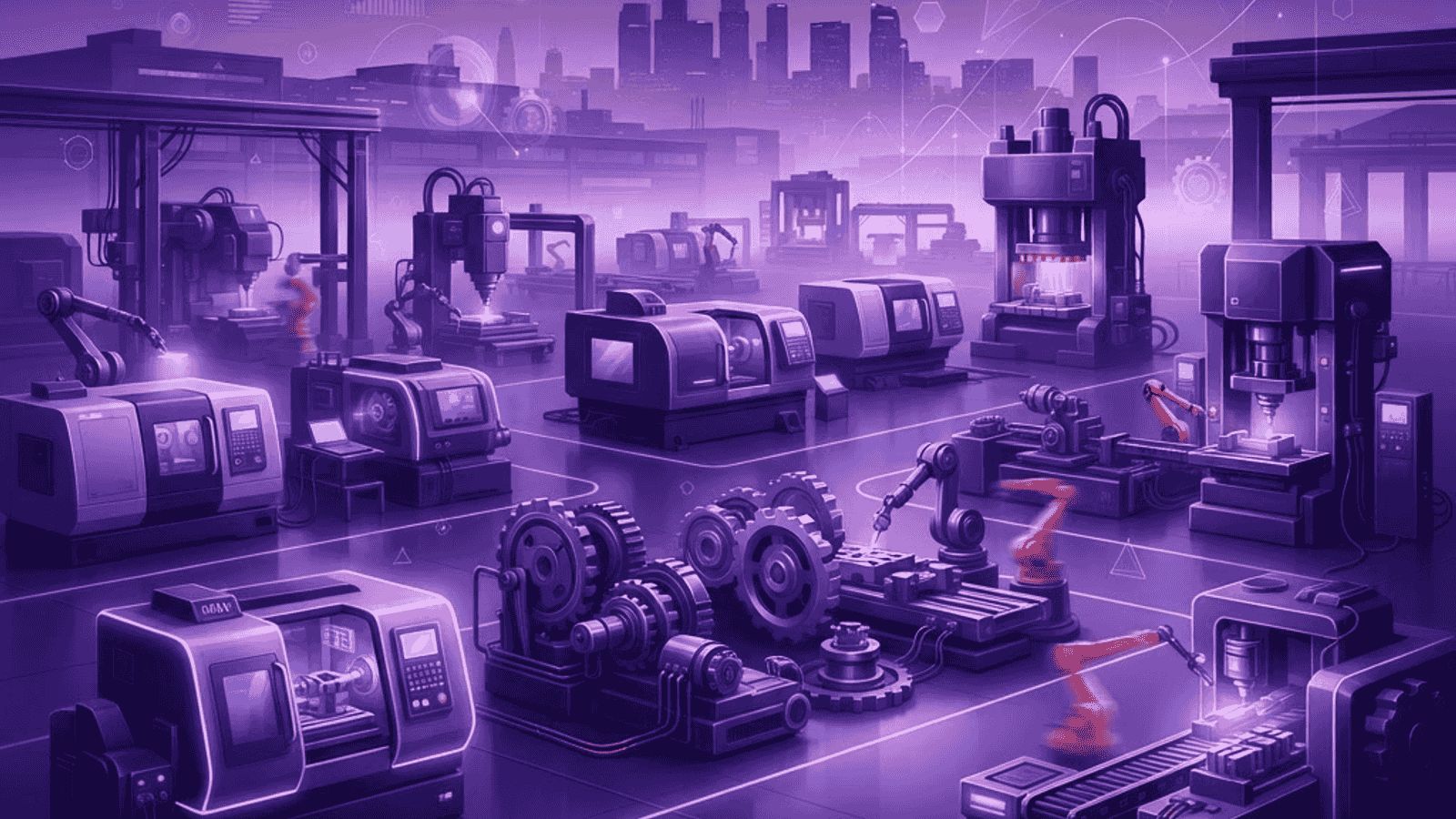
Why Anaheim Is a Machinery Building Center
Machinery manufacturing rewards proximity to customers. Capital equipment requires site surveys, installation supervision, commissioning support, operator training, and years of service afterward, all of which are easier when the builder is an hour away rather than a continent away. Anaheim's position within one of the country's densest industrial regions has made it a natural base for machine builders serving food processing, plastics, packaging, aerospace, medical device, and general manufacturing customers.
The local machinery sector skews toward customization. Rather than competing with high-volume standard equipment producers, Anaheim firms typically design systems around a specific process, product, or facility constraint. That orientation demands strong mechanical and controls engineering, and it makes the selection process fundamentally different from buying a catalog item.
The Top 10 Best Machinery Manufacturers in Anaheim
1. Canyon Automation Systems
Canyon designs and builds custom automated assembly and inspection cells integrating robotics, vision systems, and motion control. Its reputation comes from thorough front-end engineering, including cycle time simulation and detailed functional specifications developed before fabrication starts, which reduces surprises at commissioning.
2. Orange County Packaging Machinery
Producing filling, capping, labeling, and case packing equipment, this manufacturer serves food, beverage, cosmetics, and nutraceutical producers. Sanitary design principles, washdown-rated construction, and quick changeover features distinguish its equipment in facilities running multiple product formats.
3. Brookhurst Machine Tool Works
Brookhurst manufactures and rebuilds machine tools, including specialty grinding, boring, and drilling equipment. Its rebuild practice is notable: restoring geometric accuracy and replacing controls on well-built older machines often delivers capability at a fraction of new equipment cost.
4. Katella Conveyor and Material Handling
Belt, roller, chain, and modular conveyor systems form the circulatory system of any plant, and Katella engineers these layouts around throughput and accumulation requirements. Its designs emphasize maintainability, with accessible bearings, tensioners, and drive assemblies.
5. Platinum Triangle Hydraulics and Presses
Specializing in hydraulic presses, power units, and cylinder assemblies, this firm handles both new builds and system upgrades. Safety compliance receives particular emphasis, including light curtain integration, two-hand controls, and pressure relief validation.
6. La Palma Industrial Controls
Machinery is increasingly defined by its controls, and La Palma builds control panels, programs logic controllers, develops operator interfaces, and integrates data collection. Documentation quality is a stated priority, with annotated drawings and commented code that customer maintenance teams can actually support.
7. Anaheim Canyon Process Equipment
Mixers, tanks, heat exchangers, and process skids for chemical and food applications form this manufacturer's core output. Material selection, weld finish standards, and cleanability drive its designs, along with pressure vessel code compliance where applicable.
8. Ball Road Machine Guarding and Safety
Retrofitting existing equipment for current safety expectations is a substantial market, and Ball Road designs and fabricates guarding, interlocks, and safety circuits. Risk assessment services accompany the hardware, helping facilities document their compliance reasoning.
9. Harbor Precision Fixtures and Automation Tooling
Harbor produces workholding fixtures, end effectors, and specialty tooling that make automation practical. Its engineers work closely with customers' process teams, since fixture design often determines whether an automated cell achieves its intended cycle time.
10. Sunkist Equipment Service and Rebuilds
Sustaining installed machinery is a discipline of its own. Sunkist performs preventive maintenance programs, precision alignment, control retrofits, and full rebuilds, extending equipment life and improving reliability for facilities not ready for capital replacement.
How to Evaluate a Machinery Manufacturer
Engineering depth is the primary differentiator. Ask how much design work precedes fabrication, whether simulation or calculation supports the mechanical design, and who will own the project technically. A named lead engineer with process experience in your industry is worth more than any general capability claim.
Controls strategy deserves a dedicated conversation. Confirm which controller platform will be used, whether it matches your plant standard, who owns the source code, and how the program will be documented. Nonstandard or undocumented controls create long-term dependency that many facilities regret.
Acceptance testing should be defined in the contract. Factory acceptance testing at the builder's site followed by site acceptance testing after installation, with agreed performance criteria and measurement methods, protects both parties. Vague performance language is the most common source of capital equipment disputes.
Lifecycle support determines total cost of ownership. Evaluate spare parts availability, whether the machine uses commercially available components or proprietary parts, service response commitments, and training provisions for operators and maintenance staff.
Trends in Machinery and Automation
Labor availability continues to be the strongest driver of automation investment across Southern California manufacturing. Projects that previously failed to justify themselves now proceed because staffing consistency has become as valuable as labor cost reduction.
Data connectivity has moved from novelty to expectation, with buyers requesting machine performance monitoring, downtime tracking, and integration with plant systems. Machinery builders who treat data as a designed feature rather than a retrofit deliver more useful systems.
Flexibility is displacing raw speed as a design priority. Shorter product cycles and more frequent changeovers mean that a machine capable of switching formats quickly often outperforms a faster machine that requires lengthy setup. Sustainability considerations, particularly energy consumption and material waste reduction, are also entering equipment specifications more regularly.
Approaching a Capital Equipment Project
Invest in the specification. A well-written functional requirements document that describes product variations, throughput targets, utilities, footprint constraints, and integration points will produce comparable quotes and far better outcomes than an informal description.
Visit reference installations rather than only the builder's shop, and speak with maintenance personnel who live with the equipment daily. Anaheim's machinery manufacturers offer the combination of custom engineering and local accountability that complex projects require, and disciplined selection turns that advantage into measurable plant performance.