
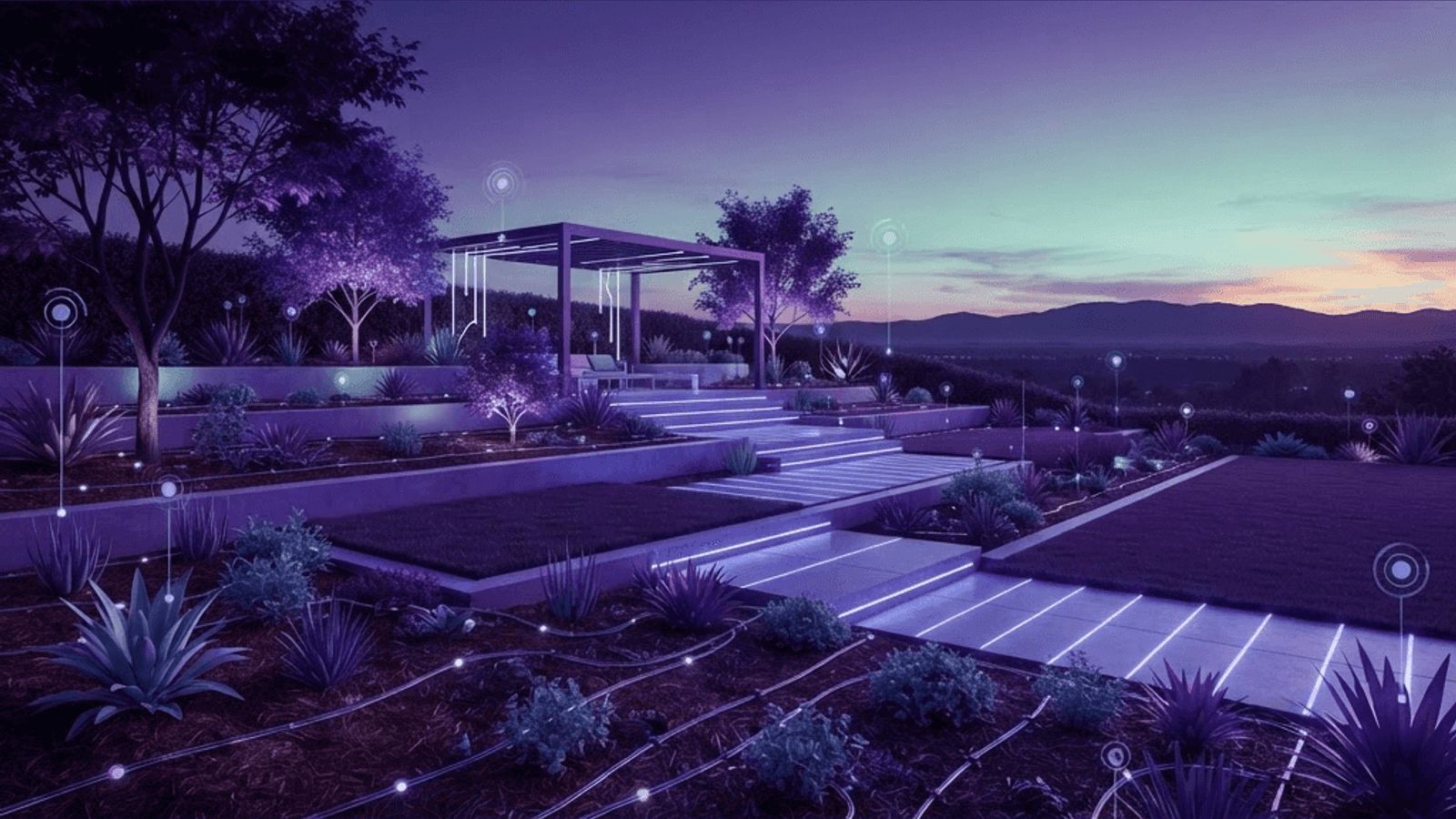
Landscaping in a Climate of Extremes
Modesto's growing conditions are generous and demanding in equal measure. The Central Valley offers a long growing season, abundant sunlight, and deep alluvial soils that support remarkable plant growth. That is why the surrounding region produces such a large share of the nation's almonds, walnuts, and stone fruit. Residential landscapes benefit from the same fundamentals.
The difficulty is water and heat. Summer temperatures routinely exceed one hundred degrees for extended stretches, humidity is low, and rainfall between May and October is negligible. Local soils frequently include heavy clay layers that drain slowly and compact easily, which complicates irrigation scheduling. Meanwhile, California water regulations and periodic drought restrictions have permanently changed expectations, making large expanses of cool-season turf both expensive and difficult to justify.
The best local landscaping companies have responded by shifting from ornamental gardening toward climate-adapted design, where plant selection, hydrozoning, soil improvement, and irrigation engineering matter as much as aesthetics.
Ten Landscaping Companies Modesto Property Owners Recommend
Valley Green Landscaping handles full design and installation projects. The company produces planting plans organized by water requirement so that irrigation zones serve plants with similar needs, a practice that reduces both waste and plant stress. Hardscape, drainage, and lighting are coordinated within the same plan rather than added later.
Modesto Lawn and Garden Care focuses on ongoing maintenance. Mowing, edging, seasonal pruning, fertilization timed to Valley conditions, and irrigation system checks form the core service. Consistency and crew stability are the qualities clients mention most often.
Central Valley Irrigation Design specializes in water delivery. Services include conversion of overhead spray to drip and inline emitters, pressure regulation, smart controller installation with weather-based scheduling, and distribution uniformity audits. In a region where irrigation represents the majority of residential water use, this expertise pays for itself.
Orchard Stone Hardscapes concentrates on the built elements of a landscape. Paver patios, seat walls, outdoor kitchens, fire features, and shade structures are its focus, with attention to base preparation and drainage that determines whether a patio remains level after several seasons of Valley soil movement.
Stanislaus Tree Service provides arboricultural care. Modesto's mature street and yard trees, including many valley oaks, sycamores, and Chinese pistache, require structural pruning, deep root watering guidance, and honest hazard assessment. The company employs certified arborists and documents recommendations rather than defaulting to removal.
Almond Valley Xeriscape designs low-water landscapes without resorting to bare gravel. Mediterranean and California native palettes, ornamental grasses, decomposed granite pathways, boulder placement, and layered mulching create visual interest at a fraction of conventional water use. The firm is often engaged for turf conversion projects.
Riverbend Landscape Construction takes on larger residential and light commercial installations, including grading, retaining walls, drainage systems, and complete site development. Its strength is sequencing complex projects so that utilities, drainage, and hardscape are completed correctly before planting begins.
McHenry Commercial Grounds Management serves office parks, shopping centers, apartment communities, and municipal-adjacent properties. Contract maintenance, seasonal color rotation, irrigation repair response, and litter and safety inspection are bundled into scheduled service.
Sunrise Outdoor Living approaches yards as extensions of the home. Covered patios, pergolas, outdoor lighting, water features, and integrated seating are designed to make outdoor space usable during Valley evenings, which are frequently pleasant even after brutally hot afternoons.
Ninth Street Sod and Turf rounds out the list serving clients who still want lawn. The company specializes in appropriate turf variety selection, including warm-season grasses that tolerate Valley heat with substantially less water than traditional cool-season varieties, along with proper soil preparation and establishment care.
Design Principles That Work in the Central Valley
Shade is the highest-value investment in a Modesto landscape. Well-placed deciduous trees on the south and west sides of a home reduce cooling load measurably while creating usable outdoor space. Because trees take years to mature, planting them early in a landscape's life is the decision homeowners most often wish they had made sooner.
Soil preparation ranks second. Compacted clay resists root penetration and holds water at the surface where it evaporates. Incorporating organic matter, breaking up compaction, and mulching heavily improves infiltration and moderates soil temperature, which reduces irrigation demand more than any equipment upgrade.
Hydrozoning is third. Grouping plants by water need allows each zone to be irrigated appropriately. Mixing thirsty and drought-tolerant plants on a single valve guarantees that something will be either overwatered or stressed.
Industry Trends
Turf replacement continues to accelerate, supported by regional rebate programs and rising water costs. Smart irrigation controllers that adjust automatically for weather and seasonal evapotranspiration have moved from premium option to default specification. Battery-electric maintenance equipment is displacing gasoline blowers and mowers as California emissions rules on small off-road engines take effect, which also reduces noise complaints in dense neighborhoods.
There is also growing interest in habitat value. Pollinator plantings, native species, and reduced pesticide use appeal to homeowners who want landscapes that support birds and beneficial insects rather than merely looking tidy.
Choosing a Landscaping Company
Confirm licensing appropriate to the scope, since installation work involving structures, grading, and irrigation systems generally requires a California C-27 landscaping contractor license. Verify insurance and workers' compensation coverage, particularly for tree work, which carries substantial risk.
Ask for a planting plan with plant names and mature sizes rather than a generic sketch, and confirm irrigation zone layout in writing. Discuss establishment period care, since even drought-tolerant plants require regular water for the first year or two. Request references for projects at least three years old, because a landscape's true quality only becomes visible once plants have matured and the first few summers have passed.