
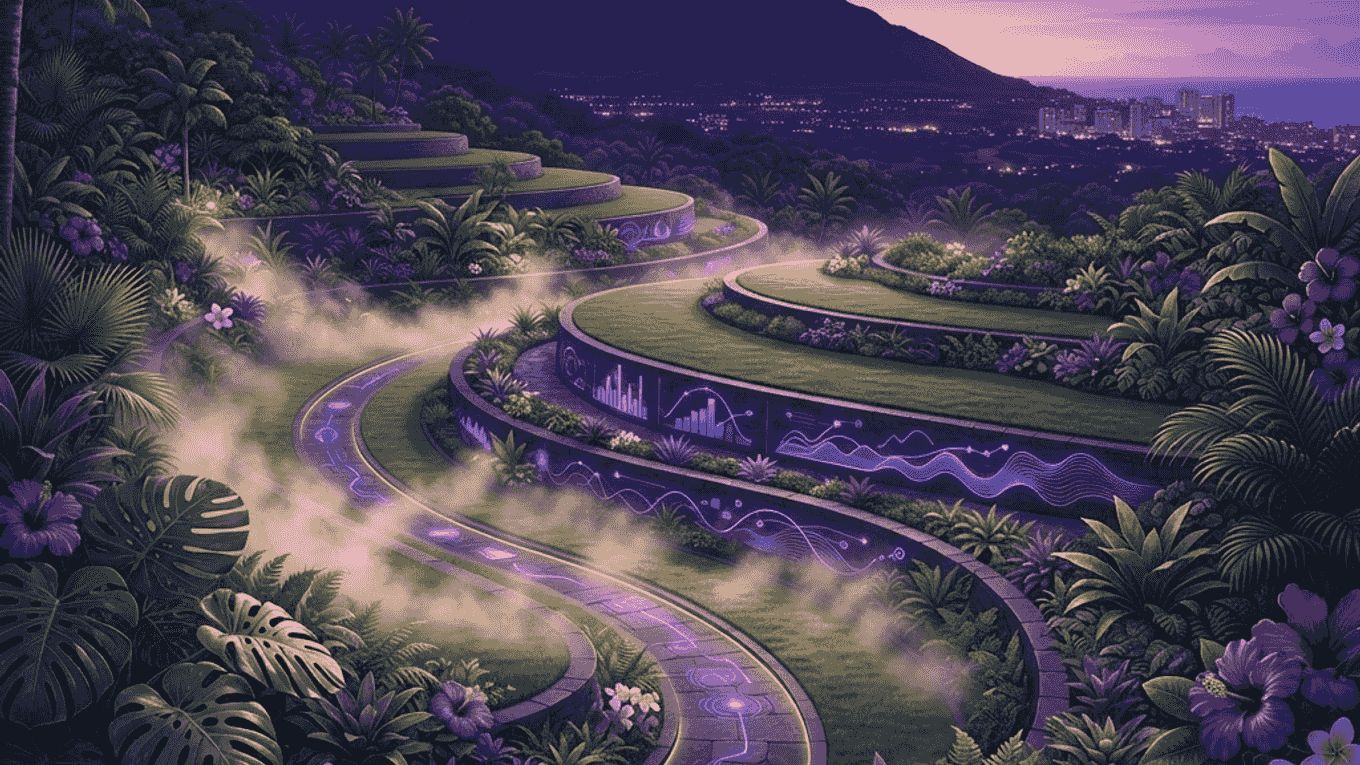
Landscaping on Oahu Is a Specialized Discipline
Honolulu offers growing conditions that most of the country can only imagine, and that abundance is exactly what makes island landscaping challenging. Plants grow fast, which means maintenance intervals are shorter and pruning decisions compound quickly. A hedge that would take three years to fill in on the mainland can close in a single season here, and an aggressive vine can overwhelm a structure just as fast.
Microclimate variation is the second complication. Oahu's rainfall gradients are dramatic over remarkably short distances. Valley neighborhoods such as Manoa and Nuuanu receive substantially more rain than nearby coastal or leeward areas, which changes plant selection, drainage design, irrigation programming, and disease pressure entirely. A palette that flourishes in a shaded, wet valley may struggle in dry, wind-exposed conditions a few miles away, and salt spray adds another filter near the shoreline. Experienced island landscapers read a site before drawing a plan.
Soil and slope matter too. Many Honolulu properties sit on heavy clay soils that drain slowly, on old coral fill, or on steep hillside lots where erosion control and retaining structures come before ornamentation. Water management, both getting it to plants efficiently and getting excess away from structures, is frequently the difference between a landscape that matures gracefully and one that becomes a maintenance liability.
What Distinguishes a Top Landscaping Company
Plant knowledge specific to Hawaii is the first marker. Strong firms can speak fluently about native and canoe plants such as naupaka, ohia lehua, hala, ti, kalo, and native hibiscus, about ornamental tropicals including heliconia, plumeria, monstera, bird of paradise, and gingers, and about which popular species become invasive or structurally problematic over time. They also understand which trees have root systems aggressive enough to threaten sewer laterals, foundations, and hardscape.
Irrigation competence is the second. Fresh water on Oahu comes from a finite aquifer system, and water rates make waste expensive. The best companies design zoned systems that group plants by water need, use drip and micro-spray where appropriate rather than broadcasting overhead, install smart controllers with rain and moisture sensing, and program seasonally instead of setting a schedule once and forgetting it. Proper backflow protection and pressure regulation are treated as standard, not optional.
Beyond horticulture, look for licensing and insurance appropriate to the work, particularly when a project includes retaining walls, drainage structures, grading, electrical for landscape lighting, or tree removal, all of which may require permits or specialized qualification. Certified arborists on staff or on call indicate serious tree care capability. On the business side, expect written proposals with plant schedules and sizes, phasing options, establishment care instructions, warranty terms on plant material, and maintenance agreements that specify visit frequency and included tasks.
The Ten Best Landscaping Companies in Honolulu
1. Pacific Bloom Landscape Design
A design-build firm known for site-specific planting plans that respond to microclimate, exposure, and soil rather than applying a standard tropical template. Pacific Bloom Landscape Design provides detailed plant schedules and phased installation options, which helps clients build ambitious landscapes across multiple budget cycles.
2. Island Native Plantings
Specializes in native and canoe plant landscapes, restoration-style plantings, and low-water designs suited to leeward and coastal exposures. Its work supports pollinators and local ecology while reducing irrigation demand, and it educates clients on establishment care that native species require.
3. Honolulu Grounds Maintenance
Focused on recurring maintenance for residential communities, condominiums, and commercial properties, including mowing, edging, hedge and palm trimming, fertilization, and irrigation checks. Clients cite consistent crews, documented service reports, and dependable scheduling across large portfolios.
4. Aloha Tropical Gardens
A residential specialist creating lush ornamental gardens with heliconia, gingers, palms, plumeria, and layered foliage textures. Aloha Tropical Gardens is often engaged for courtyard and entry transformations where immediate visual impact matters.
5. Trade Winds Irrigation and Turf
Concentrated on irrigation design, repair, and turf health, including system audits that identify leaks, poor coverage, and inefficient programming. Its retrofit work frequently reduces water consumption significantly while improving plant performance, a rare combination.
6. Diamond Head Estate Landscaping
Serves large residences and estates with comprehensive programs spanning design, installation, detailed maintenance, landscape lighting, and specimen tree care. Its horticulturists manage collections of mature and unusual plantings that require individualized attention.
7. Oahu Hardscape and Outdoor Living
Focused on the built elements of landscape: lava rock and basalt walls, permeable paver patios, stone pathways, water features, outdoor kitchens, and shade structures. The company designs drainage into every hardscape rather than treating it as an afterthought, which matters greatly in heavy rain.
8. Kama'aina Landscape Services
A locally rooted company known for practical, culturally grounded plant choices and for maintaining older established gardens sensitively rather than replacing them. Longtime clients value its restraint with mature specimens and its knowledge of heritage plantings.
9. Windward Slope and Erosion Solutions
Specialized in hillside stabilization, terracing, retaining structures, bioswales, and stormwater management for sloped and high-rainfall properties. Its work protects both the landscape and the structures below it, and it coordinates with engineers where conditions require.
10. Leeward Xeriscape and Coastal Gardens
Focused on drought-tolerant and salt-tolerant designs using succulents, ornamental grasses, and hardy coastal species, with efficient drip irrigation and mulch strategies. It suits owners seeking beautiful landscapes with genuinely low water and maintenance requirements.
Trends Shaping Island Landscapes
Water-wise design has moved from niche to mainstream. Hydrozoning, drip irrigation, generous mulching, smart controllers, and reduced turf areas are now expected in quality installations, and many homeowners are replacing thirsty lawn with planted beds, groundcovers, and permeable hardscape that require far less water while looking more intentional.
Native and edible plantings continue to gain ground. Interest in indigenous species reflects both ecological awareness and practical performance, since natives are adapted to local conditions once established. Alongside that, edible landscaping has grown steadily, with citrus, mango, avocado, banana, papaya, breadfruit, and herb gardens integrated into ornamental designs rather than confined to a back corner.
Outdoor living remains a powerful driver. Shade structures, outdoor kitchens and dining areas, low-voltage LED lighting for evening use, and privacy plantings all extend usable living space in a climate that supports year-round outdoor life. Sustainable practices such as on-site composting, green waste reduction, and reduced-emission electric maintenance equipment have also expanded, partly because noise restrictions in dense neighborhoods favor battery-powered tools.
How to Evaluate a Landscape Proposal
Insist that proposals include a plant schedule listing botanical names, container sizes, and quantities, since substituting smaller stock is an easy way to lower a bid without disclosing it. Confirm soil preparation and amendment, drainage provisions, mulch type and depth, and irrigation zoning and equipment. Ask specifically how the design accounts for your site's rainfall, exposure, salt proximity, and slope.
Clarify what happens after installation. Plant establishment is where landscapes succeed or fail, so ask about the watering schedule during establishment, who is responsible for it, and what warranty applies to plant material and for how long. Discuss mature size honestly, because plants installed at attractive spacing frequently become crowded within a few years in this climate, and a good designer plans for thinning or selects appropriately scaled species from the start.
Finally, budget for maintenance as part of the project rather than as an afterthought. Fast growth means a landscape without a maintenance plan degrades quickly. Compare maintenance agreements on visit frequency, included tasks, fertilization and pest management approach, irrigation inspection, and green waste handling rather than on monthly price alone.
Final Thoughts
Landscaping in Honolulu is an ongoing collaboration with an extraordinarily generous growing environment. The right company reads your specific microclimate, selects plants that will thrive rather than merely survive, designs irrigation that respects a finite water supply, and builds hardscape that manages tropical rainfall. The ten firms profiled here span native restoration, lush ornamental design, hardscape and outdoor living, slope stabilization, irrigation efficiency, and estate-level horticulture. Choose the specialist whose strengths match your site, plan for maintenance from day one, and your landscape will mature into something genuinely rooted in place.