
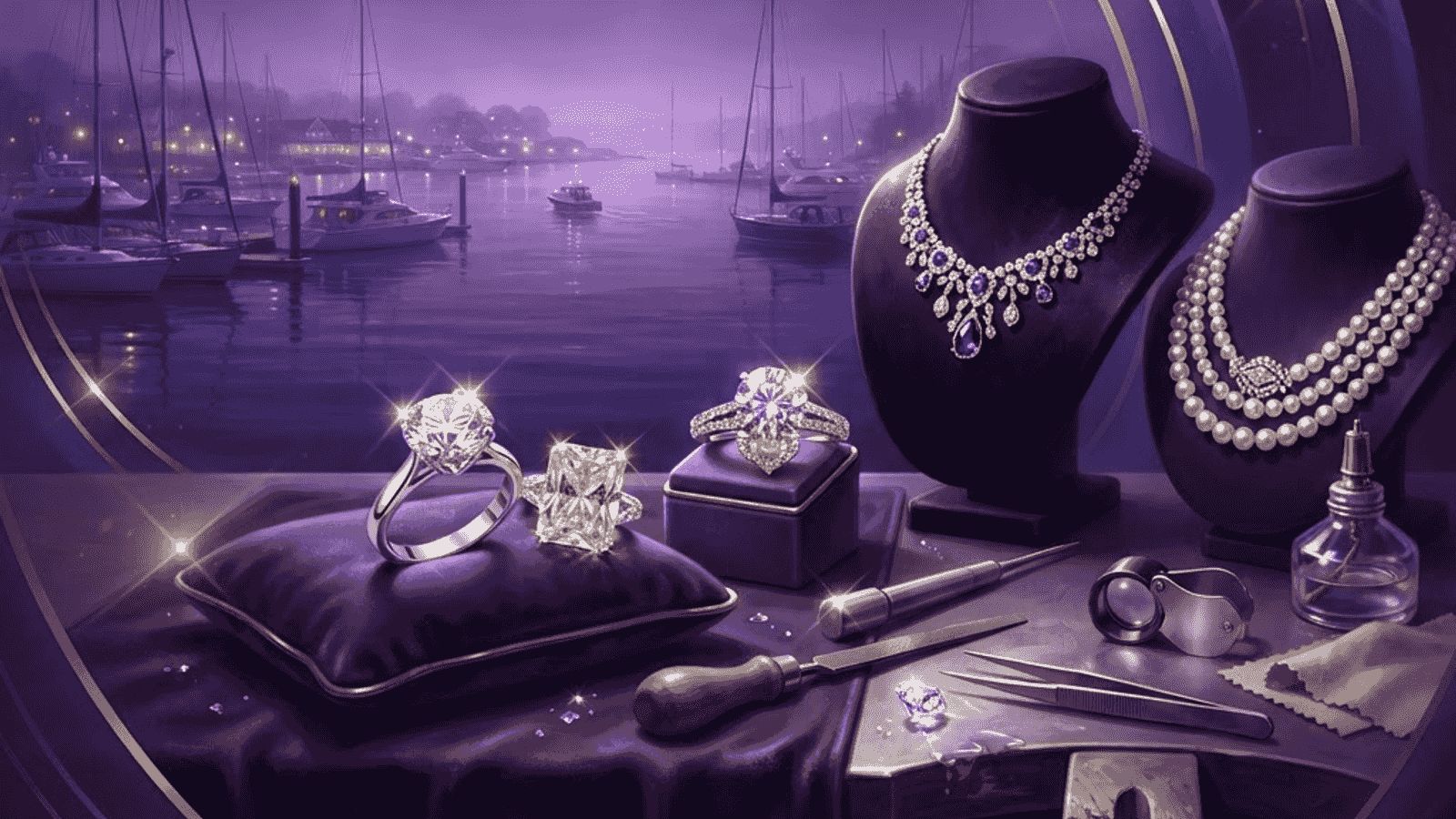
Buying Jewelry on the North Shore
Jewelry purchases in Oyster Bay tend to fall into a few recognizable categories. There are engagement and bridal purchases, which are significant financial decisions usually made with limited prior knowledge. There is gift buying around anniversaries, graduations and milestones. There is everyday jewelry chosen for durability and versatility. And there is a substantial amount of inherited jewelry needing appraisal, restoration or redesign, reflecting a community with generational depth and family pieces that have been passed down.
The coastal setting also influences material choices more than buyers expect. Salt air and swimming accelerate tarnish on sterling silver and wear on plated pieces, while chlorine damages certain alloys. Anyone who spends time on the water or in a pool is better served by solid gold, platinum or titanium than by plated or low-karat alternatives.
What Actually Determines Quality
For diamonds, independent grading is the foundation. Reports from GIA or AGS carry the most credibility, and grading from less rigorous laboratories often reflects looser standards, meaning two stones described identically can differ noticeably in appearance and value. Cut quality drives brilliance more than carat weight, so an excellently cut stone of modest size frequently outperforms a larger, poorly cut one.
Laboratory-grown diamonds are now a mainstream option and are chemically and optically identical to mined stones, though they carry different pricing and resale characteristics. Buyers should understand that distinction before choosing, and any reputable seller will disclose origin clearly.
For metals, check hallmarks. Solid gold is marked by karat, platinum by fineness, and sterling silver at 925. Gold-filled and gold-plated pieces are legitimate at their price point but will not withstand decades of wear. Setting quality is where craftsmanship shows: prongs should be even, seated firmly against the stone and not thinned by wear; pavé should be tight without gaps; and the underside of a well-made piece is finished as carefully as the top.
The Top 10 Jewelry Brands in Oyster Bay
1. Tiffany & Co.
The reference point for bridal jewelry in the New York region, Tiffany combines exacting cut standards, well-documented sourcing and settings engineered for security. The brand's classic solitaire and its silver collections span very different price points, and its service infrastructure for cleaning, resizing and restoration is comprehensive. Buyers pay a premium for the name and the standards behind it.
2. Cartier
Recognized for iconic designs and exceptional finishing, Cartier appeals to buyers seeking pieces with distinct design identity rather than generic luxury. Its bracelets, watches and high jewelry hold value well, and the manufacturing precision is evident in the tolerances and surface work. Availability across the metropolitan area makes servicing straightforward.
3. David Yurman
The cable motif has made David Yurman a regional staple for everyday luxury, with substantial sterling silver and gold pieces that suit both casual and formal wear. Construction is robust enough for daily use, which matters for bracelets and rings that will be worn constantly, and the range spans accessible silver through significant gemstone pieces.
4. Mikimoto
For pearls, Mikimoto remains the benchmark, with strict grading on nacre thickness, lustre, surface quality and matching. In a coastal community where pearls are a natural fit, the difference between well-graded cultured pearls and mass-market strands is immediately visible and holds up over decades of wear.
5. Van Cleef & Arpels
Known for meticulous stone setting and distinctive motifs, Van Cleef & Arpels produces pieces where the craftsmanship rather than carat weight carries the value. The house's invisible setting technique and enamel work represent genuine technical achievement, and its collections have proven remarkably durable in the secondary market.
6. Blue Nile
An established option for buyers who want to compare certified stones systematically and prioritize value over showroom experience. Blue Nile's inventory breadth allows precise filtering by cut, colour, clarity and certification, and its pricing on comparable graded stones is typically below traditional retail. Buyers should still have finished pieces inspected locally.
7. Brilliant Earth
Focused on traceable sourcing and laboratory-grown options, Brilliant Earth appeals to buyers for whom origin and environmental impact are decisive factors. The company documents supply chains more thoroughly than most, offers a wide selection of recycled-metal settings, and provides clear comparisons between mined and lab-grown stones at equivalent specifications.
8. Pandora
Occupying the accessible end of the market, Pandora's charm and bracelet system works well for gift-giving and gradual collection building. Materials are typically sterling silver and gold-plated alloys, so buyers in a coastal environment should expect to clean pieces regularly, but the price point and personalization make it a practical choice for milestone gifts.
9. Monica Vinader
A strong option for contemporary everyday jewelry, Monica Vinader offers stackable rings, layering necklaces and engraved pieces in solid gold vermeil and recycled sterling silver, with a lifetime warranty on many items. The design language is understated enough for professional settings and the personalization service is well executed.
10. Independent North Shore Jewelers and Bench Workshops
Local independent jewelers provide something the houses cannot: custom design, hands-on restoration of inherited pieces, stone resetting, sizing and prong rebuilding performed on premises, and honest guidance without pressure toward a particular inventory. For heirloom work in particular, a skilled bench jeweler who can retip prongs, replace a worn shank or reset a family stone into a modern setting is invaluable. Many also hold appraisal credentials for insurance documentation.
Practical Advice Before You Buy
Insist on independent certification for any significant diamond, and confirm that the report matches the stone through laser inscription or in-store verification. Get a written appraisal for insurance purposes, prepared by a credentialed appraiser rather than the seller, and update it every few years as market values change.
Understand the service terms. Ask whether resizing, prong tightening, rhodium replating and cleaning are included, whether the warranty requires periodic inspections to remain valid, and where repairs are performed. Ask about return periods and whether the seller offers trade-up policies.
Consider lifestyle honestly. Someone who works with their hands, swims regularly or spends time on the water should avoid high-set solitaires and soft stones such as opal or emerald in daily-wear rings. Lower profile settings, bezel settings and harder stones survive real life far better.
Trends in the Market
Laboratory-grown diamonds have reshaped budgets substantially, allowing larger or better-cut stones at a given price while raising legitimate questions about long-term value. Recycled and traceable metals have moved from niche to expected among younger buyers. Redesign of inherited jewelry is growing as families choose to wear heirloom stones in contemporary settings rather than leave them in drawers. And permanent or welded jewelry has become a popular service, though it requires thinking carefully about metal quality given that the piece will not be removed.
Final Thoughts
Good jewelry buying comes down to verified quality, appropriate materials for how you live, and a relationship with someone who will service the piece for decades. The established houses offer consistency and prestige, the online specialists offer transparency and value, and local independent jewelers offer craftsmanship and care that no catalogue provides. For heirlooms and custom work especially, start with the bench jeweler.