
Heating and Cooling in a Climate of Extremes
St. Paul sits in one of the most demanding HVAC climates in the United States. Design temperatures routinely reach well below zero in winter while summer brings heat combined with high humidity. A system must handle roughly a hundred degree annual swing, and equipment that performs adequately in a mild climate can fail badly here. This makes proper sizing, correct installation, and reliable service more consequential than brand selection.
The dominant heating system remains the natural gas forced air furnace, typically paired with a split system air conditioner. Boilers with radiators or in-floor hydronic distribution are common in older homes and offer excellent comfort. Increasingly, cold-climate air source heat pumps are entering the market as either full replacements or dual-fuel pairings with an existing furnace, switching to gas below a set outdoor temperature.
Why Load Calculation Matters More Than Anything
Oversizing is the most common installation error in the industry. A furnace sized by rule of thumb or matched to the outgoing unit is frequently far larger than the house requires, especially after insulation and window upgrades. Oversized equipment short cycles, producing uneven temperatures, higher wear, and poor humidity control in cooling mode.
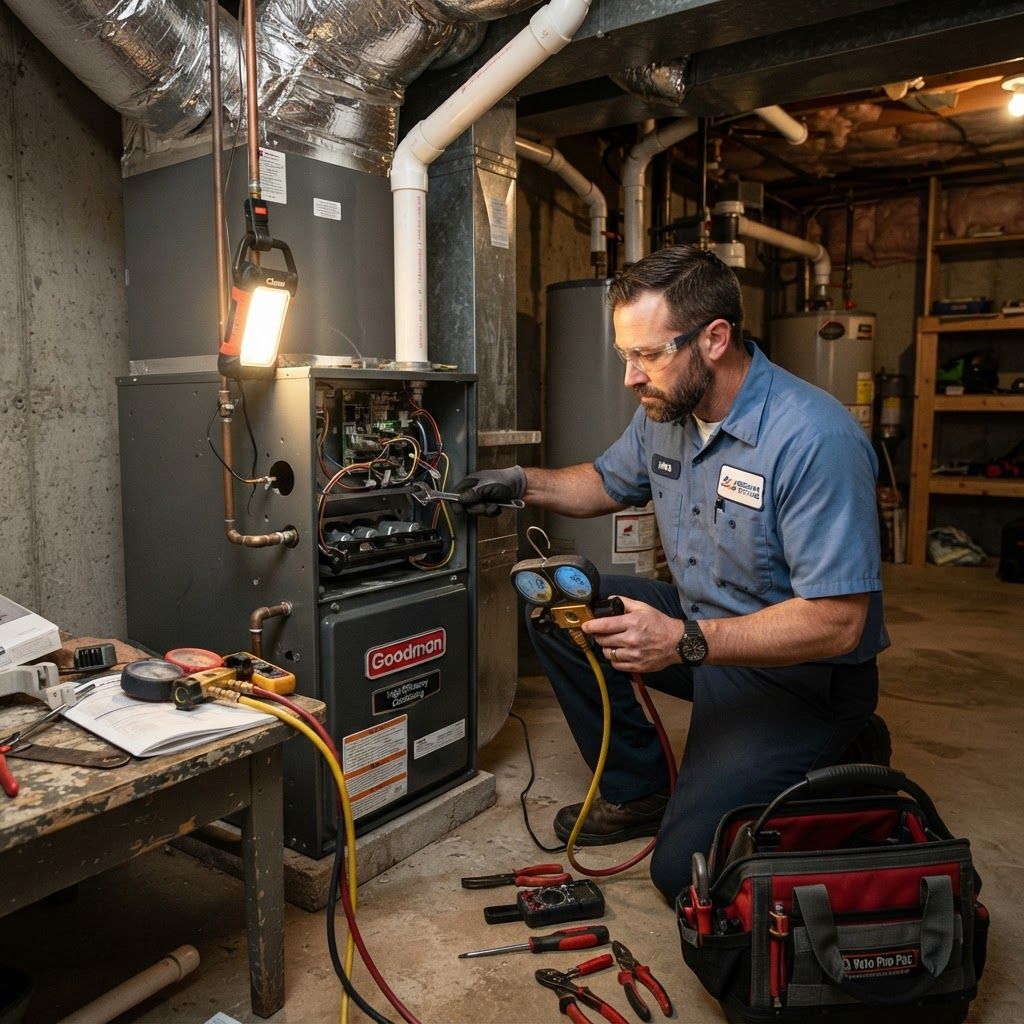
A professional contractor performs a room-by-room load calculation accounting for insulation levels, window area and performance, air leakage, orientation, and occupancy. They also evaluate the duct system, because undersized or leaky ductwork undermines even perfect equipment. Static pressure testing and airflow measurement at commissioning separate serious installers from equipment swappers.
Ten HVAC Companies Serving St. Paul
Capital Comfort Heating and Cooling provides full residential service with strong maintenance plan offerings and same-day emergency repair.
Northern Climate Heat Pump Specialists focuses on cold-climate heat pump design, dual-fuel configuration, and electrification retrofits.
Heritage Boiler and Radiant serves older homes with hydronic systems, including boiler replacement, zone valve work, and radiator restoration.
Summit Air Quality Systems concentrates on ventilation and filtration including heat recovery ventilators, high-efficiency filtration, and humidity control.
Great River Mechanical Contractors handles commercial rooftop units, chillers, and building automation systems.
Frostline Furnace Services is known for winter emergency response capacity and rapid furnace replacement during heating season failures.
Eastside Sheet Metal and HVAC self-performs custom ductwork fabrication, valuable in retrofits where standard fittings will not fit.
Union Park Heating and Air operates as a neighborhood contractor with transparent diagnostics and no-pressure replacement recommendations.
Riverfront Ductless Solutions specializes in mini-split installation for additions, attics, and homes without existing ductwork.
Landmark Commercial HVAC completes the list serving multifamily, institutional, and industrial mechanical systems with preventive maintenance contracts.
Efficiency, Electrification, and Air Quality
Cold-climate heat pump technology has advanced dramatically. Modern variable-capacity units maintain meaningful heating output at temperatures well below zero, making them viable in Minnesota when properly specified and paired with backup heat. Dual-fuel systems offer a pragmatic middle path, capturing efficient heat pump operation during the majority of the heating season while relying on gas during the coldest stretches.
Ventilation deserves more attention than it typically receives. Tightly built or well air-sealed homes need mechanical fresh air, and heat recovery ventilators supply it while reclaiming most of the thermal energy from exhaust air. This addresses stale air, elevated humidity in winter causing window condensation, and indoor pollutant accumulation.
Filtration has moved beyond the one-inch throwaway filter. Four to five inch media filters at higher efficiency ratings capture far more particulate without excessive pressure drop, provided the system is designed for them. Humidity management works both directions here, requiring humidification in winter and dehumidification during humid summer periods.
Maintenance and Lifespan
Furnaces typically last fifteen to twenty years, air conditioners twelve to eighteen, and boilers often considerably longer. Annual maintenance genuinely extends life. Heating season service should include heat exchanger inspection, combustion analysis, blower cleaning, and safety control verification. Cooling service should cover coil cleaning, refrigerant charge verification, and condensate drain clearing.
Warning signs worth acting on include rising energy bills without rate changes, uneven room temperatures, frequent cycling, unusual noises, and yellow rather than blue burner flames. Carbon monoxide detectors on every level are essential in any home with combustion appliances.
Choosing an HVAC Contractor
Ask whether a load calculation will be performed and request to see it. Confirm the contractor is licensed and that permits and inspection are included. Ask about commissioning, specifically whether airflow and static pressure will be measured and documented. Get equipment model numbers in writing along with efficiency ratings and warranty registration responsibility.
Compare bids on scope rather than headline price. A quote that includes duct modifications, a new thermostat, proper venting, and condensate handling may cost more than one that reuses everything, but the performance difference is substantial. Ask about utility rebates, which are frequently available for high-efficiency equipment in Minnesota.
Conclusion
HVAC is the system St. Paul residents depend on most heavily and think about least until it fails. The ten companies above cover furnaces, boilers, heat pumps, ductless systems, ventilation, and commercial mechanical work. Prioritize contractors who calculate rather than guess, measure rather than assume, and explain the reasoning behind their recommendations.