
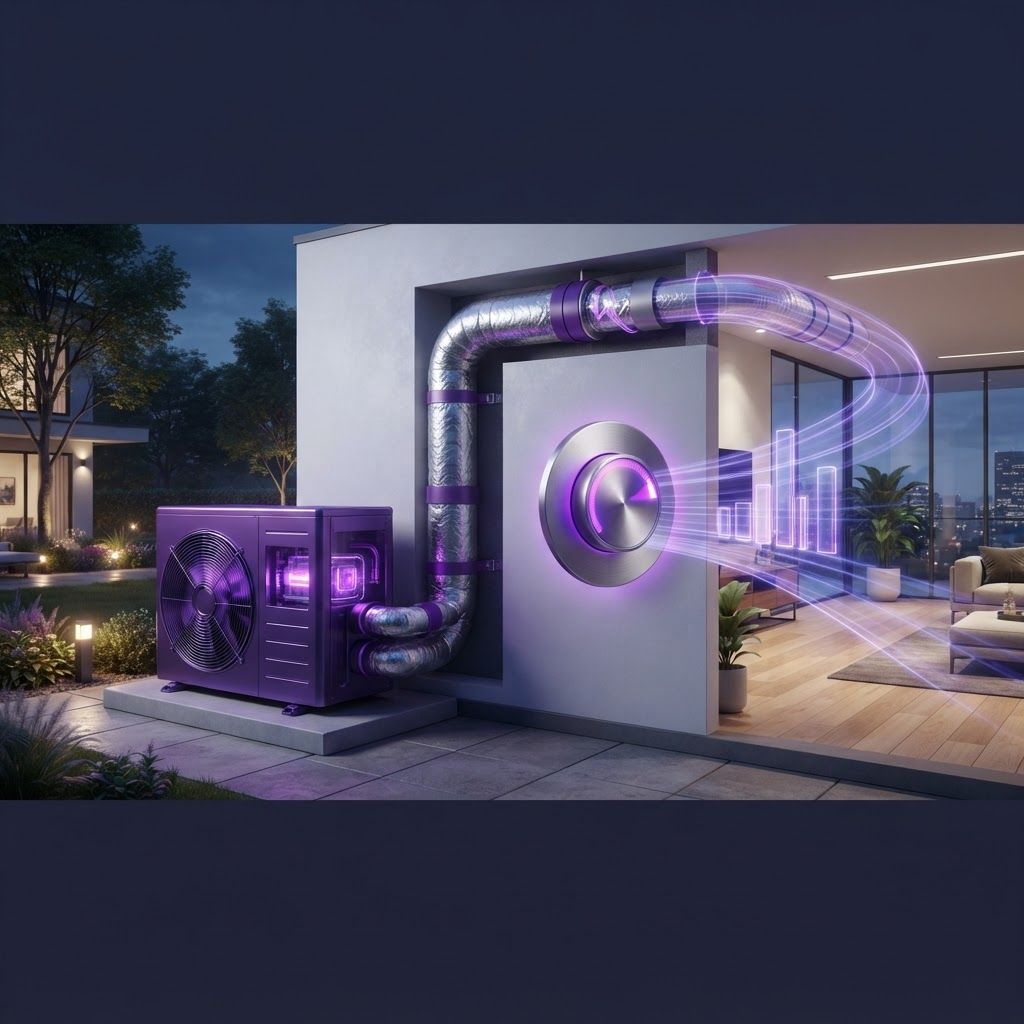
Humidity Is the Real Design Challenge
Most homeowners think of heating and cooling in terms of temperature, but in Chesapeake humidity control is the harder problem and the one most often handled poorly. The region experiences long, humid summers where dew points remain elevated for months, mild but damp shoulder seasons, and winters cold enough to require meaningful heating capacity. An oversized air conditioner cools a house quickly and then shuts off before it has run long enough to remove moisture, leaving a home that feels clammy at seventy-two degrees. Correct system design therefore prioritises adequate run time, proper airflow, controlled ventilation and, in many homes, supplementary dehumidification. Contractors who perform load calculations rather than sizing by square footage are the ones who solve this properly.
What Separates Competent HVAC Contractors
Look for contractors who perform a room-by-room load calculation, evaluate duct design and measure static pressure, verify refrigerant charge and airflow at commissioning rather than assuming factory settings, and provide written performance documentation. Certification through recognised industry programmes, proper licensing, insurance and manufacturer authorisation all matter. Crucially, a good contractor will discuss the building envelope — insulation, air sealing, duct leakage — because equipment cannot compensate for a leaky house, and improving the envelope often allows smaller and cheaper equipment.
1. Residential Installation and Replacement Companies
These firms replace ageing air conditioners, heat pumps and furnaces, and are the largest segment of the market. Quality installation involves correct equipment sizing from load calculation, evaluation and modification of existing ductwork, proper line set sizing and evacuation, condensate management with secondary protection, and commissioning with measured airflow and charge. Installation quality affects efficiency and lifespan more than the equipment brand does, a point that reputable contractors will make themselves.
2. Heat Pump Specialists
Heat pumps have become the dominant choice in this climate because they provide efficient cooling and, with modern cold-climate performance, effective heating through local winters. Variable-capacity inverter-driven systems are particularly well suited here because they run at low capacity for extended periods, which improves dehumidification and comfort while reducing energy use. Specialists in this area understand balance point calculation, backup heat staging and defrost behaviour, and configure controls so expensive electric resistance heat engages only when genuinely needed.
3. Ductless Mini-Split Installers
Ductless systems serve additions, converted garages, sunrooms, bonus rooms over garages, home offices and older homes without existing ductwork. They allow zoned control, avoid duct losses entirely and install with minimal disruption. Multi-zone configurations require careful capacity matching, as oversizing individual heads causes short cycling and poor humidity removal. Line set routing and condensate drainage details determine both appearance and reliability.
4. Duct Design, Sealing and Replacement Contractors
Duct problems are widespread and frequently the actual cause of comfort complaints blamed on equipment. Specialists measure duct leakage, redesign undersized or poorly routed systems, seal joints with mastic or aerosol sealants, insulate ducts in unconditioned spaces, correct return air deficiencies and balance airflow between rooms. In homes with crawl space or attic ductwork, leakage draws humid unconditioned air into the system, undermining both efficiency and moisture control.
5. Indoor Air Quality and Dehumidification Specialists
This is an especially valuable specialty locally. These contractors install whole-house dehumidifiers, energy and heat recovery ventilators that provide controlled fresh air without importing excess moisture, high-efficiency filtration, ultraviolet treatment and humidity-aware controls. Whole-house dehumidification often improves perceived comfort more than additional cooling capacity, allowing thermostats to be set higher while feeling cooler — which reduces energy consumption rather than increasing it.
6. Maintenance and Service Plan Providers
Preventive maintenance meaningfully extends equipment life and preserves efficiency. Service plans typically include seasonal inspections, coil cleaning, condensate drain clearing, refrigerant and electrical checks, filter replacement and priority emergency scheduling. In this climate, condensate drain maintenance is particularly important because clogged drains cause water damage, and dirty coils degrade both capacity and dehumidification performance. Documented maintenance also protects manufacturer warranty coverage.
7. Emergency Repair Services
Air conditioning failure during a Chesapeake heatwave is a health issue, not merely an inconvenience, particularly for elderly residents and young children. Emergency providers maintain extended-hours dispatch, stocked vehicles carrying common capacitors, contactors, motors and control boards, and technicians capable of accurate diagnosis under pressure. Reputable firms present repair-versus-replace analysis honestly rather than defaulting to replacement on any significant fault.
8. Commercial HVAC Contractors
Commercial contractors install and service rooftop package units, split systems, variable refrigerant flow systems, chillers, make-up air units and building automation controls for offices, retail, restaurants, medical facilities and warehouses. Restaurant work is a specialty in itself, requiring careful balance between kitchen exhaust and make-up air so the dining room does not become negatively pressurised. Preventive maintenance contracts dominate this segment because unplanned downtime carries direct business cost.
9. Industrial Ventilation and Process Cooling Firms
Industrial specialists design and maintain ventilation for warehouses and manufacturing facilities, process cooling, dust and fume extraction, high-volume low-speed fan systems and dehumidification for storage environments. In port-related warehousing, humidity control matters for inventory protection, and large-volume ventilation strategies are more cost-effective than conventional air conditioning for many facilities.
10. Energy Audit and Home Performance Contractors
These firms diagnose comfort and efficiency problems holistically using blower door testing, duct leakage measurement, infrared imaging and combustion safety testing. Their recommendations often include air sealing, insulation upgrades and duct repairs alongside, or instead of, equipment replacement. This approach frequently allows smaller equipment, reduces energy consumption and resolves persistent problems such as hot upstairs rooms that repeated equipment replacements never fixed.
Trends in HVAC
Variable-capacity inverter technology has become mainstream, delivering better humidity control and quieter operation than single-stage equipment. Refrigerant transitions to lower global warming potential options are changing available equipment and service practices. Heat pump water heaters are increasingly installed alongside HVAC work, providing efficiency gains and incidental dehumidification. Smart thermostats with humidity awareness and remote diagnostics are standard. Whole-house dehumidification has moved from niche to commonly recommended in humid coastal markets. And elevated outdoor equipment platforms are increasingly specified in flood-prone areas to protect condensers from tidal and stormwater inundation.
How to Choose an HVAC Contractor
Ask whether the contractor performs a room-by-room load calculation and request to see it. Ask how they will evaluate existing ductwork and whether static pressure will be measured. Confirm that commissioning includes measured airflow and verified refrigerant charge. Verify licensing and insurance, and confirm permits will be pulled. Obtain at least three proposals and compare equipment specifications, duct modifications, thermostat and controls, warranty terms and labour coverage — proposals frequently differ far more in scope than in price. Be wary of any quote produced without an on-site assessment, and of pressure to decide immediately on a limited-time discount.
Getting the Most From Your System
Change filters on schedule, using the filter type your system's static pressure can accommodate. Keep outdoor units clear of vegetation and clean the coils annually. Have condensate drains cleared each season. Avoid closing supply registers in unused rooms, which raises static pressure and reduces performance. Set humidity targets rather than chasing temperature alone, and consider a dehumidifier before adding cooling capacity. Seal and insulate attics and crawl spaces, since envelope improvements reduce load permanently while equipment simply meets whatever load exists.
Final Thoughts
HVAC performance in Chesapeake is defined by humidity control, duct integrity and correct sizing. The contractors who consistently deliver comfortable homes are those who calculate loads, measure airflow, address ductwork and treat moisture as a primary design objective rather than a side effect of cooling. Choosing on that basis produces a system that is quieter, cheaper to run and more comfortable than any equipment upgrade alone can achieve.