
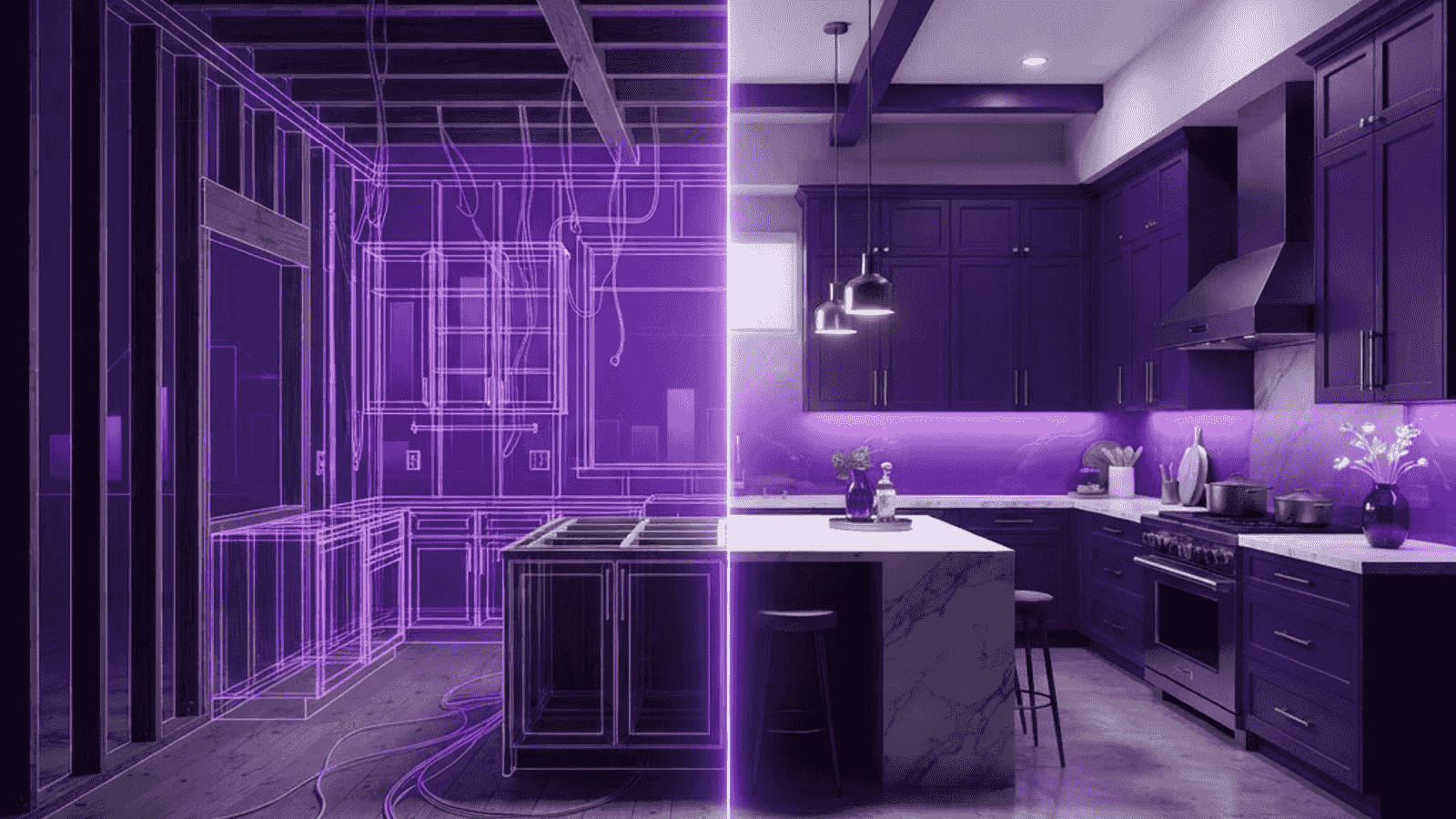
Renovation Is the Dominant Form of Building in Greensboro
Greensboro's most desirable neighborhoods were largely built decades ago, which means the majority of significant residential investment in the city goes into existing homes rather than new ones. Kitchens are opened up, primary suites are added over garages, attics become offices, basements become living space, and porches are enclosed or rebuilt. Fisher Park, Sunset Hills, Westerwood, Irving Park, Starmount, and Lindley Park all carry housing stock with excellent bones and floor plans designed for a different era of daily life.
That creates both opportunity and risk. Older homes reward renovation with materials and proportions that would be prohibitively expensive to reproduce. They also hide knob-and-tube wiring, galvanized supply lines, undersized headers, asbestos-containing floor mastic, and framing that has settled out of plane. The renovation companies that build strong reputations here are the ones that plan for those discoveries instead of being surprised by them.
Design-Build Versus Separate Architect and Contractor
Two delivery models dominate. In the design-build approach, one firm handles design, engineering coordination, permitting, and construction under a single contract. This reduces finger-pointing, tends to produce budgets grounded in real construction costs earlier, and shortens the timeline. In the separate model, an architect develops drawings that are then competitively bid to contractors, which can yield sharper pricing and stronger design advocacy but requires the homeowner to manage the relationship between two parties.
For most kitchen, bath, and moderate addition projects in Greensboro, design-build is the more practical choice. For substantial structural reconfiguration or architecturally sensitive work in a historic district, an architect-led process is often worth the added coordination.
The 10 Best Home Renovation Companies in Greensboro
1. Roby Services
With trade divisions spanning electrical, plumbing, and HVAC alongside remodeling, Roby can execute complex renovations without subcontracting the mechanical work, which simplifies scheduling and accountability.
2. Lawrence Design Build
Design-build firms of this profile pair in-house designers with dedicated project managers, producing drawings, selections, and a fixed scope before demolition begins, the single best predictor of a project that finishes on budget.
3. Renovate Design Build
Focused on whole-house renovation and additions, with experience navigating Greensboro's permitting and inspection process for structural modification and load transfer.
4. Triad Home Renovations
A locally rooted general contractor handling kitchens, baths, and basement conversions, valued for clear communication and realistic timelines on mid-size projects.
5. Distinctive Kitchens and Baths
Specialists in the two highest-value rooms in any home, offering cabinetry design, plumbing relocation, tile and stone selection, and lighting design as an integrated package.
6. Bradford Custom Builders
Custom builders who also renovate bring high finish standards and detailed specifications, appropriate for projects where millwork, trim matching, and cabinetry quality drive the result.
7. Gate City Construction Group
Experienced with older homes in Greensboro's historic districts, including window restoration, plaster repair, and exterior work that must satisfy neighborhood design guidelines.
8. Piedmont Remodeling and Construction
Covers a broad scope from aging-in-place modifications to full additions, offering a single contractor relationship as homeowners' needs evolve over time.
9. Legacy Remodeling Solutions
Known for basement finishing and garage conversions, categories that add usable square footage at a lower cost per foot than building new footprint.
10. Carolina Craft Builders
Emphasizes craftsmanship on carpentry-heavy projects: built-ins, staircases, coffered ceilings, and custom trim packages that make a renovation read as original to the house.
Budgeting Realistically
Renovation budgets fail for predictable reasons. The first is omitting a contingency; ten percent is the minimum for newer homes and fifteen to twenty percent is prudent for anything built before 1970, because opening walls reveals conditions no one could have quoted. The second is underestimating selections, since the allowance for tile, plumbing fixtures, lighting, countertops, and hardware is where budgets quietly inflate. The third is changing scope mid-project, which costs disproportionately more than including the same work in the original plan.
A strong contract protects both parties. It should include a detailed scope of work, a schedule of values tied to milestone payments rather than large upfront deposits, allowances stated explicitly with what happens when they are exceeded, a written change order process, a projected timeline with the conditions that would extend it, and lien waivers from subcontractors as payments are released.
Permits, Inspections, and Historic Districts
Guilford County and the City of Greensboro require permits for structural, electrical, plumbing, and mechanical work, and inspections happen at defined stages. A contractor who suggests skipping permits is creating a problem that will surface at resale, when unpermitted work can derail a closing or complicate an insurance claim. Properties within locally designated historic districts face additional review for exterior changes, which affects window replacement, siding, roofing material, and porch alterations. Experienced local firms build that review time into the schedule rather than discovering it late.
Which Renovations Hold Value in This Market
In Greensboro, kitchen updates, added or reconfigured bathrooms, primary suite additions, and improved outdoor living consistently perform well. So does anything that increases functional square footage without expanding the footprint, particularly basement and attic conversions. Mechanical upgrades, new HVAC, updated electrical service, and modern insulation, do not photograph well but heavily influence buyer confidence in older homes.
Final Thoughts
The best home renovation companies in Greensboro invest heavily in the phase before construction: measuring, designing, specifying, and pricing until the plan is real. Choose a licensed and insured firm with local references you can visit, budget a genuine contingency, insist on permits, and resist the temptation to expand scope once work begins. Renovation done deliberately is the most reliable way to get a modern home inside a house with genuine character.