
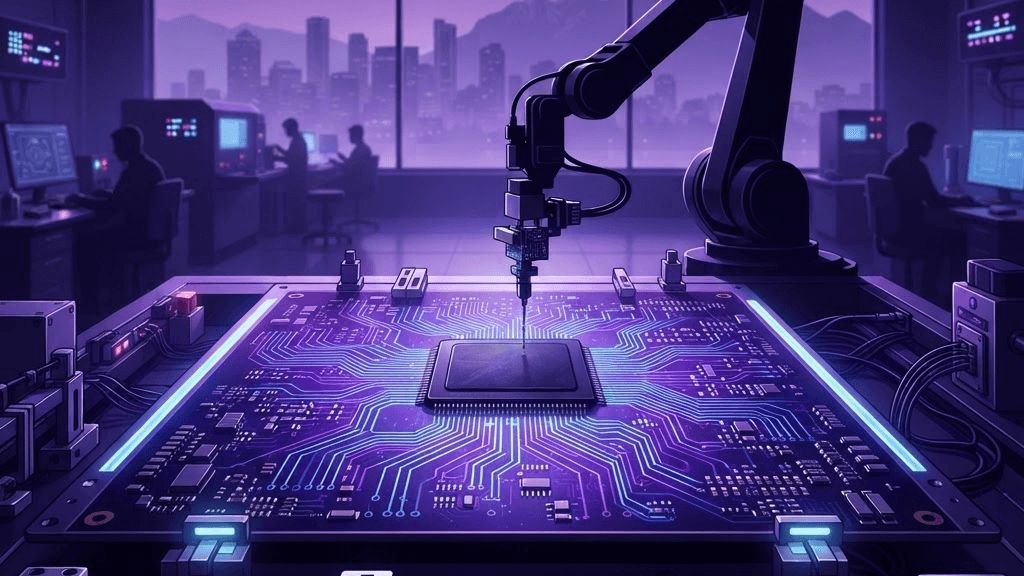
The Hardware Industry Vancouver Does Not Advertise
Vancouver is widely known for software, film production and real estate, yet the region quietly hosts one of Canada's most technically advanced hardware manufacturing clusters. Companies headquartered in Vancouver, Burnaby, Richmond and the surrounding municipalities build fuel cell systems, quantum computing hardware, wireless connectivity modules, video surveillance systems, marine energy storage, medical devices and security technologies deployed globally.
This cluster developed through several reinforcing factors. Strong engineering programmes at local universities supplied talent in electrical, mechanical and materials engineering. Early clean technology investment in British Columbia created anchor companies that trained specialists and attracted suppliers. Pacific port access simplified component sourcing and export logistics. The result is a genuine supply ecosystem rather than isolated companies.
Why Hardware Is Fundamentally Harder
Hardware businesses face constraints software companies do not. Physical products require capital before revenue, involve tooling with long lead times, and cannot be patched instantly when defects appear. Component sourcing exposes companies to global supply volatility, and certification requirements in medical, automotive, marine and telecommunications markets add years to development timelines.
Consequently, the differentiator among hardware manufacturers is rarely initial design brilliance. It is manufacturing discipline: design for manufacturability, supplier qualification, quality management systems, statistical process control, field failure analysis and service infrastructure. Companies that master these unglamorous capabilities survive; those that do not fail even with excellent products.
The Ten Leading Hardware Manufacturers in the Vancouver Region
1. Ballard Power Systems
Ballard Power Systems, based in Burnaby, is among the world's most established proton exchange membrane fuel cell manufacturers, supplying power modules for buses, trucks, trains and marine vessels. Its decades of continuous development illustrate how long horizon hardware innovation can be, and it anchors British Columbia's hydrogen technology cluster.
2. D-Wave Quantum
D-Wave, headquartered in the Vancouver area, builds quantum annealing computers and was the first company to sell quantum computing systems commercially. Manufacturing hardware that operates near absolute zero requires extraordinary engineering across cryogenics, superconducting circuits, magnetic shielding and control electronics.
3. Avigilon
Avigilon, founded in Vancouver and now part of Motorola Solutions, designs and manufactures high-definition video surveillance cameras and analytics systems used worldwide. It is a strong example of combining imaging hardware with embedded software intelligence, and it retains substantial local engineering operations.
4. Sierra Wireless
Sierra Wireless, based in Richmond and now part of Semtech, built a global business in cellular connectivity modules, gateways and internet of things devices. Its products underpin connected vehicles, industrial equipment and infrastructure monitoring, and its certification expertise across global carrier networks represents years of accumulated capability.
5. Corvus Energy
Corvus Energy manufactures large-scale lithium ion battery systems for marine and offshore applications from its Richmond operations. Marine electrification demands exceptional safety engineering and classification society approval, making this among the more rigorous hardware categories in the region.
6. General Fusion
General Fusion, based in Richmond, develops magnetised target fusion energy technology, building large experimental machines that combine plasma physics, high-speed mechanical compression and advanced control systems. It represents the most ambitious end of Vancouver hardware engineering.
7. Kardium
Kardium, headquartered in Burnaby, develops advanced medical devices for cardiac ablation procedures. Medical device manufacturing imposes stringent quality system, traceability and clinical validation requirements, and the company demonstrates the depth of the region's health technology engineering capability.
8. Nanotech Security
Nanotech Security, based in Burnaby, produces nano-optic security features used in banknotes, documents and brand protection applications. Its work combines nanofabrication, optical engineering and high-volume manufacturing precision at scales measured in nanometres.
9. Loop Energy
Loop Energy, operating from Burnaby, manufactures hydrogen fuel cell systems for commercial vehicles, with distinctive flow field architecture aimed at improving efficiency. It reflects the depth of British Columbia's hydrogen supply chain, where multiple companies and specialist suppliers coexist.
10. Vecima Networks
Vecima Networks, with British Columbia operations, designs and manufactures broadband access, content delivery and video processing hardware for telecommunications operators. Its long history in carrier equipment demonstrates sustained hardware engineering in a demanding reliability environment.
Trends Affecting Hardware Manufacturing
Supply chain resilience has permanently changed procurement practice. Manufacturers now qualify multiple suppliers for critical components, carry deeper inventory on long lead time parts and design with substitutability in mind, accepting higher unit costs for reduced disruption risk.
Electrification and energy storage continue to expand across marine, transportation and industrial applications, which favours the region's existing fuel cell and battery expertise. Regulatory requirements around repairability, recycled content and end-of-life handling are increasingly influencing product design. Meanwhile, embedded intelligence has become standard, meaning hardware companies must now maintain software engineering, cybersecurity and update infrastructure capabilities alongside physical manufacturing.
Working With Hardware Manufacturers
If you are sourcing manufactured products or components, evaluate quality management certification, request field failure rate data, and ask how design changes are controlled and communicated. Understand lead times honestly and confirm second-source availability for critical parts.
If you are building a hardware company in the region, the practical advantage is ecosystem access: contract manufacturers, machine shops, testing laboratories, certification consultants and experienced operations engineers are all available locally. That density is precisely what makes Vancouver a more viable hardware location than its software reputation suggests.