
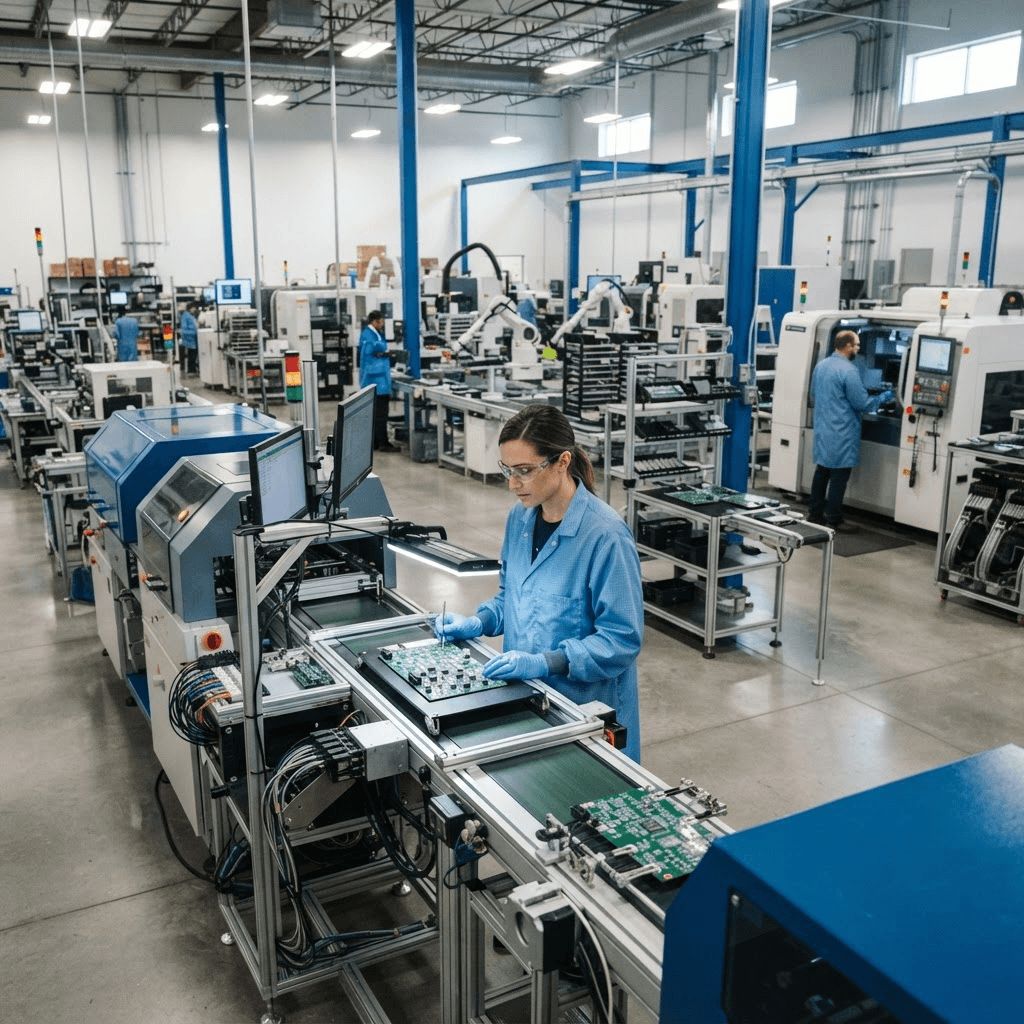
A Manufacturing Region With Real Depth
Hardware manufacturing is one of the oldest and most resilient parts of the St. Louis economy. The region's position on the Mississippi and Missouri rivers made it a natural assembly and distribution point long before interstates existed, and successive waves of industry left behind an unusually deep bench of machinists, tool and die makers, electrical engineers, and quality specialists. Today the metro supports aerospace, rail, automotive, industrial equipment, medical devices, and electronics production, often within the same supplier networks.
What makes the area distinctive is the combination of heavy industrial capability and precision work. A company can source a large weldment, a machined titanium component, a printed circuit board assembly, and a molded enclosure without leaving the region. That density shortens development cycles and reduces the logistics risk that has troubled distant supply chains in recent years.
The Top 10 Hardware Manufacturers in St. Louis
1. Boeing Defense, Space and Security. The region's largest manufacturing employer builds military aircraft and advanced systems at a scale that shapes the entire supplier ecosystem. Its standards for documentation, traceability, and quality control cascade through hundreds of local shops, raising the regional baseline.
2. Emerson. Headquartered in the metro area, Emerson designs and manufactures industrial automation equipment, control systems, valves, and climate technologies. Its presence anchors regional expertise in process control hardware and industrial electronics.
3. Watlow and regional thermal systems manufacturers. Precision heating elements, sensors, and thermal controllers require tight tolerances and materials expertise. Producers in this niche serve semiconductor, medical, and food processing customers worldwide.
4. LMI Aerospace, part of Sonaca Group. Producing aerostructures, complex sheet metal assemblies, and machined components, this operation exemplifies the region's aerospace supply chain strength and its capability with exotic alloys.
5. Hunter Engineering. Designing and building wheel alignment, balancing, and inspection equipment used in service bays globally, Hunter combines mechanical engineering, optics, and embedded software in a single product line manufactured largely in the region.
6. Nidec Motor Corporation. Electric motors and drives for commercial, industrial, and appliance applications are engineered and produced here, supporting local expertise in electromechanical design and high-volume winding operations.
7. Bommarito and Wainwright Industries. Contract manufacturers of stamped, machined, and assembled components, these operations serve automotive and aerospace customers and are frequently cited for continuous improvement culture and employee-driven quality programs.
8. Zoltek, a Toray Group company. Producing carbon fiber and composite materials, Zoltek supplies wind energy, automotive, and industrial customers, giving the region genuine advanced materials capability rather than only metal fabrication.
9. Stereotaxis and the medical device cluster. Building robotic systems for cardiac procedures requires precision mechanics, sterile design discipline, and regulatory documentation. Medical device manufacturers in the metro area operate under FDA quality systems that few general shops can match.
10. Contract electronics manufacturers across St. Charles and the metro east. A network of mid-sized firms handles printed circuit board assembly, cable harnesses, box builds, and testing. For hardware startups, these shops are often the most practical path from prototype to first production run.
Trends Reshaping Regional Manufacturing
Reshoring has been the dominant story. After extended disruption in overseas logistics, many companies moved at least dual sourcing back to domestic suppliers, and St. Louis benefited from its central location and existing capacity. Lead time reliability now competes with unit price in sourcing decisions.
Automation is the second force. Robotic welding cells, automated inspection, and machine vision quality control have spread beyond the largest plants into mid-sized shops, driven by both labor availability and consistency requirements. Rather than eliminating jobs outright, the shift has changed the job mix toward programming, maintenance, and quality engineering.
Third, sustainability requirements from large customers have pushed suppliers to document energy use, material sourcing, and waste streams. Shops that can supply this data win contracts that competitors cannot bid on.
Choosing a Manufacturing Partner
Start with capability matching rather than price. A shop optimized for high-volume stamping will handle a low-volume precision assembly poorly, and vice versa. Ask about typical batch sizes, tolerance capability, and the industries served, then confirm relevant certifications such as ISO 9001, AS9100 for aerospace, or ISO 13485 for medical devices.
Visit the floor. Organization, tooling condition, and how operators discuss quality reveal more than any capability statement. Ask to see the inspection area and the process for handling nonconforming parts, since how a supplier manages failure predicts your experience far better than how it describes success.
Discuss engineering support explicitly. The best partners contribute design for manufacturability feedback that reduces cost before tooling is committed. Clarify tooling ownership, minimum order quantities, and how engineering changes are priced and scheduled. Finally, agree on quality metrics and a communication rhythm in advance, because sustained supplier relationships succeed on predictability rather than heroics.
Why St. Louis Works for Hardware
The region offers a rare combination for physical products: a skilled trades workforce, industrial real estate at reasonable cost, freight access by rail, river, road, and air, and a supplier base that spans raw material to finished assembly. For a hardware company, that means shorter iteration loops, easier factory visits, and fewer surprises in transit.
Whether the product is an industrial sensor, a medical instrument, or a consumer device, the practical path in this market is to engage a manufacturing partner early, involve their engineers in design decisions, and build volume gradually with a supplier who can scale alongside you. The manufacturers above prove that St. Louis remains a place where things get built well.