
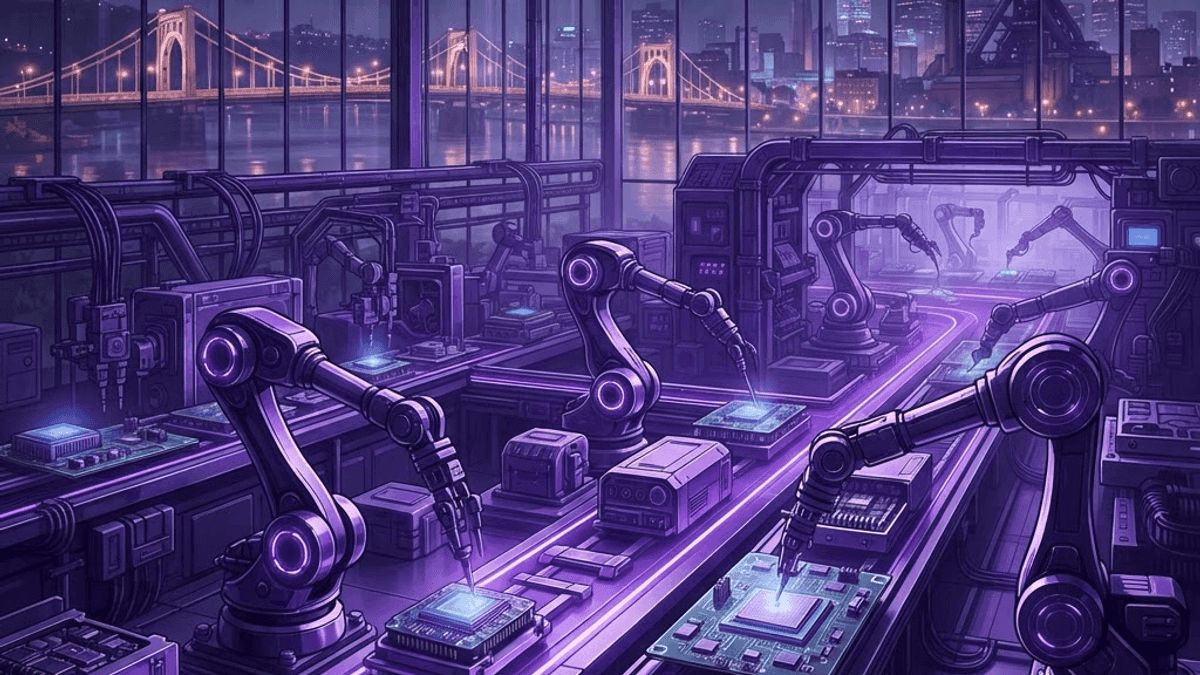
Industrial Heritage Turned Advanced Manufacturing
Pittsburgh's identity was forged in steel, and while the mills that once defined the skyline are largely gone, the underlying industrial capability never disappeared. It transformed. The region retained metallurgical expertise, machining capacity, materials science research, and a workforce culture that understands tolerances and shift schedules. Layered on top of that came robotics, additive manufacturing, sensors, and electronics, producing a hardware ecosystem that can take a product from concept to production without leaving western Pennsylvania.
This matters strategically. Hardware startups in coastal cities frequently ship designs overseas because domestic capability is scarce and expensive nearby. Pittsburgh companies often find machine shops, sheet metal fabricators, electronics assemblers, and materials labs within an hour's drive. That proximity shortens iteration cycles dramatically, and iteration speed is the primary determinant of hardware success.
The Top 10 Hardware Manufacturers and Partners in Pittsburgh
1. Gecko Robotics. Gecko designs and builds wall-climbing inspection robots that operate in boilers, tanks, and industrial vessels. The hardware challenge is severe: adhesion to curved and fouled surfaces, heat tolerance, sensor stability during motion, and reliability in environments where a stranded robot is a serious problem. Gecko is among the clearest examples of Pittsburgh translating industrial understanding into novel hardware.
2. Astrobotic. Astrobotic builds lunar landers, rovers, and space systems from its Pittsburgh facility. Space hardware imposes the most demanding manufacturing discipline available: vibration and thermal qualification, radiation considerations, mass budgets measured in grams, and absolutely no field service. Its presence has raised the regional bar for aerospace-grade quality systems and given local suppliers experience meeting them.
3. Kennametal. A long-established manufacturer of tooling and wear-resistant materials, Kennametal represents Pittsburgh's materials science depth. Its carbide cutting tools and engineered components serve aerospace, energy, and general machining markets globally. For any regional manufacturer dealing with tool life, surface finish, or difficult materials, this expertise is a local asset.
4. Wabtec. Wabtec manufactures rail equipment, braking systems, locomotive components, and transit technology, with substantial regional presence. Rail hardware demands extreme durability, safety certification, and multi-decade service life, which produces engineering and quality practices that ripple through its supplier network.
5. Precision machining and contract manufacturing shops. The region hosts a dense population of computer numerical control machining shops, many family-owned across generations, capable of tight-tolerance work in aluminum, stainless steel, titanium, and engineering plastics. For prototype and low-to-mid volume production, these shops are the practical backbone of hardware development in western Pennsylvania.
6. Sheet metal fabrication and weldment specialists. Enclosures, frames, brackets, and structural assemblies come from a mature regional fabrication base with laser cutting, forming, welding, and finishing capability. Because so much hardware cost hides in enclosures and structure, early collaboration with a fabricator often produces the largest cost reductions in a design.
7. Electronics manufacturing services providers. Regional providers offer printed circuit board assembly, cable harnessing, box build integration, and testing. Their value for hardware startups is design for manufacturability review before production, catching component sourcing risks, testability gaps, and assembly problems while changes are still inexpensive.
8. Additive manufacturing and rapid prototyping bureaus. With strong regional research in metal additive processes, Pittsburgh supports service bureaus offering polymer and metal three-dimensional printing, urethane casting, and rapid tooling. These shortened prototype cycles from weeks to days, fundamentally changing how local hardware teams iterate.
9. Robotics integrators and automation builders. These firms design and construct automated cells, custom fixtures, end-of-arm tooling, and inspection stations for manufacturers scaling production. As regional manufacturers face persistent skilled labor constraints, integrators have become central to capacity expansion.
10. Materials testing and characterization laboratories. Supporting the entire ecosystem, regional labs provide metallurgical analysis, failure investigation, mechanical testing, and coating evaluation. When a part fails in the field, these labs determine whether the cause was design, material, process, or use, which is information no manufacturer can afford to guess at.
Choosing a Manufacturing Partner
Visit the facility. Nothing substitutes for walking a shop floor: organization, tooling condition, work-in-progress management, and how staff discuss quality reveal more than any capability presentation. Ask what quality certifications they hold and, more importantly, ask to see a recent corrective action record. A shop that documents and resolves nonconformance is more trustworthy than one that claims never to have any.
Match the shop to your volume. A high-volume production facility will treat a fifty-unit prototype run as an unwelcome interruption, while a prototype shop will struggle to hold cost and consistency at ten thousand units. Transitioning between partners as volume grows is normal and should be planned rather than resisted.
Discuss capacity and lead time honestly, including what happens when their largest customer places a rush order. Ask about material sourcing and whether they hold stock or purchase per job, since that determines your exposure to supply disruption.
From Prototype to Production
The transition that breaks most hardware projects is not the first working unit. It is the hundredth. Design for manufacturability should begin far earlier than most teams expect. Reduce part count, avoid tolerances tighter than function requires, standardize fasteners, design for assembly access, and eliminate operations that require unusual skill. Every one of those decisions compounds across production volume.
Build a bill of materials with real sourcing information early, including lead times, minimum order quantities, and second sources for critical components. Many hardware delays are component availability problems rather than engineering problems. Establish test procedures before production, because inspecting quality into a product after the fact is far more expensive than building it in.
Cost Structure Realities
Hardware cost is dominated by decisions made early. Tooling, material selection, part count, and assembly labor are largely locked by the time a design is finalized, and later cost reduction efforts typically recover a fraction of what a better initial design would have. Budget for at least two or three full design iterations before production, and treat that as normal engineering rather than failure. The Pittsburgh advantage is that those iterations can happen faster and more collaboratively than they would with a distant supplier.