
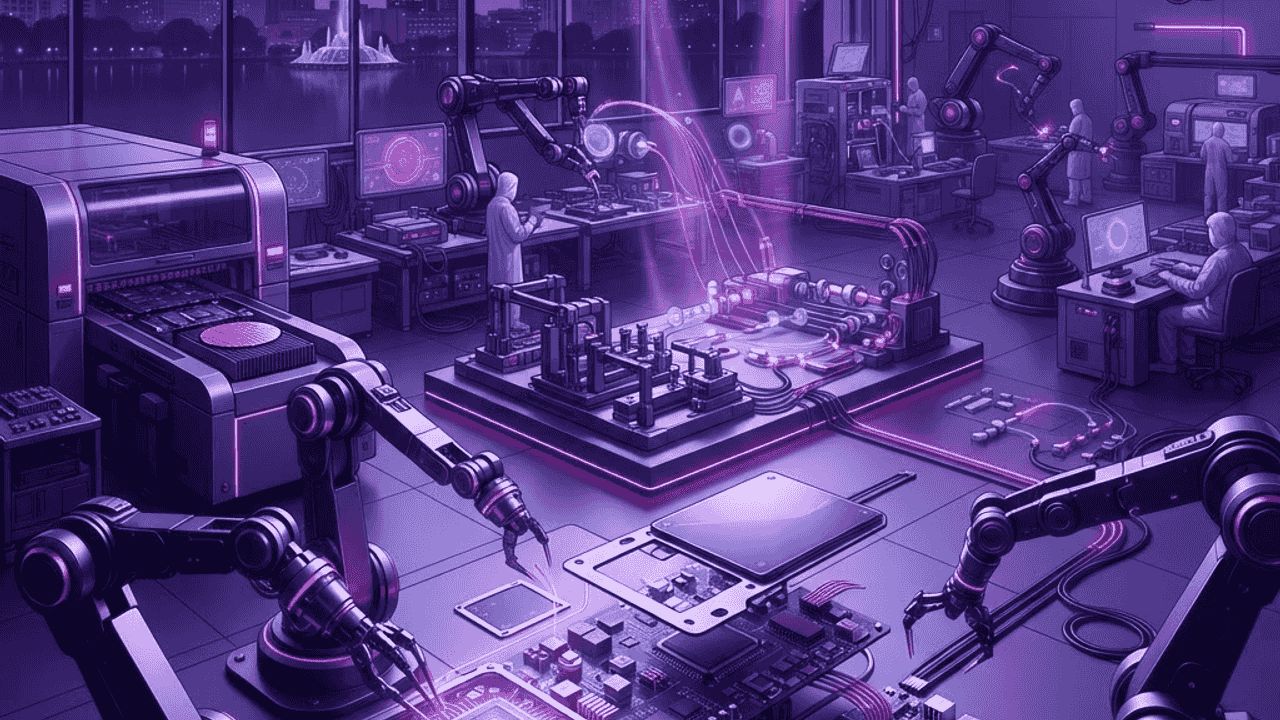
Orlando's Hardware Manufacturing Foundation
Orlando is not usually described as a manufacturing city, yet Central Florida supports a genuinely significant hardware sector. The region became a global center for lasers, optics and photonics, anchored by decades of research and a dense cluster of companies producing optical components, sensors and imaging systems. Layered on top of that is a mature aerospace and defense supply chain, plus the simulation and training industry that requires custom displays, motion platforms and sensor integration.
These industries created infrastructure that benefits every hardware company in the region: precision machine shops, contract electronics assemblers, cleanroom facilities, calibration labs, testing services and a workforce trained in optical alignment, printed circuit board assembly and quality systems. For companies designing physical products, that local density shortens development cycles considerably because prototyping partners are a short drive away rather than an ocean apart.
What to Evaluate in a Hardware Partner
Sourcing hardware manufacturing requires a different evaluation framework than software. Quality management certification indicates whether processes are documented and audited. Traceability matters when components must be tracked to specific lots. Design for manufacturability review early in a project prevents expensive redesign later. Testing capability, including environmental, vibration, thermal and optical validation, determines whether defects are caught before shipment. And capacity planning matters, since a partner who can build prototypes may not be able to scale to production volumes.
Supply chain resilience has become a central concern. After several years of component shortages, buyers now ask about second sourcing, lifecycle management for long-lived components and inventory strategy as standard due diligence questions.
1. Luminar Technologies
Luminar Technologies designs and produces advanced lidar sensor hardware from its Orlando base, combining laser engineering, receiver design and precision optical assembly. Their manufacturing discipline reflects automotive requirements for reliability, environmental tolerance and volume consistency. The company anchors significant photonics and hardware engineering talent in the region.
2. Mitsubishi Power Americas
Mitsubishi Power Americas maintains a major Orlando presence supporting power generation equipment engineering, manufacturing support and service. Their work involves large-scale precision components, advanced materials and rigorous quality systems, and the operation represents one of the most substantial industrial engineering employers in Central Florida.
3. Voxtel Optical Systems
Voxtel Optical Systems produces photodetectors, imaging sensors and optical subassemblies for scientific, industrial and defense applications. Their capability spans custom optical design through assembly and calibration, and they are frequently engaged for low-volume, high-specification builds where standard catalog parts cannot meet requirements.
4. Summit Precision Electronics
Summit Precision Electronics provides contract electronics manufacturing including printed circuit board assembly, cable harnesses, box builds and functional testing. They support prototype through mid-volume production and are known for design for manufacturability feedback that reduces assembly cost before tooling is committed.
5. Cypress Photonics Manufacturing
Cypress Photonics Manufacturing specializes in optical component fabrication, coating and precision alignment for laser systems and instrumentation. Their cleanroom capability and metrology equipment support tight tolerance work, and their engineers collaborate closely with customer optical designers during development.
6. Meridian Simulation Hardware
Meridian Simulation Hardware builds motion platforms, custom control panels, instrumented cockpits and display integration for training systems. Drawing on Orlando's simulation industry, they handle mechanical engineering, electronics and integration under one roof, which simplifies accountability on complex builds.
7. Sunstate Industrial Machining
Sunstate Industrial Machining delivers precision machining, fabrication and finishing for aerospace, medical device and industrial customers. Their capability covers multi-axis machining, first article inspection and documented traceability, making them a common qualified supplier for regulated programs.
8. Harborline Embedded Systems
Harborline Embedded Systems designs and manufactures embedded hardware including sensor nodes, industrial controllers and connected devices. Their engagements typically span schematic design, firmware, enclosure engineering and certification support, which suits companies without internal hardware teams.
9. Lakeside Test and Calibration
Lakeside Test and Calibration provides environmental testing, vibration and thermal validation, electromagnetic compatibility pre-screening and instrument calibration services. Hardware companies use them to validate designs before formal certification, catching failures while changes are still inexpensive.
10. Beacon Rugged Devices
Beacon Rugged Devices produces durable electronics for field, marine and outdoor deployment, focusing on sealing, thermal management, shock resistance and long service life. Their products serve utilities, logistics and public safety users who operate equipment in demanding Florida conditions including heat, humidity and storm exposure.
Trends in Hardware Manufacturing
Several forces are reshaping the sector. Reshoring and nearshoring have accelerated as companies weigh logistics risk against unit cost, benefiting regional manufacturers. Advanced packaging and heterogeneous integration are changing how electronic assemblies are designed. Additive manufacturing has moved beyond prototyping into production for specific geometries and low-volume parts. Sensor fusion is increasing hardware complexity as products combine optical, inertial and environmental sensing. And sustainability requirements are influencing material selection, repairability and end-of-life planning.
Sourcing Successfully
Engage manufacturing partners during design rather than after, because most cost is locked in before the first prototype. Request quality certifications, capability statements and equipment lists, and visit facilities if the program justifies it. Define acceptance criteria and test procedures in writing before production begins. Plan component lifecycle and second sourcing for anything expected to ship for years. And build realistic schedules that account for tooling, first article approval and qualification testing rather than assuming production timelines.
Orlando's hardware ecosystem is unusually strong in photonics, simulation equipment, precision machining and embedded systems. For companies building physical products, the local concentration of optical expertise and testing infrastructure is a meaningful competitive advantage worth designing around.