
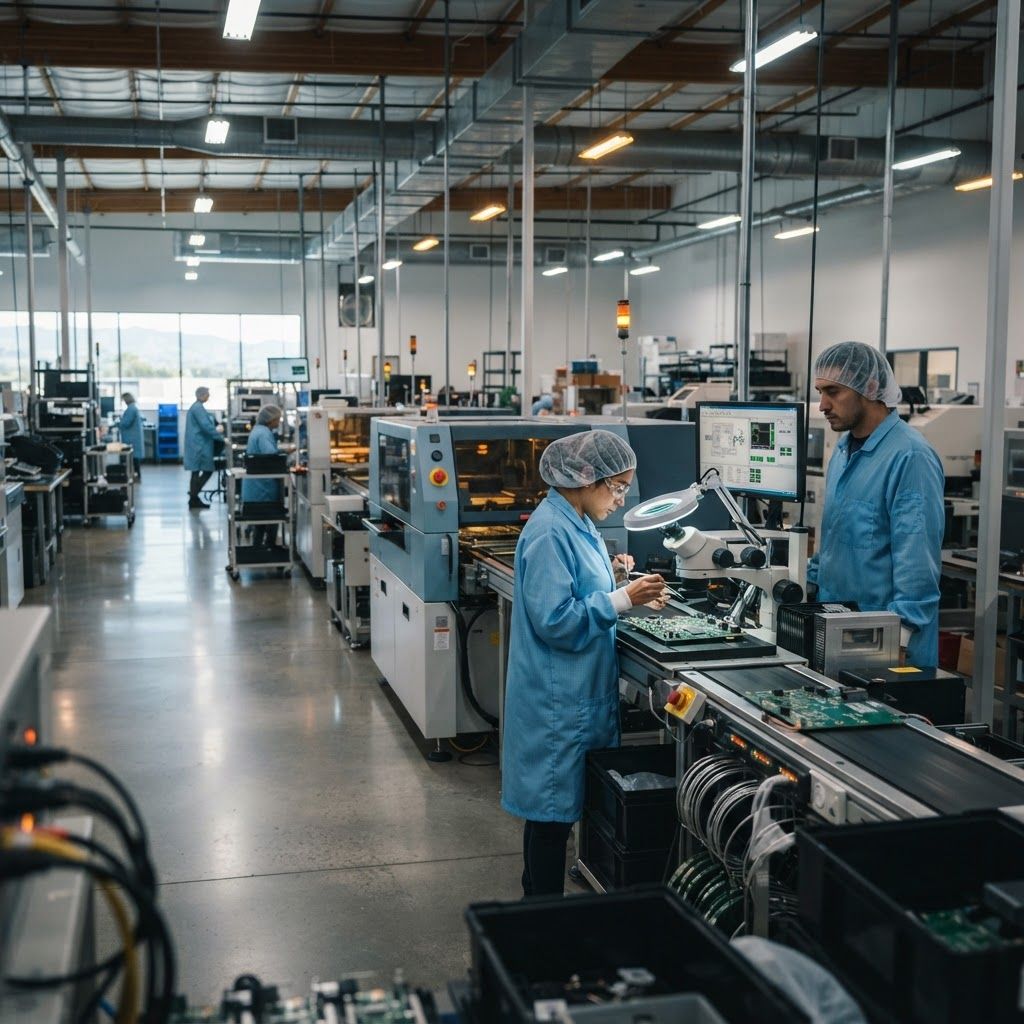
Why Chula Vista Has Become a Hardware Manufacturing Hub
Chula Vista occupies an unusually strategic position for physical product manufacturing. It sits between the engineering talent of the greater San Diego region and one of the busiest manufacturing corridors on the continent to the south, which means local hardware firms can move quickly between prototyping, tooling, and volume production without the delays that come with overseas supply chains. Add a deep aerospace and defense heritage, a maturing clean energy sector, and a growing base of medical device work, and the city offers a manufacturing ecosystem that punches far above its population size.
For founders, procurement leads, and engineering managers, this proximity matters in practical ways. A design review can happen in person on a Tuesday and a revised prototype can be on the bench by the following week. That speed reduces development risk, shortens time to revenue, and makes it far easier to catch tolerance issues, thermal problems, and assembly bottlenecks before they become expensive production defects.
How These Manufacturers Were Evaluated
The companies below were assessed on engineering depth, quality systems, breadth of in-house capability, communication quality, and consistency at scale. Certification maturity carries real weight in this industry, since standards such as ISO 9001 for general quality management, AS9100 for aerospace work, and ISO 13485 for medical devices signal that a factory has documented, auditable processes rather than informal habits. Equally important is transparency: the best manufacturers share yield data, flag design choices that will hurt manufacturability, and quote realistic timelines instead of optimistic ones.
The 10 Best Hardware Manufacturers Serving Chula Vista
1. Bayfront Precision Manufacturing
Bayfront Precision is widely regarded as the benchmark for tight-tolerance machining in the area. The company combines multi-axis CNC milling and turning with in-house metrology, which allows it to verify critical dimensions without shipping parts to a third-party inspection house. Engineering teams working on aerospace brackets, optical housings, and structural components tend to favor Bayfront for its documentation discipline and its willingness to consult early on design for manufacturability.
2. Otay Mesa Electronics Group
Otay Mesa Electronics Group specializes in printed circuit board assembly, from low-volume engineering builds to sustained production runs. Its strengths include automated optical inspection, fine-pitch component placement, and conformal coating for units destined for harsh environments. The team is known for catching footprint and thermal relief issues during the quoting stage, which spares customers a costly second spin of the board.
3. South Bay Industrial Fabrication
South Bay Industrial Fabrication handles sheet metal, weldments, and larger structural assemblies. Laser cutting, press brake forming, powder coating, and welding all happen under one roof, which shortens lead times considerably for enclosures, frames, and equipment skids. Customers in industrial equipment and renewable energy frequently cite the company's finish quality and its ability to absorb mid-project design changes without derailing schedules.
4. Coronado Systems Assembly
Coronado Systems Assembly focuses on complex box build and system integration work, taking machined parts, cable harnesses, boards, and firmware and delivering finished, tested units ready for the field. Its functional test development capability is a genuine differentiator, since a well-designed test fixture catches latent defects that visual inspection will always miss.
5. Third Avenue Prototyping Works
Third Avenue Prototyping Works serves the earliest and most uncertain stage of product development. The shop runs additive manufacturing alongside soft tooling and short-run machining, so a design team can hold three material variants of the same part within days. Startups appreciate the candid feedback on which geometries will scale and which will become a production headache.
6. Pacific Medical Device Manufacturing
Pacific Medical Device Manufacturing operates in the demanding world of regulated production, with controlled environments, validated processes, and full traceability from raw material lot to finished device. Its quality engineering team is deeply experienced in design history files and process validation, making it a strong partner for companies moving from clinical builds toward commercial launch.
7. Harbor Cable and Wiring Solutions
Harbor Cable and Wiring Solutions builds custom cable assemblies, wiring harnesses, and overmolded connectors. Interconnects are a frequent and underestimated source of field failures, and Harbor's investment in pull testing, continuity verification, and disciplined labeling addresses exactly that risk. The company is also praised for accommodating urgent replacement builds.
8. Sweetwater Plastics and Tooling
Sweetwater Plastics and Tooling covers injection molding, tool design, and secondary operations such as ultrasonic welding and pad-free assembly. Bringing tooling in-house shortens the feedback loop between a first-article part and a corrected mold, which matters enormously when cosmetic surfaces or snap-fit features are involved.
9. Eastlake Robotics and Automation
Eastlake Robotics and Automation designs and builds custom automation cells, conveyors, and vision inspection stations for manufacturers looking to raise throughput and consistency. Its consultative approach stands out: rather than selling the largest possible system, the team typically identifies the single constraint in a line and automates that first.
10. Palomar Power Components
Palomar Power Components produces power supplies, battery packs, and energy storage modules with a focus on thermal design and safety compliance. As electrification spreads across mobility, marine, and industrial applications, the company's testing depth around cycle life and thermal behavior has made it a trusted supplier for demanding programs.
Industry Trends Shaping Local Production
Several forces are reshaping hardware manufacturing in the region. Nearshoring continues to pull production closer to end markets as companies weigh resilience against unit cost. Automation is spreading beyond high-volume lines into mid-volume shops, driven by more affordable collaborative robots and vision systems. Sustainability requirements are also becoming procurement criteria rather than marketing language, pushing manufacturers toward energy monitoring, scrap reduction, and recyclable packaging. Finally, digital traceability is now expected, with customers wanting serialized records rather than paper binders.
How to Choose the Right Manufacturing Partner
Start by matching the manufacturer's core competency to your actual bottleneck rather than to your entire bill of materials. Tour the facility if at all possible, since organization on the floor is a reliable proxy for process discipline. Ask how the shop handles a failed first article, because the answer reveals more about its quality culture than any certificate on the wall. Request references from customers at a similar production volume, and confirm capacity headroom before you commit, so a successful launch does not immediately outgrow your supplier. Above all, treat the relationship as a long-term engineering partnership; the manufacturers that ask difficult questions early are the ones that protect your margins later.
Final Thoughts
Chula Vista's hardware manufacturers offer a rare combination of proximity, capability, and responsiveness. Whether you need precision machining, regulated medical assembly, or a full turnkey system build, the depth of local options means you can keep engineering and production close together, iterate faster, and bring a better product to market with fewer surprises.