
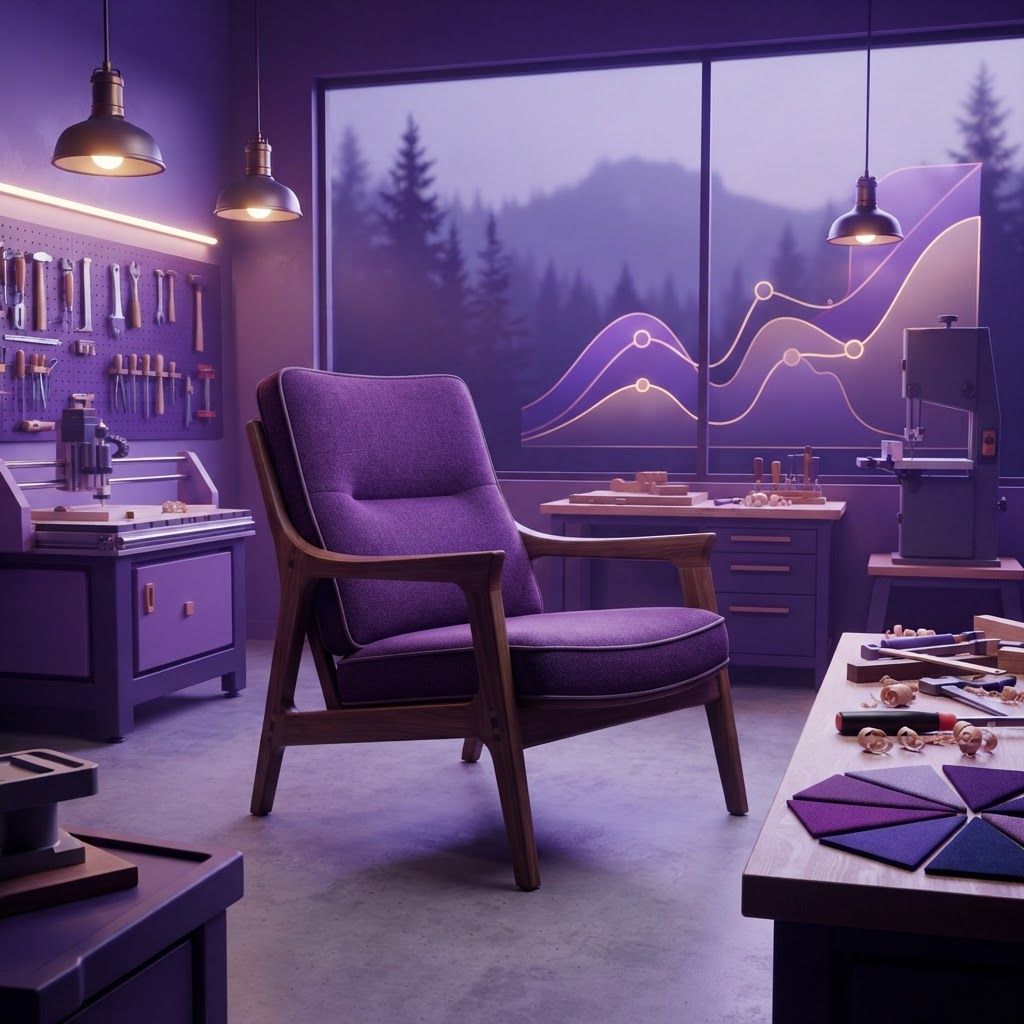
A Craft Tradition Rooted in Northwest Timber
Furniture making in Tacoma grew directly out of the timber economy that built the city. For more than a century, logs moved through the tideflats, mills cut dimensional lumber, and secondary manufacturers turned that material into doors, millwork, cabinetry, and furniture. The large mills have mostly gone, but the skills did not leave with them. Today the city supports a layered furniture industry: small studio makers working in solid hardwood, mid-sized cabinet and casegoods shops serving contractors and designers, upholstery specialists, and commercial manufacturers producing office and hospitality furniture at volume.
Local material access still shapes the work. Douglas fir, western maple, alder, walnut, and reclaimed old-growth fir salvaged from demolished warehouses all appear regularly in Tacoma-built pieces. Makers here also work extensively with steel, because the same industrial district that supports metal fabrication sits within a few miles of most woodshops. That proximity explains why mixed-material furniture, wood tops on welded steel bases, has become something of a regional signature.
The Segments Inside a Single Industry
Buyers often use the phrase furniture manufacturer to describe four very different kinds of business. Studio and custom makers build individual commissioned pieces, usually in solid wood, with lead times measured in months and pricing that reflects hand-fitted joinery. Architectural millwork and casegoods shops produce built-in cabinetry, reception desks, library shelving, and fixture packages, working from architectural drawings and coordinating with general contractors. Upholstery manufacturers and restorers focus on frames, springs, foam, and fabric, and often handle both new production and the reupholstering of vintage pieces. Commercial and contract manufacturers build repeatable product lines for offices, hotels, restaurants, senior living, and healthcare, where durability standards and fire ratings matter as much as appearance.
Knowing which category fits a project prevents most disappointment. A studio maker asked to produce two hundred identical chairs will quote a price that seems absurd, while a contract manufacturer asked for a one-off walnut dining table may decline entirely or subcontract it.
What Distinguishes the Strongest Shops
Several markers separate genuinely capable Tacoma furniture manufacturers from shops that merely assemble purchased components. The first is joinery. Mortise and tenon, dovetail, and properly executed floating tenon construction indicate a shop that understands wood movement across seasons. Pieces built entirely with screws, dowels, and pocket holes may hold together, but they rarely survive decades of Northwest humidity swings without loosening.
The second marker is finishing capability. A dedicated, well-ventilated finish room with controlled temperature produces dramatically better results than spraying in a dusty shared workspace. Shops that offer conversion varnish, catalyzed lacquer, or water-based commercial finishes can meet performance requirements that a simple oil finish cannot, which matters enormously for restaurant tabletops and healthcare furniture.
The third is drawing and engineering competence. Manufacturers that produce their own shop drawings, submit them for approval, and maintain a cut list and hardware schedule for every job are far less likely to deliver something that does not fit the space. For commercial work, the ability to read architectural plans and coordinate with other trades is not optional.
Finally, material sourcing discipline separates the top tier. Shops that buy kiln-dried lumber, verify moisture content on arrival, and acclimate stock in the shop before machining avoid the warping and panel cracking that plague less careful operations.
Commercial and Hospitality Work in the South Sound
Tacoma's hospitality and institutional building activity has given commercial furniture makers steady work. Hotel renovations near the convention district, restaurant buildouts across the Stadium and Sixth Avenue corridors, expanding healthcare campuses, university facilities, and continued public school construction all generate demand for casegoods, seating, and fixtures. Contract manufacturers serving these clients must satisfy requirements that residential makers rarely encounter, including flammability testing for upholstered seating, cleanability standards for medical environments, ADA clearance dimensions, and seismic anchoring for tall casework.
Buyers in this segment should ask directly about testing documentation, warranty terms, replacement part availability, and installation capability. A manufacturer that can install its own product with its own crews typically resolves punch list issues far faster than one that ships to a third-party installer.
Sustainability as a Practical Advantage
Environmental credentials carry real weight in this market, and not only for reasons of principle. Shops that use certified lumber, low-VOC or water-based finishes, and formaldehyde-free panel products help their clients pursue green building certifications on commercial projects. Reclaimed material is especially meaningful in Tacoma, where salvaged old-growth fir from demolished industrial buildings offers grain density that is simply unavailable in new-growth lumber.
Waste handling also distinguishes serious operations. Shops that capture and sell or reuse sawdust and offcuts, maintain proper dust collection for worker health, and manage finish waste responsibly tend to run more organized facilities overall, which correlates strongly with build quality.
How to Evaluate a Manufacturer Before Committing
Visit the shop. A short walkthrough reveals more than any portfolio. Look for organized material storage, functioning dust collection, sharp tooling, work in progress that matches the quality shown in photographs, and staff who can explain what they are building. Ask to see a piece at an unfinished stage, because finish hides a great deal.
Request a written quote that itemizes materials, species, finish specification, hardware brands, drawer slide and hinge types, lead time, and payment schedule. Vague quotes lead to disputes. Ask how change orders are priced and who is responsible if a delivered piece does not fit. For custom work, expect a deposit, and expect the maker to be clear about what portion is nonrefundable once material is purchased.
Finally, ask about repair. The best furniture manufacturers stand behind their work years later, will re-finish a damaged top, replace a failed slide, or rebuild a joint. That willingness is the clearest signal that a shop expects its pieces to last.
Looking Ahead
The Tacoma furniture sector is likely to keep consolidating around two poles: highly skilled custom makers whose value cannot be replicated by imported product, and efficient commercial shops that win on lead time, local service, and installation. Mid-range production furniture will continue to face import pressure. For buyers, that polarization is useful clarity. Decide whether the project needs craft or needs scale, then choose a manufacturer that genuinely lives in that half of the market rather than one attempting to serve both.