
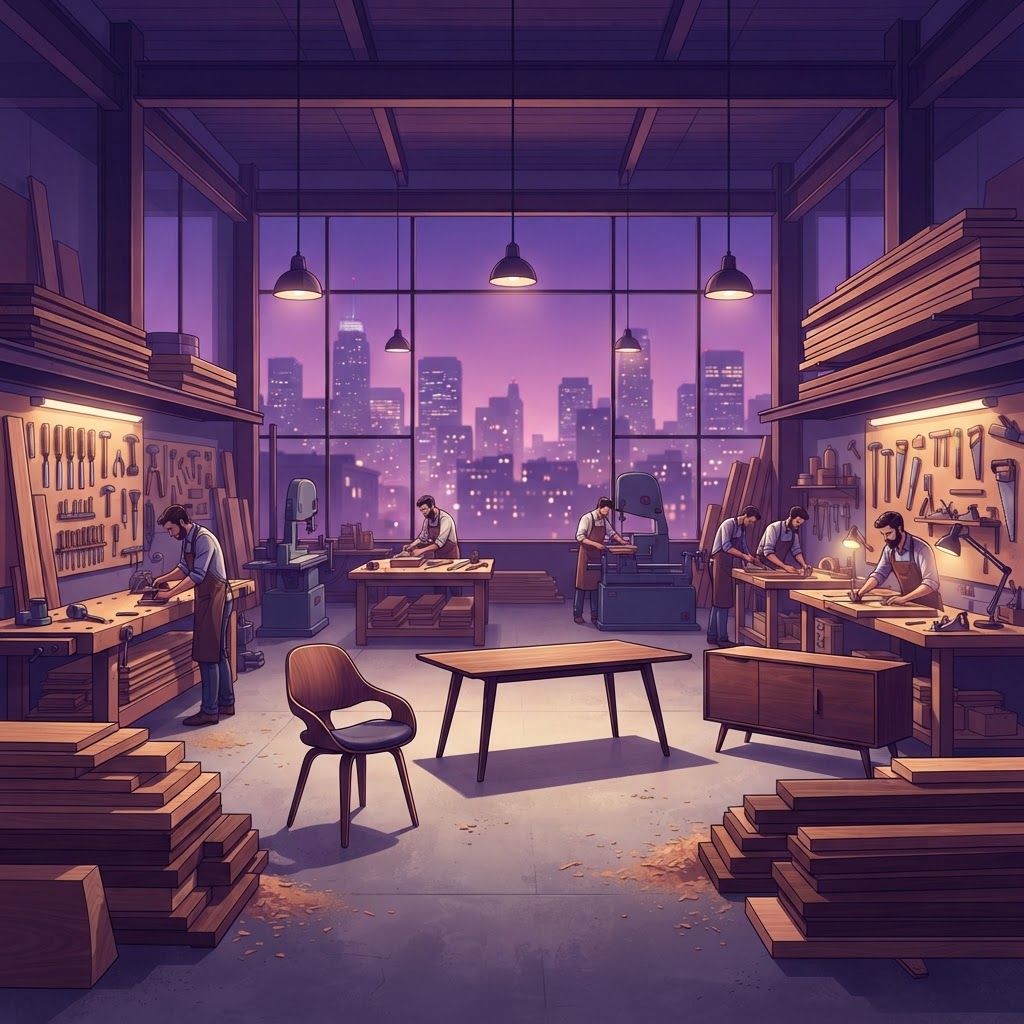
A Woodworking Tradition With Modern Capability
Virginia has a long furniture-making heritage, and Richmond inherited both the craft knowledge and the supply relationships that come with it. Hardwood forests in the surrounding region provide oak, maple, cherry, walnut, and poplar, while generations of woodworkers have passed along joinery and finishing skills. What has changed is the equipment: computer numerical control routers, wide-belt sanders, spray booths with precise environmental control, and dust collection systems now sit alongside traditional hand tools.
The result is a sector that can serve very different customers. A homeowner commissioning a dining table, an architect specifying millwork for a restaurant, and a corporate facilities manager ordering three hundred workstations can all find capable local producers. Understanding which category a manufacturer serves best is the key to a good outcome.
How to Judge Furniture Quality
Construction details reveal more than appearance. Look for solid hardwood or high-quality plywood rather than low-density particleboard in structural components, mortise and tenon or dovetail joinery in stress areas, corner blocking on seating frames, and drawers on full-extension hardware with mechanical joints instead of staples. Finish quality shows in sanding consistency, film uniformity, and how edges and inside corners are treated.
For commercial purchases, testing standards matter. Furniture rated to recognized performance standards has been subjected to cycle testing, load testing, and stability evaluation. Certifications covering low chemical emissions and responsibly sourced wood are increasingly required in specifications for schools, healthcare facilities, and corporate interiors.
The Top 10 Furniture Manufacturers in Richmond
1. James River Furniture Company
James River Furniture Company is among the region's best-known producers of solid hardwood residential furniture, including dining sets, casegoods, and bedroom collections. Traditional joinery is standard, and customers can specify wood species, dimensions, and finish. The company's hand-rubbed finishing process, applied in multiple thin coats, produces depth that sprayed production finishes rarely match.
2. Shockoe Woodworks
Shockoe Woodworks focuses on custom millwork and built-in cabinetry for homes and commercial interiors, including libraries, banquettes, reception desks, and retail fixtures. Field measurement, shop drawings, and installation are handled in house, which eliminates the coordination failures common when fabrication and installation are split between companies.
3. Capital Contract Seating
Capital Contract Seating manufactures commercial-grade chairs, booths, and lounge seating for restaurants, hotels, and offices. Frames are built for heavy use, upholstery options span hundreds of performance fabrics, and the company can reupholster existing frames as an economical refresh. Hospitality designers value its ability to match a specified silhouette closely.
4. Dominion Office Furniture
Dominion Office Furniture produces desks, workstations, conference tables, and storage systems for corporate and institutional clients. Its strengths are project management and scale: coordinated finishes across large orders, phased delivery to match construction schedules, and installation crews familiar with occupied buildings. Height-adjustable and collaborative configurations now dominate its catalog.
5. Fall Line Modern Furniture
Fall Line Modern Furniture designs and builds contemporary pieces characterized by clean lines, mixed materials, and visible craftsmanship. Steel and wood combinations, live-edge slabs stabilized properly, and minimal hardware define its aesthetic. The studio works closely with interior designers on one-off and small-batch commissions.
6. Tredegar Metal and Wood Furnishings
Tredegar Metal and Wood Furnishings specializes in industrial-influenced furniture that combines fabricated steel structures with hardwood surfaces. Powder coating and welding are performed on site, allowing full control over both material streams. Breweries, coworking spaces, and casual restaurants have driven much of its growth.
7. Hanover Upholstery Manufacturing
Hanover Upholstery Manufacturing builds sofas, sectionals, and occasional chairs using eight-way hand-tied springs on premium lines and durable engineered suspension on others. Frame construction from kiln-dried hardwood and thorough cushion specification discussions with customers set expectations accurately, which is why its return rate stays low.
8. Midlothian Cabinet Makers
Midlothian Cabinet Makers produces kitchen and bath cabinetry with a strong emphasis on fit and finish. Soft-close hardware, custom sizing to eliminate filler panels, and finish matching across multi-room projects are standard. Homeowners undertaking renovations in older houses with irregular dimensions form a natural customer base.
9. Broad Street Institutional Furniture
Broad Street Institutional Furniture serves schools, libraries, healthcare facilities, and government offices with durable, code-conscious furniture. Cleanability, tamper resistance, and accessibility compliance drive its designs. Long product life and parts availability are central to its value proposition.
10. Chesterfield Restoration and Custom Furniture
Chesterfield Restoration and Custom Furniture combines antique restoration with new custom work, bringing conservation-minded techniques to both. Veneer repair, structural stabilization, period-appropriate finishing, and careful color matching are its specialties. Clients with inherited pieces or historic property furnishings rely on its judgment.
Trends in Furniture Manufacturing
Sustainability has become a purchasing criterion rather than a preference. Certified wood sourcing, water-based finishes with low emissions, recycled content in metal and textile components, and repairability all influence specifications. Local production itself is a sustainability advantage, reducing transportation impact and shipping damage.
Customization continues to expand, driven by consumer expectations set online and by designers seeking distinctive interiors. Digital fabrication makes small-batch variation economical in ways that were impossible a generation ago. At the same time, hybrid work has reshaped commercial demand toward flexible, reconfigurable, and residential-feeling office furniture.
Choosing the Right Manufacturer
Start by defining use conditions honestly. Commercial-grade construction costs more but survives environments that would destroy residential pieces. Request material specifications in writing, including wood species, substrate types, foam density, fabric durability ratings, and finish systems. Ask to see or feel samples, especially finishes, which photograph unreliably.
Discuss lead times early. Custom hardwood furniture built properly requires weeks, sometimes months, and a suspiciously short quote may signal shortcuts. Clarify warranty terms, repair capability, and how the manufacturer handles damage discovered at delivery. Finally, ask about installation for anything large or built in; professional installation prevents most of the problems that surface later.
Final Thoughts
Richmond offers an unusually rich mix of furniture manufacturers, from traditional hardwood specialists to contract producers equipped for large commercial projects. Matching the maker to your actual requirements, then verifying construction details rather than relying on photographs, produces furniture that performs for decades. The ten companies profiled here illustrate the range of craftsmanship available in the region.