
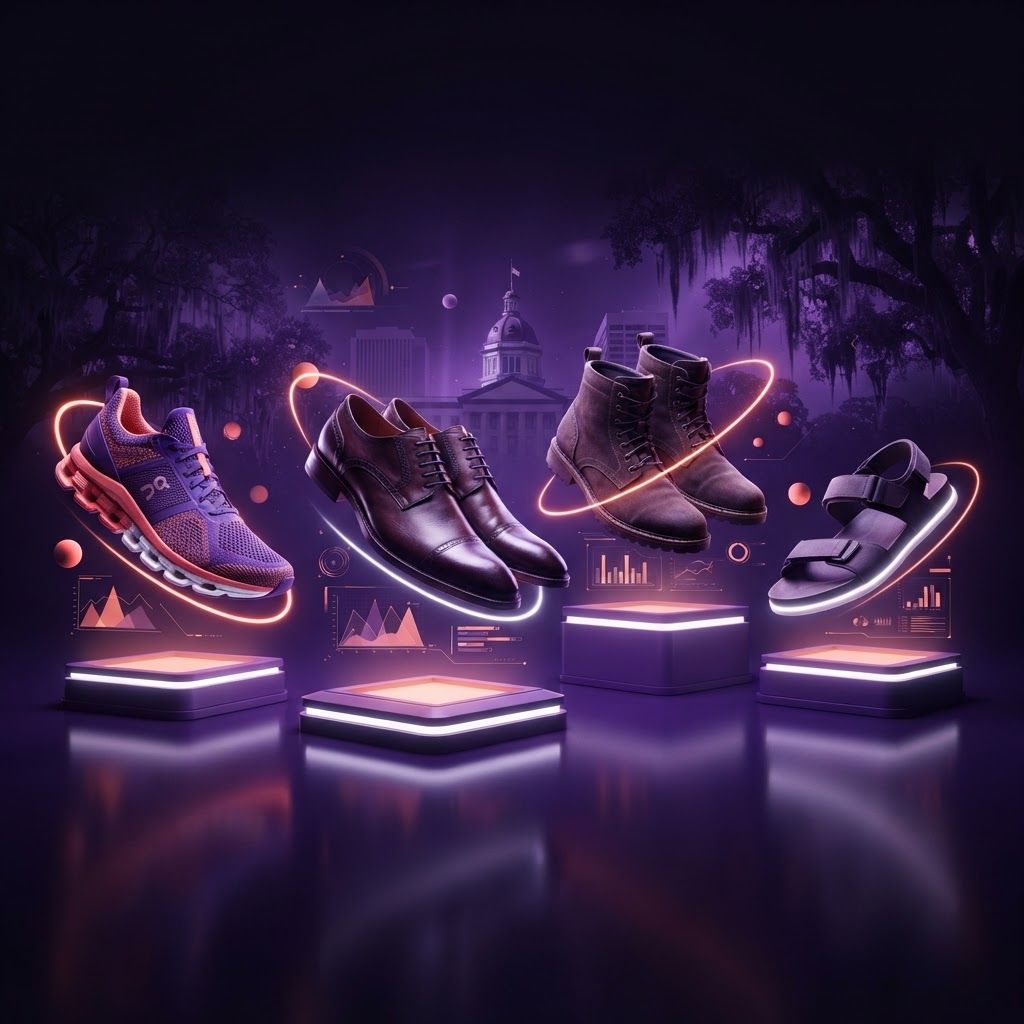
What Footwear Needs to Handle in Tallahassee
Footwear choices in Tallahassee are shaped by conditions that are easy to underestimate. The city sits on genuinely rolling terrain, unusual for Florida, which means walking routes involve real elevation change. Summer humidity keeps shoes damp, accelerating material breakdown and odor. Heavy seasonal rainfall creates persistent wet conditions. And an extensive network of trails, greenways and canopy roads supports a large community of runners, hikers and cyclists.
Layered on top of that is a large student population walking substantial daily distances across campus, and a professional sector requiring dress footwear that remains comfortable through long days. The brands that succeed here manage moisture, provide genuine support and resist humidity-driven deterioration.
Ten Footwear Brands Worth Considering
1. Brooks — Brooks has built its reputation almost entirely on running, and its focus shows in fit consistency, midsole engineering and the availability of multiple support categories and widths. For runners logging regular mileage on Tallahassee's hilly routes, the combination of predictable sizing across model updates and well-tuned cushioning makes it a reliable long-term choice.
2. Hoka — Hoka's maximally cushioned, rockered designs reduce impact loading, which appeals to runners returning from injury, walkers covering long distances and professionals who spend all day standing. Its lightweight midsole foams deliver substantial cushioning without the weight penalty older designs carried.
3. New Balance — New Balance's most distinctive advantage is width availability. Offering narrow through extra-wide across many models solves fit problems that most brands ignore, and improper width is one of the most common causes of blisters, neuroma pain and toenail damage.
4. Nike — Nike covers running, training, basketball and lifestyle categories with strong breathability in its engineered mesh uppers, which matters considerably in humid conditions. Its performance running platforms and broad availability make it a practical default for a wide range of activity.
5. Adidas — Adidas combines responsive midsole technologies with knit uppers that manage moisture well. Its training and lifestyle lines are strongly represented on campus, and its recycled material initiatives appeal to buyers weighing environmental impact.
6. Merrell — For hiking the Apalachicola National Forest, Munson Hills and regional trail systems, Merrell delivers durable outsoles with reliable wet traction, protective toe construction and both waterproof and ventilated options. In humid climates, breathable non-waterproof models often prove more comfortable than fully sealed ones.
7. Salomon — Salomon's trail running and hiking footwear emphasizes aggressive lug patterns, secure lacing systems and precise fit for technical terrain. Its shoes excel in the muddy, root-laced conditions common on North Florida trails after rain.
8. Birkenstock — Contoured cork footbeds provide arch support that most casual sandals lack, which matters when open footwear is worn for months at a time. The footbed molds to the wearer over time, and replaceable soles extend usable life considerably.
9. Allen Edmonds and Quality Dress Shoe Makers — For the professional market, welted construction dress shoes can be resoled repeatedly, making them substantially more economical over a decade than cemented alternatives. Leather also breathes better than synthetic dress shoes, a real advantage in humid conditions.
10. Olukai and Coastal Casual Brands — Water-friendly sandals and slip-ons designed for wet environments combine quick-drying materials, non-marking outsoles and genuine arch support. For a market close to the Gulf Coast with frequent rain, footwear that tolerates saturation without degrading is genuinely practical.
Trends in Footwear
Midsole foam technology has advanced dramatically, with supercritical foams delivering higher energy return at lower weight. Carbon plates, initially limited to racing shoes, have filtered into training models and even walking footwear.
Support philosophy has shifted away from rigid motion control toward guided stability that works with natural foot mechanics, using geometry and differential foam density rather than hard corrective posts.
Sustainability has entered footwear meaningfully through recycled uppers, bio-based foams, reduced adhesive construction and resale or recycling programs, though durability remains the most impactful environmental factor.
Fit technology has improved with three-dimensional foot scanning and pressure mapping available at specialty retailers, producing better recommendations than length measurement alone.
How to Choose Footwear Properly
Get measured, including width and arch length, and do it late in the day when feet are naturally at their largest. Foot dimensions change over years, and many people wear the wrong size for a decade without realizing it.
Match the shoe to actual use. Running shoes are built for forward motion and perform poorly in lateral sports; trail shoes feel stiff on pavement; cushioned walking shoes lack the stability required for court sports. Buying purpose-specific footwear reduces both discomfort and injury risk.
Prioritize breathability in this climate. Mesh uppers and moisture-managing linings reduce the maceration and fungal issues that constant humidity encourages. Rotating between two pairs allows each to dry fully, which extends the life of both.
Assess durability signals: outsole rubber coverage in high-wear zones, reinforced stitching at flex points, and whether the shoe can be resoled. Replace running shoes based on midsole compression rather than outsole appearance, since cushioning degrades before the tread wears out.
Finally, respect the break-in reality. Quality leather dress shoes require gradual break-in, but athletic footwear should feel comfortable immediately. Discomfort in a running shoe at purchase will not resolve with wear.
Investing Wisely in Footwear
Footwear is one of the few purchases where quality directly affects physical wellbeing. Proper fit, purpose-appropriate design and adequate breathability prevent problems that no amount of cushioning can compensate for. The brands profiled here lead in specific dimensions — running fit consistency, maximal cushioning, width availability, trail traction, arch support and resoleable construction — and choosing based on your actual activity pattern and foot shape rather than appearance produces footwear that lasts and keeps you comfortable through Tallahassee's demanding conditions.