
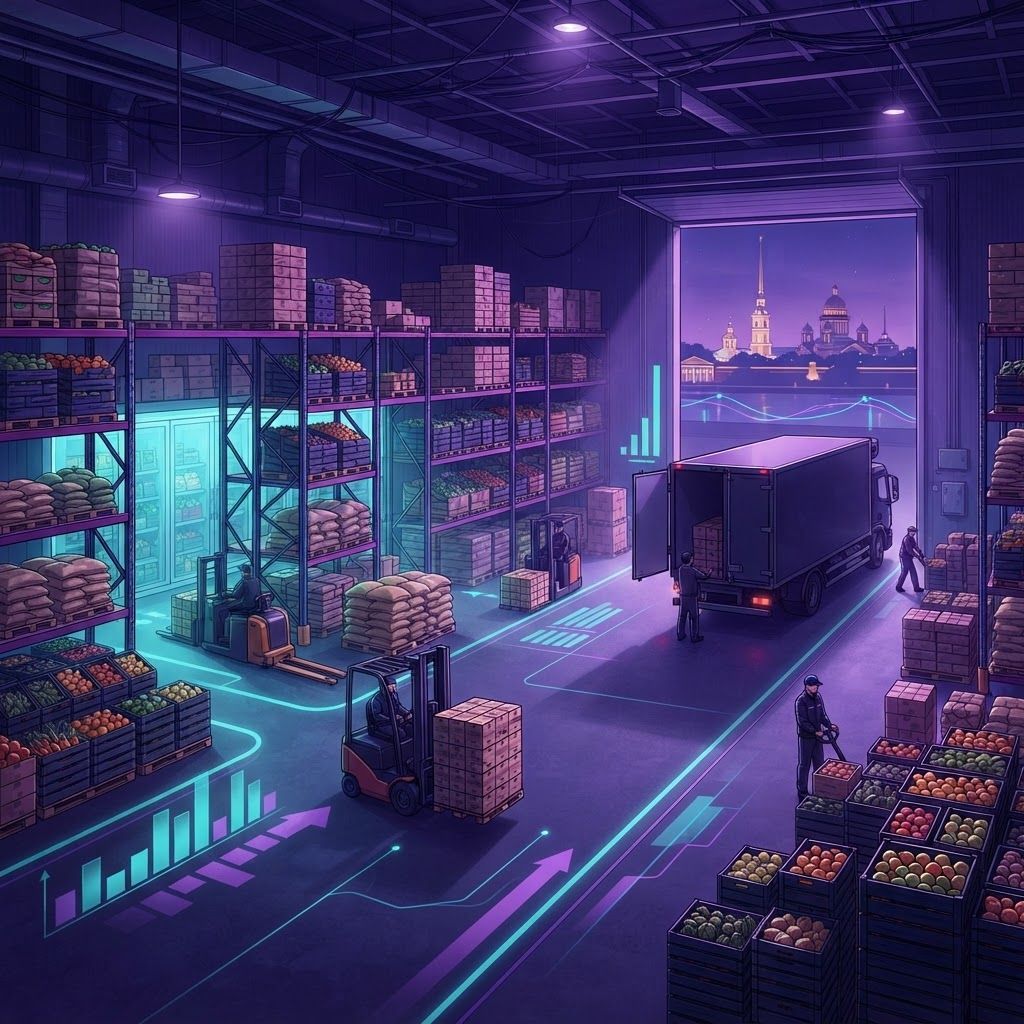
The Supply Chain Behind a City's Kitchens
Food wholesale is the least visible and most consequential industry in any large city. Every restaurant service, school lunch, supermarket shelf and hotel breakfast depends on a chain of cold storage, refrigerated transport, quality inspection and precise scheduling that most consumers never think about. In St. Petersburg that chain is particularly interesting because the city combines a major Baltic seaport, proximity to Leningrad Region agriculture and fisheries, and a dense, demanding hospitality market.
The market divides along useful lines. Full-service HoReCa distributors supply restaurants and hotels with broad assortments. Category specialists focus on fresh produce, meat, seafood or dairy where handling expertise is critical. Dry goods wholesalers move ambient products in bulk. Cash-and-carry operators serve small businesses needing immediate collection. The ten companies below illustrate each model.
1. Globus Gourmet Wholesale Division
Premium food distribution serves the city's high-end restaurants, hotels and specialty retailers with imported cheeses, cured meats, oils, chocolate and fine ingredients. Distributors of this type differentiate through product knowledge, careful temperature-controlled handling of delicate items, small-quantity availability that lets chefs experiment, and reliable sourcing of ingredients unavailable elsewhere. For fine dining kitchens, ingredient distinctiveness is competitive advantage.
2. Petmol Dairy Distribution
Dairy is among the most demanding categories in wholesale because shelf life is short and the cold chain must never break. Regional dairy distributors supply milk, cream, butter, cheese, yoghurt and cultured products to retailers and food manufacturers. Their differentiators are daily delivery frequency, precise temperature control, batch traceability and consistent fat content specification, which matters greatly to bakeries and pastry kitchens.
3. Baltic Seafood Wholesale
Proximity to the Baltic and access to northern fisheries make seafood a regional strength. Wholesalers in this category handle fresh and frozen fish, shellfish, caviar and processed seafood products. Their expertise lies in ice management, rapid turnaround from landing to delivery, filleting and portioning services, and rigorous freshness grading. Restaurants judge seafood suppliers almost entirely on consistency of quality rather than price.
4. Neva Fresh Produce Terminal
Fruit and vegetable wholesale is a daily business driven by seasonality and rapid quality decay. Produce terminals and distributors combine imported year-round lines with local seasonal supply from the Leningrad Region and southern Russia. Their differentiators are early morning delivery windows, quality grading discipline, ripening room management for bananas and stone fruit, and flexibility to substitute when a crop fails.
5. Petersburg Meat and Poultry Supply
Meat wholesale requires strict veterinary documentation, cold chain integrity and butchery capability. Suppliers in this segment provide beef, pork, poultry and processed meats, often with custom cutting to a chef's specification. Their strengths are traceability from farm to delivery, consistent portion weights that help restaurants control food cost, and vacuum packing that extends usable life without freezing.
6. Metro Cash and Carry St. Petersburg
Cash-and-carry wholesale serves small restaurants, cafes, catering businesses and independent retailers who need immediate access to a wide assortment without minimum order commitments. Its advantages are extensive range under one roof, professional pack sizes, transparent pricing and the ability to buy exactly what is needed today. For small operators without storage space or purchasing staff, this model is indispensable.
7. Ladoga Dry Goods and Grocery Wholesale
Ambient dry goods form the volume backbone of food wholesale: flour, sugar, rice, pasta, canned goods, oils, condiments and preserves. Wholesalers here compete on price efficiency, palletised delivery, stock depth and framework contracts that shield buyers from commodity price swings. Institutional buyers such as schools and hospitals depend heavily on this category for budget predictability.
8. Gulf Frozen Foods Logistics
Frozen distribution is a specialised discipline requiring investment in blast freezing, low-temperature warehousing and insulated fleet capacity. Operators in this segment handle frozen vegetables, ready meals, bakery dough, ice cream and frozen protein. Their differentiators are unbroken cold chain documentation, minimal temperature excursion during delivery, and consolidation services that allow customers to receive frozen, chilled and ambient goods in a single drop.
9. Karelia Bakery and Confectionery Ingredients
Bakeries and pastry kitchens need a distinct ingredient set: specialty flours, improvers, chocolate couverture, fillings, glazes and decorations. Wholesalers in this niche differentiate through technical support, since baking outcomes depend on precise ingredient behaviour. A supplier who can diagnose why a dough is not proving correctly builds loyalty that price competition cannot break.
10. Nevsky HoReCa Full-Service Distribution
Full-service distributors aim to be a single supplier for restaurants and hotels, covering fresh, chilled, frozen, ambient, beverages and non-food consumables. The proposition is simplicity: one order, one delivery, one invoice. Their differentiators are order accuracy, delivery time reliability during narrow pre-service windows, digital ordering platforms and dedicated account managers who understand a kitchen's rhythm.
Trends Transforming Food Wholesale
Digital ordering has become standard. Chefs now place orders from a phone late at night rather than by telephone during business hours, and distributors without a functioning platform lose customers steadily. Data from these platforms also enables better forecasting, reducing both waste and stockouts.
Food safety expectations continue to rise. Traceability documentation, temperature logging throughout transport and rapid recall capability are now baseline requirements rather than differentiators. Waste reduction is a parallel priority, driven by both cost and environmental pressure, and has encouraged more frequent smaller deliveries instead of large infrequent drops.
Local sourcing has grown meaningfully. Leningrad Region producers of dairy, vegetables, berries and poultry supply increasing volumes, appealing to restaurants marketing regional provenance and to buyers seeking shorter, more resilient supply chains. Plant-based and alternative protein products have also moved from novelty to permanent category. Finally, labour scarcity is pushing warehouse automation and route optimisation software, which improves delivery precision.
How to Choose a Food Wholesaler
Delivery reliability is the first criterion, and it outweighs price for most professional kitchens. A missing delivery removes dishes from a menu and damages customer trust, so ask specifically about on-time performance and order fill rates rather than accepting general assurances.
Verify cold chain and food safety practices in concrete terms: how temperatures are monitored, what documentation accompanies deliveries, and how the supplier handles a temperature excursion. Request references from businesses similar to yours. Examine product consistency by trialling core items over several weeks rather than judging a single sample.
Consider commercial structure: minimum order values, delivery frequency, credit terms and how price changes are communicated. Volatile commodity categories require transparent pricing mechanisms. Finally, weigh consolidation against specialisation. A single full-service distributor simplifies administration, while category specialists usually deliver better quality in fresh produce, seafood and meat. Many successful operators combine both, using one core distributor plus two or three specialists.
Final Thoughts
St. Petersburg's food wholesale sector is deep, competitive and well adapted to a demanding hospitality market and a large retail population. Whether the requirement is daily fresh produce before dawn, unbroken frozen logistics, premium imported ingredients or bulk institutional supply, capable partners exist locally. The ten companies profiled illustrate the different models available, and the strongest procurement strategies usually blend a reliable full-service distributor with trusted specialists in the categories where quality matters most.