
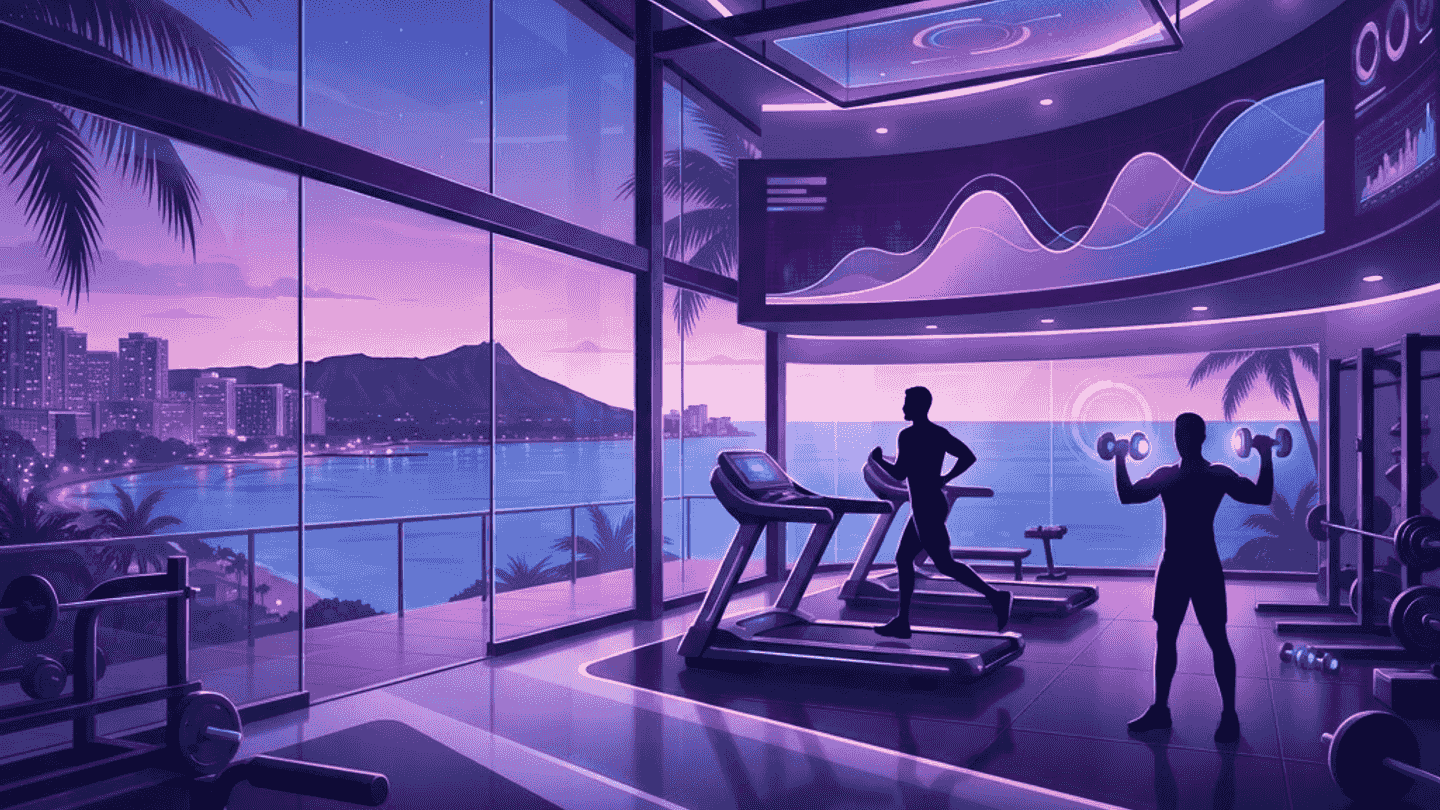
Why Honolulu Has Become a Fitness Destination
Few cities make movement feel as natural as Honolulu. With year-round warm weather, accessible shorelines, and a culture that treats outdoor activity as part of daily life, residents here tend to view training as maintenance for an active lifestyle rather than an obligation. That mindset has shaped the local fitness industry in a distinctive way. Gyms on Oahu are rarely just rooms full of equipment. They function as community hubs where surfers build shoulder resilience, hikers train for the Koolau ridgelines, paddlers develop rotational power, and office workers in downtown Honolulu decompress after long days.
The result is a market that rewards specialization. Honolulu supports large multi-purpose athletic clubs with pools and courts, lean strength-focused warehouses, group-training studios built around energy and accountability, and recovery-oriented facilities offering cold plunge, sauna, and mobility work. Understanding those categories is the fastest way to narrow your search.
How the Best Facilities Distinguish Themselves
Strong fitness centers in Honolulu tend to share several traits. First, they solve the island's space and parking constraints thoughtfully, whether through validated garage arrangements, walkable locations, or efficient floor layouts that avoid equipment bottlenecks during peak hours. Second, they invest in coaching quality rather than only equipment volume. Certified trainers who can screen movement, program progressive overload, and adjust for injury history deliver far more value than another row of machines.
Third, the leading clubs handle climate realistically. Ventilation, humidity control, and clean locker facilities matter enormously in a tropical setting, and members notice quickly when a gym neglects them. Finally, the best operators embrace flexible membership structures. Honolulu has a large population of military families, visiting professionals, and students, so short-term memberships, class packs, and no-contract options have become competitive differentiators rather than afterthoughts.
The Ten Fitness Centers Leading the Market
1. 24 Hour Fitness maintains several Honolulu locations and remains the default choice for members who value predictable access. Its appeal lies in breadth: extensive cardio decks, full free-weight areas, functional turf zones, group exercise studios, and in most locations a swimming pool. For members with irregular schedules, the extended hours and multi-club access are the decisive advantages.
2. Honolulu Club operates as a premium athletic and social club near Ala Moana, combining conditioning floors with racquetball, aquatics, group classes, and spa amenities. It attracts professionals and families who want fitness, recovery, and social connection under one roof, along with a quieter and more service-oriented atmosphere than high-volume chains.
3. UFC GYM brings a hybrid model to the island, layering mixed martial arts instruction, boxing, kickboxing, and Brazilian jiu-jitsu onto a conventional strength and conditioning base. It suits members who find traditional workouts monotonous and prefer skill acquisition alongside physical development, and its youth programs are notably popular with local families.
4. Egan Inoue Fitness carries the credibility of a founder with deep competitive roots in Hawaii sport. Programming here emphasizes small-group coaching, athletic performance, and accountability, with an especially strong reputation for helping beginners build sustainable habits rather than chasing short-term transformations.
5. CrossFit Oahu represents the island's established functional-fitness community. Coach-led classes follow a structured daily program blending Olympic lifting, gymnastics movements, and metabolic conditioning. The strongest asset is culture: consistent attendance is driven by the group dynamic as much as the training itself, which explains long member tenures.
6. Orangetheory Fitness applies heart-rate-based interval training to a fixed, coach-guided hour. Members who respond to measurable feedback appreciate the objective data on effort zones, and the predictable class format removes decision fatigue for busy professionals in the Kakaako and Kahala areas.
7. F45 Training delivers rotating circuit-based team workouts that change daily, mixing resistance and cardio stations in a high-energy environment. Its efficiency is the selling point, with complete sessions engineered to fit tight schedules while still covering strength, conditioning, and mobility.
8. Powerhouse Gym serves the serious lifting community with a deep inventory of barbells, plates, racks, and specialty machines. Members here prioritize equipment depth and an unpretentious training atmosphere over amenities, and the gym has cultivated a loyal bodybuilding and powerlifting following.
9. YMCA of Honolulu plays a role no commercial operator matches, offering affordable access, youth programming, aquatics, senior fitness, and family services across multiple branches. For households seeking value and community programming rather than boutique polish, it consistently ranks among the most practical options in the city.
10. Club Pilates anchors the low-impact and rehabilitative end of the market. Reformer-based sessions build core stability, postural control, and joint health, making it a frequent complement to heavier training and a preferred entry point for members recovering from injury or returning to exercise after a long absence.
Trends Shaping Honolulu Fitness
Several shifts are visible across the local industry. Recovery has moved from luxury to expectation, with contrast therapy, compression, and guided mobility appearing in facilities that once offered only equipment. Hybrid membership models that pair in-person classes with digital programming have also persisted, giving members continuity when travel or work disrupts routines.
There is growing demand for functional longevity training as well. Rather than aesthetic goals alone, more members in their forties, fifties, and sixties are pursuing strength, balance, and joint durability so they can keep hiking, paddling, and swimming for decades. Honolulu gyms have responded with small-group coaching, screening protocols, and progressive programming aimed at that population.
Choosing the Right Gym for Your Goals
Start with logistics, because proximity predicts attendance better than any amenity list. Then match format to temperament: self-directed lifters thrive in equipment-rich facilities, while members who need structure and accountability perform better in coached group settings. Ask about trainer certifications, class capacity at the hours you actually train, and trial options before committing.
Finally, evaluate whether the facility supports the life you want outside the gym. In Honolulu, that usually means training that improves your ocean, trail, and everyday performance. The best fitness center is not the one with the longest feature list but the one you will still be walking into a year from now.