
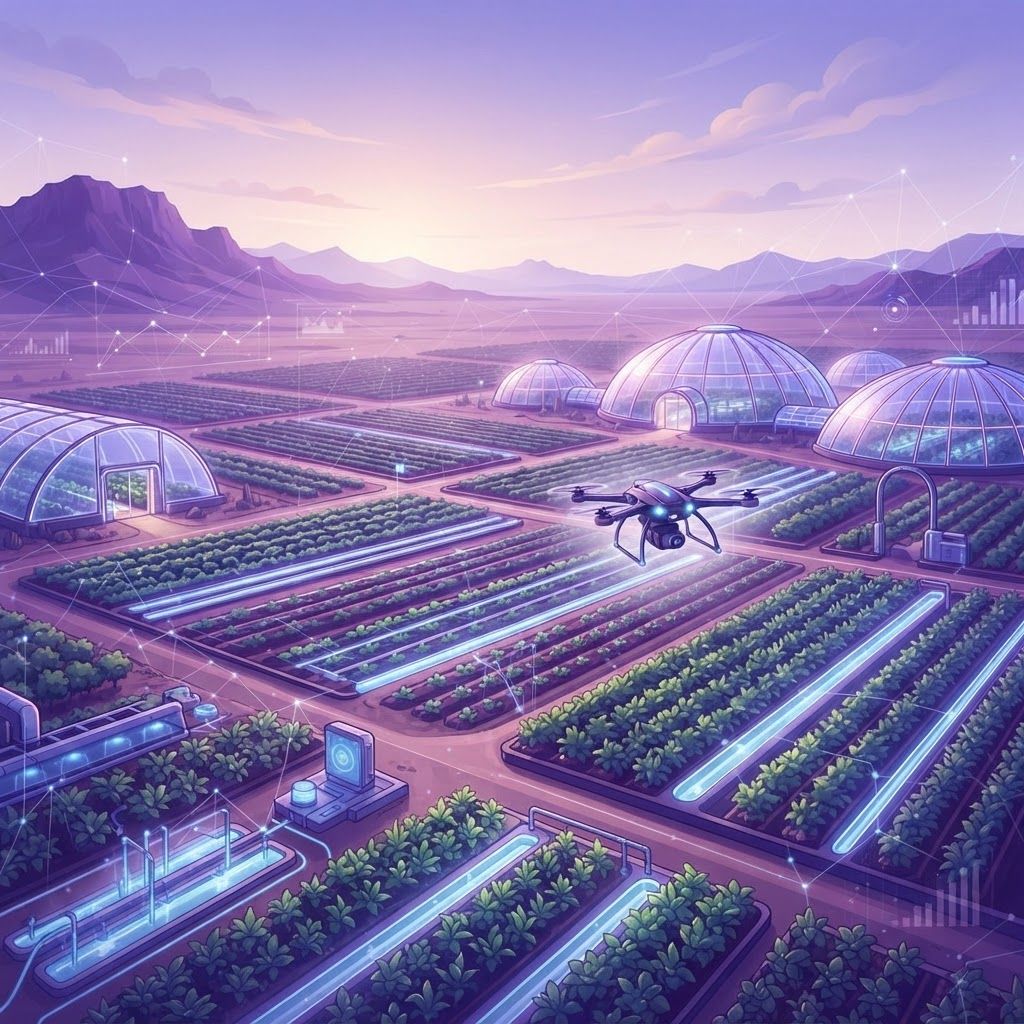
Farming in the Mojave Desert is an exercise in engineering discipline. Rainfall in the Las Vegas valley averages only a few inches annually, summer temperatures routinely exceed one hundred and ten degrees, soils are alkaline and low in organic matter, and water allocation is governed by one of the most closely watched agreements in the country. Despite all of that, agriculture around Sunrise Manor is not merely surviving but adapting, driven by controlled environment production, precision irrigation and a local food market willing to pay for freshness.
The Reality of Desert Agriculture
Traditional field farming at scale is difficult in southern Nevada, and the operations that thrive here have generally moved indoors or adopted intensive water saving methods. Greenhouse and vertical production systems can achieve dramatic reductions in water use per unit of output compared with open field growing, largely by capturing and recirculating water that would otherwise evaporate.
The advantages of the location partly offset the constraints. Solar radiation is abundant and consistent, which reduces supplemental lighting costs for greenhouse operations. Low humidity limits certain fungal disease pressures. Proximity to an enormous hospitality and restaurant market means produce can reach a customer within hours of harvest rather than days, a meaningful quality advantage for delicate crops.
The Top 10 Farming Companies Serving Sunrise Manor
1. Desert Bloom Farms
One of the more established growers in the eastern valley, Desert Bloom Farms operates greenhouse production focused on tomatoes, cucumbers and peppers using recirculating hydroponic systems. Its year round supply schedule makes it a dependable partner for restaurant buyers who need consistency.
2. Sunrise Valley Hydroponics
Specializing in leafy greens and culinary herbs, Sunrise Valley Hydroponics runs nutrient film and deep water culture systems that deliver rapid harvest cycles. Short transit times to local kitchens mean product arrives with shelf life that distant suppliers cannot match.
3. Manor Family Produce Company
A multigenerational operation combining outdoor plots with hoop house protection, Manor Family Produce Company grows seasonal vegetables and melons suited to desert conditions and sells through farmers markets and community supported agriculture subscriptions.
4. Silver State Vertical Farms
Operating a controlled environment facility with stacked growing systems and tuned lighting, Silver State Vertical Farms produces microgreens, salad mixes and specialty greens with minimal water use and no exposure to seasonal weather variation.
5. Mojave Date and Orchard Growers
Date palms are genuinely suited to this climate, and Mojave Date and Orchard Growers cultivates date varieties along with pomegranates and figs, crops with deep root systems and strong heat tolerance that require far less intervention than thirstier alternatives.
6. Eastside Urban Agriculture Collective
Working across a network of smaller urban parcels and rooftop sites, Eastside Urban Agriculture Collective grows vegetables for neighborhood distribution while running training programs that bring new growers into the sector.
7. Crescent Livestock and Poultry Ranch
Supplying eggs and pasture raised poultry to local buyers, Crescent Livestock and Poultry Ranch manages shade infrastructure, cooling systems and feeding schedules specifically adapted to extreme summer heat, an operational challenge that defeats less prepared producers.
8. Nevada Desert Herbs and Botanicals
Focusing on culinary and medicinal herbs suited to arid conditions, Nevada Desert Herbs and Botanicals supplies fresh and dried product to restaurants, tea blenders and personal care manufacturers, capturing value in a high margin niche.
9. Boulder Ridge Aquaponics Farm
Combining fish production with plant growing in a closed loop, Boulder Ridge Aquaponics Farm uses nutrient rich water from fish tanks to feed vegetable beds while plants filter the water in return, producing two revenue streams from one water allocation.
10. Aurora Regenerative Agriculture Group
Working on soil restoration in the desert environment, Aurora Regenerative Agriculture Group applies cover cropping, composting and reduced tillage to rebuild organic matter and water holding capacity in soils that historically hold very little of either.
Water Management as the Central Discipline
Every serious agricultural operation in this region treats water as its binding constraint. Drip irrigation with soil moisture sensing delivers water directly to root zones and avoids the enormous evaporative losses of overhead application. Greenhouse condensate recovery captures transpired moisture for reuse. Treated reclaimed water serves non food contact applications where regulations allow. Shade structures reduce plant water demand while protecting crops from heat stress.
The economics reinforce the environmental case. Water carries real cost and real regulatory scrutiny, so efficiency improvements pay back in both directions.
Markets and Distribution
Local producers sell through several channels. Direct restaurant supply commands premium pricing and rewards consistency and reliability above all. Farmers markets build brand recognition and customer relationships. Community supported agriculture programs provide predictable revenue and forward cash flow. Some growers supply specialty grocers who market local origin as a differentiator. The valley enormous hospitality sector represents the largest opportunity, though it demands volume consistency that small operations struggle to guarantee.
Technology and the Future of Local Growing
Sensor networks, automated climate control, predictive irrigation scheduling and integrated pest management have moved from experimental to standard among competitive growers. Solar generation pairs naturally with agriculture in this region, and agrivoltaic arrangements that place panels above crops can reduce heat stress while producing electricity. Controlled environment agriculture costs continue to fall as lighting efficiency improves.
Supporting Local Agriculture
For buyers, sourcing locally shortens supply chains, improves freshness and keeps money circulating in the regional economy. For anyone considering entering the sector, the lesson from successful operations here is consistent: start with water strategy, choose crops that suit the climate rather than fighting it, and secure committed buyers before scaling production. Desert farming rewards planning far more than optimism.