
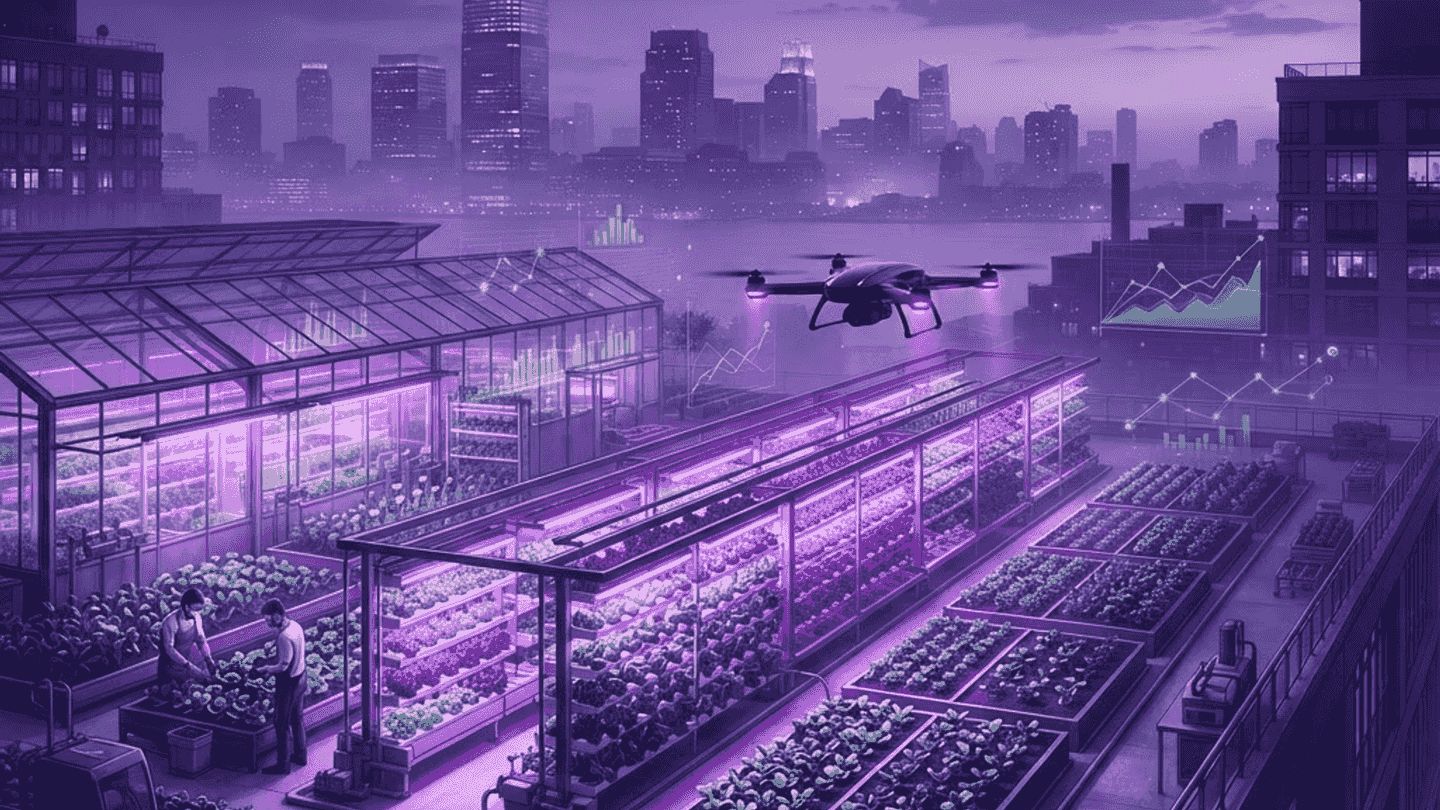
Urban Agriculture in a Dense City
Jersey City is one of the most densely populated cities in the United States, which makes it an unlikely farming location and, paradoxically, an ideal one. Land is scarce and expensive, so agriculture here has moved indoors and upward: warehouse-scale vertical farms under LED lighting, rooftop beds on industrial buildings, hydroponic container systems, community plots reclaimed from vacant lots, and school growing programs. What these operations share is proximity. A head of lettuce harvested in Jersey City can reach a restaurant in Manhattan or a grocery shelf in Hudson County within hours rather than days.
That proximity translates into measurable advantages: longer shelf life at the point of sale, dramatically lower transport emissions, and produce harvested at peak rather than picked early for shipping durability. The city has also actively encouraged urban agriculture through public programs that connect growers with residents, most visibly through free produce distribution initiatives that treat fresh food access as a public health measure rather than a retail transaction.
What Makes an Urban Farming Operation Successful
Controlled environment agriculture is as much an engineering discipline as a horticultural one. Yield per square foot, energy consumption per kilogram harvested, water recirculation efficiency, labor automation and crop selection all determine whether an operation is viable. Because energy is the dominant operating cost, the strongest growers invest heavily in lighting efficiency, climate control tuning and crop varieties bred for indoor conditions. Distribution strategy matters equally: farms selling directly to restaurants, subscription customers or institutional buyers typically capture more value than those competing on wholesale commodity terms.
The Top 10 Farming Companies and Operations in Jersey City
1. AeroFarms
Among the most recognized names in indoor agriculture, AeroFarms has been closely associated with Jersey City through a public partnership that placed aeroponic growing systems in community locations across the city, pairing food production with nutrition education and free distribution to residents. Its aeroponic approach mists roots with nutrient solution instead of submerging them, which reduces water use substantially compared with field growing while allowing tightly controlled crop cycles.
2. Hudson Vertical Greens
Hudson Vertical Greens operates warehouse-scale stacked growing systems focused on leafy greens, herbs and microgreens for restaurant and retail customers. The company emphasizes year-round consistency, contracting fixed weekly volumes with chefs who need predictable supply regardless of season, and its pesticide-free growing protocol appeals to buyers marketing clean-label produce.
3. Liberty Rooftop Farms
Making use of underutilized industrial roof space, Liberty Rooftop Farms grows tomatoes, peppers, cucumbers and salad crops in soil beds and greenhouse structures. Rooftop production offers natural light and stormwater retention benefits for host buildings, and the farm supplements income through community events, workshops and seasonal produce shares.
4. Garden State Hydroponics Co.
Garden State Hydroponics designs, installs and operates recirculating hydroponic systems, serving both as a grower and as a technology provider to restaurants, schools and building developers wanting on-site production. Its nutrient management and monitoring expertise helps clients avoid the common failure modes that sink first-time indoor growing projects.
5. Bergen Community Farm Collective
A neighborhood-based collective cultivating reclaimed lots, Bergen Community Farm Collective combines vegetable production with volunteer training and food distribution to nearby households. Its model prioritizes access and education over commercial scale, and it has become a practical entry point for residents learning to grow food in limited space.
6. Palisade Microgreens Co.
Palisade Microgreens focuses narrowly on high-value shoots and specialty herbs harvested within days of germination and delivered same-day to chefs. Short crop cycles allow rapid response to menu changes, and the company's cut-to-order approach delivers produce with a freshness window that distant suppliers cannot match.
7. Newport Container Farms
Newport Container Farms deploys insulated shipping containers fitted with climate control and LED lighting as modular growing units that can be sited on parking areas or vacant parcels. Modularity is the point: capacity can expand incrementally, and units can be relocated as land availability changes, which suits a city where development pressure is constant.
8. Harborside Mushroom Works
Cultivating oyster, shiitake and specialty mushrooms in humidity-controlled rooms, Harborside Mushroom Works supplies restaurants, farmers markets and specialty grocers. The operation uses agricultural byproducts as substrate and composts spent material, giving it one of the tighter circular loops among local growers.
9. Greenville Urban Growers Alliance
Greenville Urban Growers Alliance coordinates multiple small growing sites across the southern neighborhoods, aggregating harvests to reach volumes that individual plots could not supply. By pooling distribution and sharing equipment, participating growers gain access to institutional buyers and community food programs.
10. Exchange Place Aquaponics Lab
Combining fish cultivation with plant production, Exchange Place Aquaponics Lab runs closed-loop systems in which fish waste feeds plants and plants filter the water. The operation functions as both a producer and a demonstration facility, hosting school groups and researchers studying integrated urban food systems.
Trends Driving Urban Farming Forward
Energy efficiency dominates current innovation, since lighting and climate control determine whether indoor farms can compete on price. Improvements in LED spectrum tuning and heat recovery have narrowed that gap meaningfully. Automation is advancing as well, with seeding, transplanting and harvesting increasingly mechanized to control labor costs. On the demand side, retailers and restaurants are willing to pay for traceability and shelf life, which favors local growers. Finally, urban agriculture is increasingly framed as infrastructure, valued for stormwater management, heat island mitigation, workforce training and food access alongside crop output.
Working With Local Growers
Buyers should start with a small standing order and evaluate consistency across several weeks rather than judging a single delivery. Clarify harvest and delivery schedules, packaging formats and how substitutions are handled when a crop underperforms. Restaurants benefit from planning menus around what a grower can reliably produce rather than requesting items outside the system's strengths. For residents, community farms and distribution programs offer both fresh produce and hands-on growing knowledge that translates directly to balconies and small yards.
Final Thoughts
Farming in Jersey City demonstrates that agriculture can adapt to almost any environment when it is redesigned around local constraints. The operations profiled here range from technology-intensive vertical farms to volunteer-run community plots, and together they form a food network that is shorter, fresher and more accountable than conventional supply chains. As energy efficiency improves and automation matures, this sector is likely to become a permanent and expanding feature of the city's economy.