
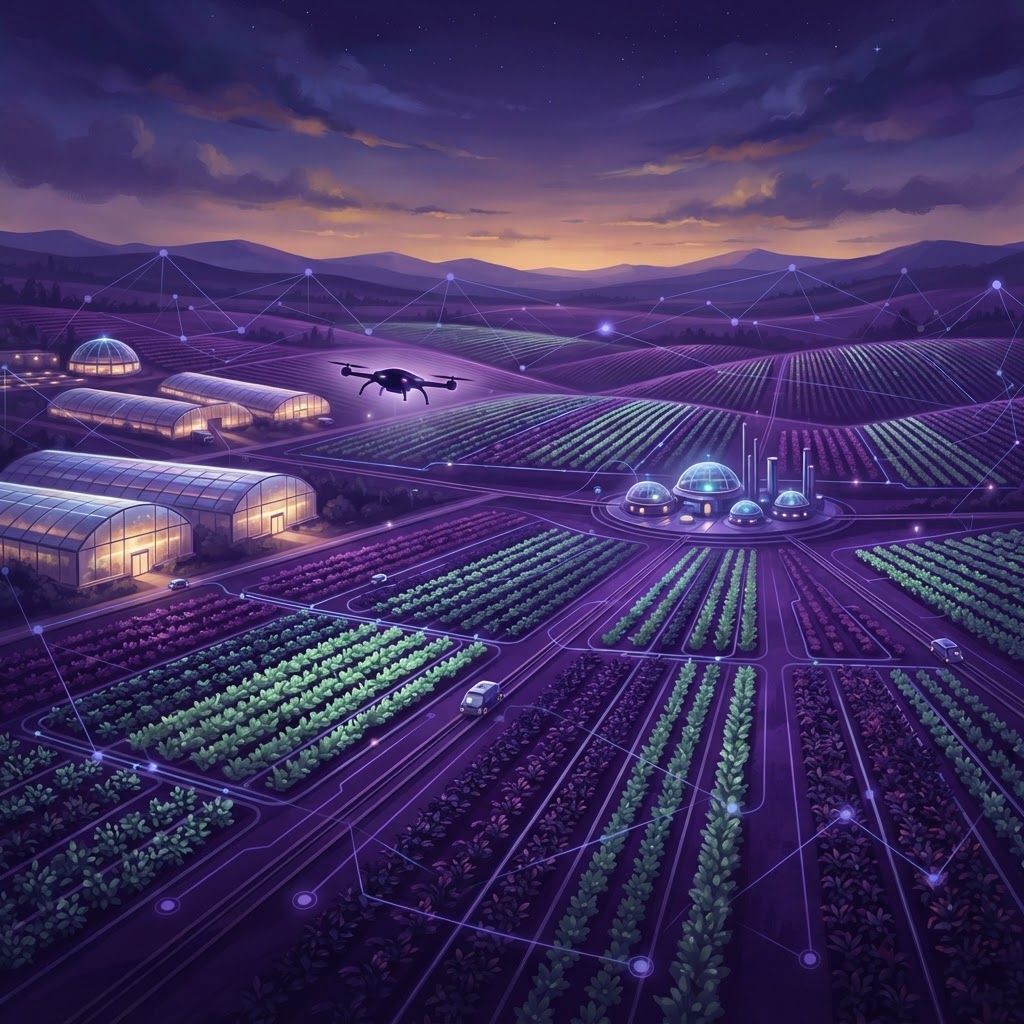
Agriculture in an Urban Setting
Glendale is not farmland in the traditional sense, and any honest discussion of farming here has to start there. The city is densely developed, land is expensive, and water is regulated. Yet agriculture persists and in some forms thrives, taking shapes adapted to urban constraints: nurseries producing ornamental and edible plants, controlled environment operations growing high-value greens, community and rooftop farms, specialty growers in the surrounding foothills, and educational farms teaching production skills.
What makes these operations viable is proximity to demand. Restaurants within minutes want produce harvested that morning. Landscape contractors need plant material without long hauls. Farmers market shoppers pay premiums for genuinely local food. When land is expensive, the answer is to grow things where freshness and transport savings justify the cost, and that is precisely what successful operations here do.
Forms of Urban and Peri-Urban Farming
Nursery production grows ornamental plants, trees, and edible starts for retail and landscape markets, and it is the largest agricultural activity in most Southern California urban areas. Controlled environment agriculture uses greenhouses or indoor systems with hydroponics or aeroponics to produce leafy greens, herbs, and microgreens year-round with dramatically reduced water use.
Specialty and small-plot farming grows high-value crops on limited acreage, often selling directly to restaurants. Community and educational farms combine production with training and food access programs. Beekeeping and pollinator operations produce honey and provide pollination services. Backyard and rooftop production, while individually small, aggregates to a meaningful contribution when supported by shared infrastructure.
The Top 10 Farming Companies in Glendale
1. Verdugo Hills Nursery & Growers — Produces drought-adapted ornamentals, natives, and fruit trees for retail and landscape markets. Its emphasis on regionally appropriate plants aligns with water conservation requirements shaping local landscaping.
2. Glendale Hydroponic Greens — Operates a controlled environment facility growing lettuces, herbs, and microgreens for restaurants and markets. Year-round production and same-day harvest delivery are advantages field growing cannot match.
3. Crescenta Valley Citrus Grove — Maintains established citrus plantings producing oranges, lemons, and specialty varieties. Foothill microclimates suit citrus well, and mature trees represent decades of accumulated productive capacity.
4. Adams Hill Urban Farm — Cultivates intensive vegetable beds on a small urban parcel, selling through a subscription box program and to nearby restaurants. High-density planting and succession sowing maximize yield per square foot.
5. Foothill Herb Company — Grows culinary and medicinal herbs in greenhouse and field production, supplying restaurants, apothecaries, and farmers markets with fresh and dried product.
6. Kenneth Road Microgreens — Produces microgreens and shoots on short cycles in a compact indoor facility. Rapid turnover and premium pricing make this one of the few genuinely profitable small-footprint crops.
7. Grandview Apiary — Manages honeybee colonies producing local honey and providing pollination services to regional growers, along with education on pollinator-supportive planting.
8. Glenoaks Community Farm — Combines vegetable production with education, volunteer programs, and food access initiatives, functioning as both a working farm and a community resource.
9. Chevy Chase Succulent Growers — Specializes in succulents and cacti for retail nurseries and landscape designers, a category that has grown substantially alongside water-conscious landscaping.
10. Brand Boulevard Rooftop Agriculture — Develops and operates rooftop growing systems on commercial buildings, producing food while providing building insulation and stormwater benefits.
Water: The Defining Constraint
No discussion of Southern California agriculture is complete without water. Supply is limited, pricing reflects scarcity, and regulatory restrictions tighten during drought periods. Every successful operation here manages water deliberately rather than incidentally.
Practical approaches include drip and micro-irrigation delivering water directly to root zones, soil moisture monitoring to irrigate based on actual need rather than schedule, mulching to reduce evaporation, and crop selection favoring drought-adapted species. Controlled environment agriculture goes further, recirculating nutrient solution and using a small fraction of the water field production requires for equivalent yield. Rainwater capture and, where permitted, greywater reuse supplement municipal supply.
The Economics of Urban Farming
Urban farming faces a brutal arithmetic problem: land cost per square foot is orders of magnitude higher than rural farmland, while commodity crop prices are set by rural production. Operations that succeed do so by refusing to compete on commodities.
Instead they concentrate on crops where freshness commands premiums, harvest-to-plate time is a genuine selling point, or the product is too delicate to ship. They sell directly, capturing retail rather than wholesale margins. They stack revenue streams, combining production with education, events, or consulting. And they often occupy land that would otherwise be unproductive, such as rooftops, utility easements, or parcels awaiting development.
Trends and Outlook
Controlled environment agriculture continues to advance as lighting efficiency improves and automation reduces labor requirements. Interest in local food remains strong, supporting direct-to-consumer and restaurant sales channels. Native and drought-adapted plant demand grows as water restrictions influence landscaping choices.
Policy has also become more supportive, with urban agriculture incentive programs and zoning accommodations in various California jurisdictions reducing barriers. Meanwhile, soil health practices, cover cropping, and reduced tillage have gained attention even at small scales, driven by evidence that they improve water retention and reduce input needs.
Final Thoughts
Farming around Glendale is a story of adaptation rather than scale. The operations that work grow high-value crops close to the people who eat them, manage water as their scarcest input, and diversify revenue beyond production alone. For residents, these farms and nurseries offer unusually fresh food and regionally appropriate plants. For anyone considering entering the field, the lesson is clear: in an urban setting, proximity and quality are the competitive advantages worth building on.