
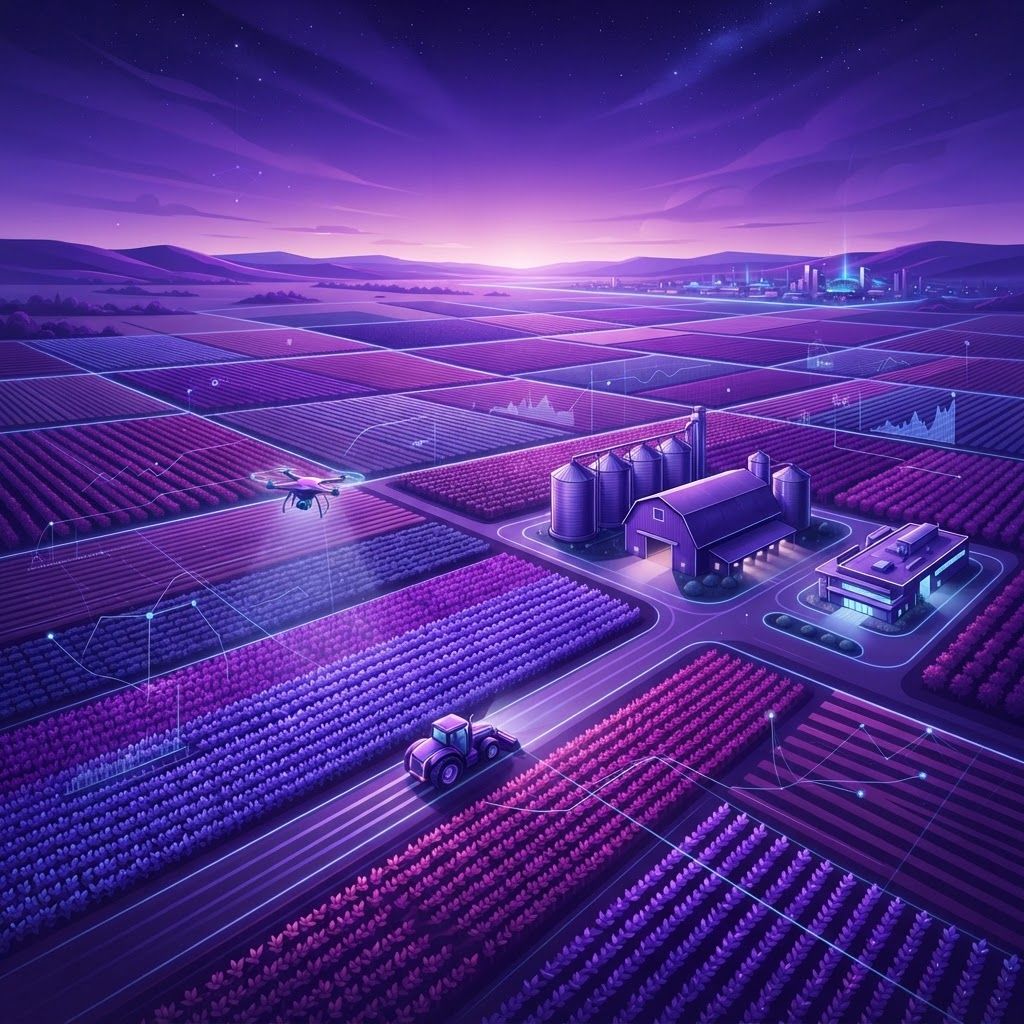
Des Moines as the Capital of American Agriculture
Few cities are as thoroughly defined by a single industry as Des Moines is by agriculture. Iowa leads the nation in corn, soybean, egg, and pork production, and the capital city functions as the commercial brain of that output. Crop insurance underwriting, agricultural lending, commodity trading, seed genetics, farm management, and agronomic research all cluster within a short drive of downtown. The result is an ecosystem where a farmer can secure financing, insure a crop, buy seed, hire an agronomist, and market grain without leaving the metro.
That concentration matters because modern farming is far more than fieldwork. A typical operation now manages satellite imagery, variable-rate prescriptions, futures contracts, sustainability documentation, and equipment telematics alongside planting and harvest. The companies below have grown by absorbing that complexity on behalf of growers.
What Distinguishes a Strong Farming Company
Evaluating agricultural companies requires looking past acreage. Agronomic depth is the first measure: does the company employ certified crop advisers and conduct its own field trials? Second is data capability, since precision agriculture is now inseparable from profitability. Third is financial stability, because growers depend on suppliers and buyers to honor commitments across multi-year cycles. Fourth is transparency around sustainability practices, which increasingly determines access to premium markets. Finally, the best companies invest in the next generation of farmers through training, land transition planning, and beginning-farmer programs.
1. Corteva Agriscience
With major operations in the Des Moines area, Corteva is one of the most significant pure-play agricultural science companies in the world. Its portfolio spans seed genetics, crop protection, and digital agronomy, and its research investment shapes what gets planted across millions of acres. For local growers, the practical value is access to advanced hybrids, regionally validated trial data, and agronomic support tied directly to the research pipeline. Corteva's presence also anchors a talent pool of plant scientists and data specialists that benefits the entire region.
2. Pioneer
Pioneer's roots in Iowa run deeper than almost any agricultural brand, and its Johnston operations remain central to global seed development. The company built its reputation on a dense network of local sales agronomists who live in the communities they serve, walk fields through the season, and place products based on soil type and disease pressure rather than catalog convenience. That field-level intimacy, combined with extensive yield trial infrastructure, is why Pioneer remains a benchmark for seed decision-making across the Corn Belt.
3. Farmers National Company
Farm management and land brokerage are quietly among the most consequential services in agriculture, because a large share of American farmland is owned by people who do not farm it. Farmers National Company specializes in professional farm management, land sales, auctions, and appraisal. Landowners rely on it to negotiate leases, oversee conservation practices, and maintain soil productivity across generations. For tenants, working with a professional manager often means clearer expectations and longer-term lease stability.
4. Peoples Company
Peoples Company has become one of the most respected land brokerage and farm management firms in the Midwest, known for data-driven valuation and a strong auction practice. Its analysts track soil productivity indices, tile drainage, and comparable sales with a rigor that has helped bring transparency to a historically opaque market. The firm also works extensively on land investment, appraisal, and energy and conservation easements, making it a useful partner for both operators expanding acreage and investors entering farmland.
5. Kent Nutrition Group
Animal agriculture is inseparable from Iowa's crop economy, and Kent has served livestock and poultry producers for generations with feed, nutrition programs, and technical support. Its research farms and nutritionists help producers optimize rations against volatile ingredient costs, which is often the single largest lever in livestock profitability. For diversified operations that both grow grain and raise animals, a nutrition partner that understands local feedstuffs is genuinely valuable.
6. Diamond V
Iowa's fermentation and animal health sector has produced companies focused on gut health and immune support products for livestock. Diamond V built its reputation on research-backed fermentation technology used in dairy, poultry, and swine production. Its relevance to farming companies lies in performance consistency and reduced reliance on inputs that face regulatory pressure, an increasingly important consideration for producers selling into export and premium channels.
7. Landus
As a farmer-owned cooperative, Landus occupies a different structural position than investor-owned suppliers. It provides grain marketing, agronomy, feed, and storage across a wide Iowa footprint, and its members share in the returns. Cooperatives matter because they concentrate bargaining power for individual growers and keep infrastructure such as elevators and fertilizer terminals in local hands. Landus has also invested notably in digital tools and soil health programs.
8. Key Cooperative
Key Cooperative serves central Iowa growers with grain handling, agronomy, energy, and feed services. Its strength is logistical: local elevators, application equipment, and delivery capacity that let farmers move product efficiently during compressed planting and harvest windows. In agriculture, service availability during a two-week weather window is worth more than a marginal price advantage, and well-run regional cooperatives compete precisely on that reliability.
9. Iowa Cold Storage and Grain Handling Operators
Post-harvest infrastructure companies in the metro provide drying, storage, blending, and rail loading capacity. These operations determine whether a grower can hold grain for better basis or must sell at harvest lows. Their investment in aeration, quality monitoring, and identity-preserved segregation also enables growers to serve specialty markets such as food-grade soybeans and non-GMO corn, which carry meaningful premiums.
10. Practical Farmers of Iowa Network Enterprises
Iowa's independent and diversified farming community has organized into a robust network of small enterprises focused on cover crops, small grains, pasture-raised livestock, and direct-to-consumer marketing. Collectively these operations represent a fast-growing segment. They demonstrate that profitability at smaller scale is achievable through soil health, reduced input dependence, and premium channels, and they have become an important source of practical research through on-farm trials.
Trends Reshaping Farming in Central Iowa
Several shifts are visible across every company above. Carbon and sustainability programs now attach real financial value to cover cropping and reduced tillage, creating new revenue lines and new documentation burdens. Autonomous and semi-autonomous equipment is moving from demonstration to deployment, driven partly by labor scarcity. Water quality regulation and nutrient management continue to influence practice adoption throughout the Des Moines River watershed. And land transition is accelerating as older owners retire, making succession planning and professional management more important than ever.
Choosing the Right Agricultural Partner
Growers get the most from these companies by matching them to specific gaps rather than buying broad relationships. A seed and agronomy partner should be judged on local trial performance and in-season field presence. A land management firm should be judged on lease outcomes and soil stewardship over a decade, not a single year. A cooperative should be judged on delivery capacity during peak windows. Des Moines offers enough depth that operators can assemble a genuinely specialized support team, and that ability to build a customized bench is the metro's real competitive advantage in agriculture.