
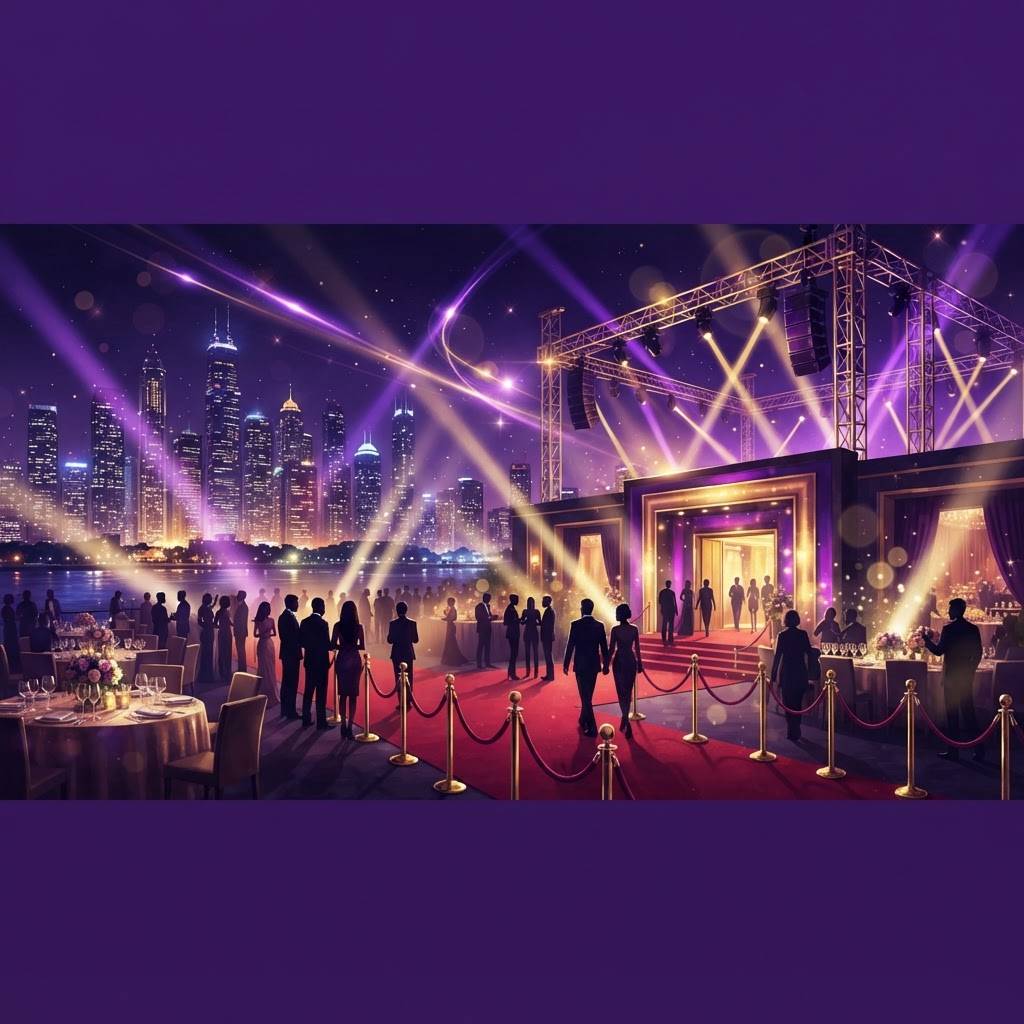
Event Production Where the Standard Is Exceptional
Few places hold events to a higher standard than Hollywood. Premieres, award ceremonies, brand launches, industry galas, and high-profile private celebrations all take place here, often with media coverage and significant reputational stakes. An event that runs smoothly is invisible; one that does not becomes a story.
That environment has produced an event management sector with unusual depth. Companies here routinely handle credentialing, security coordination, talent logistics, broadcast integration, and complex vendor orchestration alongside conventional planning work. The technical bar is simply higher than in most markets.
What Clients Should Evaluate
Relevant experience is the starting point, but specificity matters. A firm excellent at corporate conferences may not be right for a premiere with press management and talent handling. Ask for examples closely matching your event type, scale, and venue category.
Vendor relationships determine what is actually achievable. Established firms hold long-standing relationships with venues, caterers, AV providers, and staffing agencies, which translates into better availability, pricing, and reliability under pressure.
Contingency planning separates professionals from coordinators. Ask directly how the firm handles weather disruption, vendor failure, power loss, or a schedule collapse. A confident, specific answer indicates real experience; a vague reassurance does not.
Finally, evaluate financial transparency. Clear budgets distinguishing pass-through costs from management fees prevent the disputes that sour otherwise successful events.
Ten Event Management Companies Serving Hollywood
Sunset Event Productions handles large-scale premieres and industry events with full production capability including staging, lighting, and press management.
Hollywood Premiere Group specializes in film and television launch events, coordinating red carpet logistics, talent arrivals, and media access.
Vine Street Brand Activations focuses on experiential marketing, building immersive environments that translate brand concepts into physical experiences.
Highland Corporate Events serves conferences, summits, and internal corporate programs with strong registration and attendee management systems.
Cahuenga Wedding & Celebration Design produces private celebrations with design-led planning and discreet execution for high-profile clients.
Franklin Award Show Logistics concentrates on ceremony production including run-of-show management, seating, and broadcast coordination.
Argyle Nonprofit Gala Partners works with charitable organizations on fundraising events, balancing production quality against cost efficiency.
Studio Row Music Event Services handles concerts and showcase events with artist advancing, backline coordination, and venue management.
Cherokee Lane Private Client Events provides bespoke planning with an emphasis on confidentiality and personalized design.
Beachwood Festival Operations rounds out the list with multi-day outdoor event management including permitting, crowd flow, and vendor coordination.
Trends in Event Management
Hybrid and content-first design has persisted. Events are now planned with capture in mind from the outset, with sightlines, lighting, and moments designed so that footage and photography extend the event's reach far beyond attendance.
Sustainability has become a standard client requirement. Reusable staging, waste diversion, local sourcing, and reduced single-use materials appear in briefs regularly, and firms with established practices in this area have an advantage.
Safety and crowd management planning has intensified, with detailed emergency procedures, medical provisioning, and coordination with local authorities now expected rather than exceptional for events of any meaningful size.
Working Effectively With an Event Firm
Provide a clear objective rather than a list of preferences. A firm that understands whether the goal is press coverage, fundraising, relationship building, or brand impression will make better design decisions throughout.
Establish a realistic budget early and be honest about it. Experienced planners can achieve remarkable results within constraints they know about, but discovering limits late in the process forces compromises at the worst moment.
Designate a single decision-maker. Events involve hundreds of time-sensitive choices, and conflicting direction from multiple stakeholders is the most common cause of cost overruns and execution errors.
What Excellence Looks Like
The best event companies in Hollywood share a common trait: they absorb complexity so the client experiences calm. Behind a seamless evening sits a schedule accurate to the minute, redundant systems for every critical function, and a team that has already solved problems the client never learns about.
Choosing a partner on that basis, rather than on presentation polish alone, is the most reliable path to an event that achieves its purpose and reflects well on everyone involved.
Understanding Event Budgets
Event budgets are frequently misunderstood because a large share is pass-through cost rather than profit. Venue, catering, staffing, rentals, permits, insurance, and production labor typically consume most of the total, with the management fee representing a modest percentage.
Contingency is essential. Experienced planners build in a reserve of roughly ten to fifteen percent, because late changes are nearly universal. Clients who refuse contingency end up approving overages under time pressure anyway, usually at worse rates than if the work had been planned.
Measuring Whether an Event Succeeded
Defining success metrics before the event makes evaluation meaningful. Depending on purpose, relevant measures might include attendance by target segment, media impressions, funds raised, qualified leads generated, or content produced for later use.
Post-event review with the production team is equally valuable. Documenting what worked, what created friction, and what the vendor list should look like next time turns each event into institutional knowledge, steadily improving results for organizations that run events regularly rather than treating each one as a fresh start.