
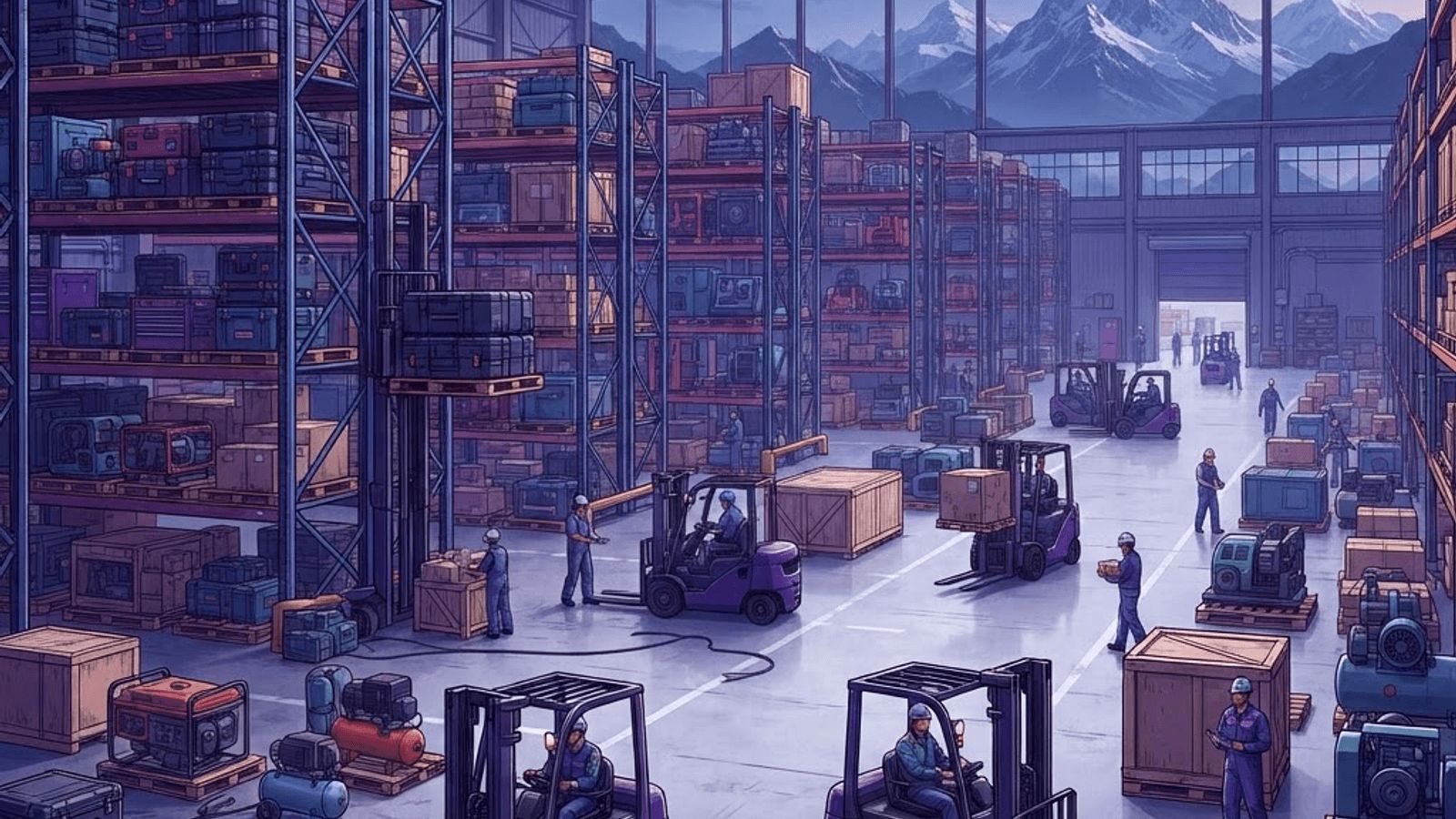
Equipment Supply at the Crossroads of the West
Salt Lake City has served as a staging point for western industry since the transcontinental rail era, and equipment distribution is one of the clearest expressions of that legacy. Mining operations in the Oquirrh Mountains, construction along a rapidly growing Wasatch Front, an enormous logistics build-out near the airport and inland port area, and a dense hospitality sector have collectively created demand for nearly every category of commercial and industrial equipment.
The result is a market where a buyer can source a telehandler, a walk-in cooler, a pallet racking system and a CNC machine tool without leaving the valley. That breadth is unusual for a metro of this size and is one of the practical reasons companies choose Salt Lake City as a regional operating base.
What Equipment Buyers Should Evaluate
Equipment purchasing differs fundamentally from consumable purchasing because the acquisition is only the beginning of the relationship. Total cost of ownership dominates, and it is driven by parts availability, technician coverage, uptime guarantees and eventual resale value far more than by the invoice price.
Buyers should therefore examine the supplier's service organization before examining the machine. How many field technicians serve the valley? What is the average response time? Are major components stocked locally or shipped from a distant hub? Is training included, and is it delivered on site? A distributor with a thin service bench can turn an excellent machine into an operational liability.
Financing structure is the second consideration. Rental, rent-to-own, lease and purchase each suit different situations, and the right structure depends on utilization rate, tax position and how quickly the technology in question is evolving. The third is fleet standardization, because operating a single brand across a fleet simplifies parts inventory, technician training and operator familiarity in ways that frequently outweigh a lower price on a one-off unit.
Ten Leading Equipment Wholesalers and Distributors in Salt Lake City
1. Arnold Machinery Company
Headquartered in Salt Lake City, Arnold Machinery has supplied the western United States for generations across material handling, construction and mining divisions. Its long-standing service commitment is the reason many Utah warehouses have run its forklifts for decades, and its multi-division structure lets a single customer relationship cover very different equipment needs.
2. Wheeler Machinery Company
A cornerstone of Utah heavy equipment, Wheeler supports construction, mining and power generation customers with sales, rental, parts and major component rebuild capability performed locally. For operations where downtime carries severe cost, in-region rebuild capacity is a decisive advantage.
3. Komatsu Equipment Company
With significant Salt Lake City operations, Komatsu Equipment serves earthmoving and mining customers throughout the Intermountain West. Its emphasis on machine telematics and remote fleet monitoring has helped regional contractors move from reactive repair toward scheduled maintenance.
4. Century Equipment and regional material handling specialists
Warehouse growth around the Salt Lake City International Airport corridor has driven strong demand for forklifts, reach trucks, order pickers and battery systems. Material handling specialists differentiate through fleet management programs that track utilization and maintenance across dozens or hundreds of units.
5. Intermountain Bobcat and compact equipment dealers
Compact track loaders, skid steers, mini excavators and attachments serve landscapers, utility contractors and small builders throughout the valley. Distributors in this category compete on rental fleet depth and attachment availability, since versatility is the entire value proposition of compact equipment.
6. Sunbelt Rentals and United Rentals Salt Lake City branches
National rental networks maintain substantial valley inventory covering aerial lifts, generators, compaction, climate control and trench safety. For contractors managing variable project loads, rental converts a capital problem into an operating expense and eliminates maintenance overhead entirely.
7. Restaurant and foodservice equipment distributors
Salt Lake City's hospitality sector supports distributors supplying commercial ranges, refrigeration, dishwashing systems, prep tables and smallwares. The best of them provide kitchen design services and coordinate with mechanical contractors, which prevents the costly rework that plagues poorly planned build-outs.
8. Industrial tool and machine tool distributors
Utah's precision manufacturing base requires CNC machining centers, lathes, tooling, metrology equipment and workholding. Distributors in this space differentiate through applications engineering, offering test cuts and process development rather than simply quoting a machine.
9. Welding and gas equipment suppliers
Fabrication shops across the valley depend on distributors supplying welding machines, consumables, industrial gases, plasma cutting systems and safety equipment. Reliable gas delivery schedules and cylinder management are often more important to customers than machine pricing.
10. Agricultural and turf equipment dealers
Serving farms in the surrounding counties as well as golf courses, municipalities and large property owners, these dealers supply tractors, mowers, implements and irrigation equipment. Seasonal service scheduling and parts availability during peak windows define their reputations.
Trends in Equipment Distribution
Telematics has changed the customer relationship permanently. Distributors now sell uptime data and predictive maintenance alongside iron, and customers increasingly expect utilization reporting as a standard service. Electrification is advancing steadily in material handling and compact equipment, driven by indoor air quality requirements and total cost of ownership rather than regulation alone.
Rental penetration continues to rise as contractors seek balance sheet flexibility, which has pushed traditional dealers to build substantial rental fleets of their own. Meanwhile, skilled technician shortages remain the industry's binding constraint, and the distributors investing seriously in apprenticeship programs are the ones maintaining service response times.
Choosing the Right Equipment Partner
Specify the application before shopping the machine. Distributors can only recommend well when they understand duty cycle, terrain, throughput targets and operator skill level. Request a demonstration under realistic conditions rather than on a paved dealer lot, and involve the operators who will run the equipment daily.
Negotiate the service agreement with the same rigor as the purchase price, including guaranteed response times and parts availability commitments. Ask for references from customers running comparable duty cycles, and verify resale values on the brand you are considering. In Salt Lake City's competitive equipment market, buyers who evaluate the whole ownership picture consistently outperform those who chase the lowest quote.