
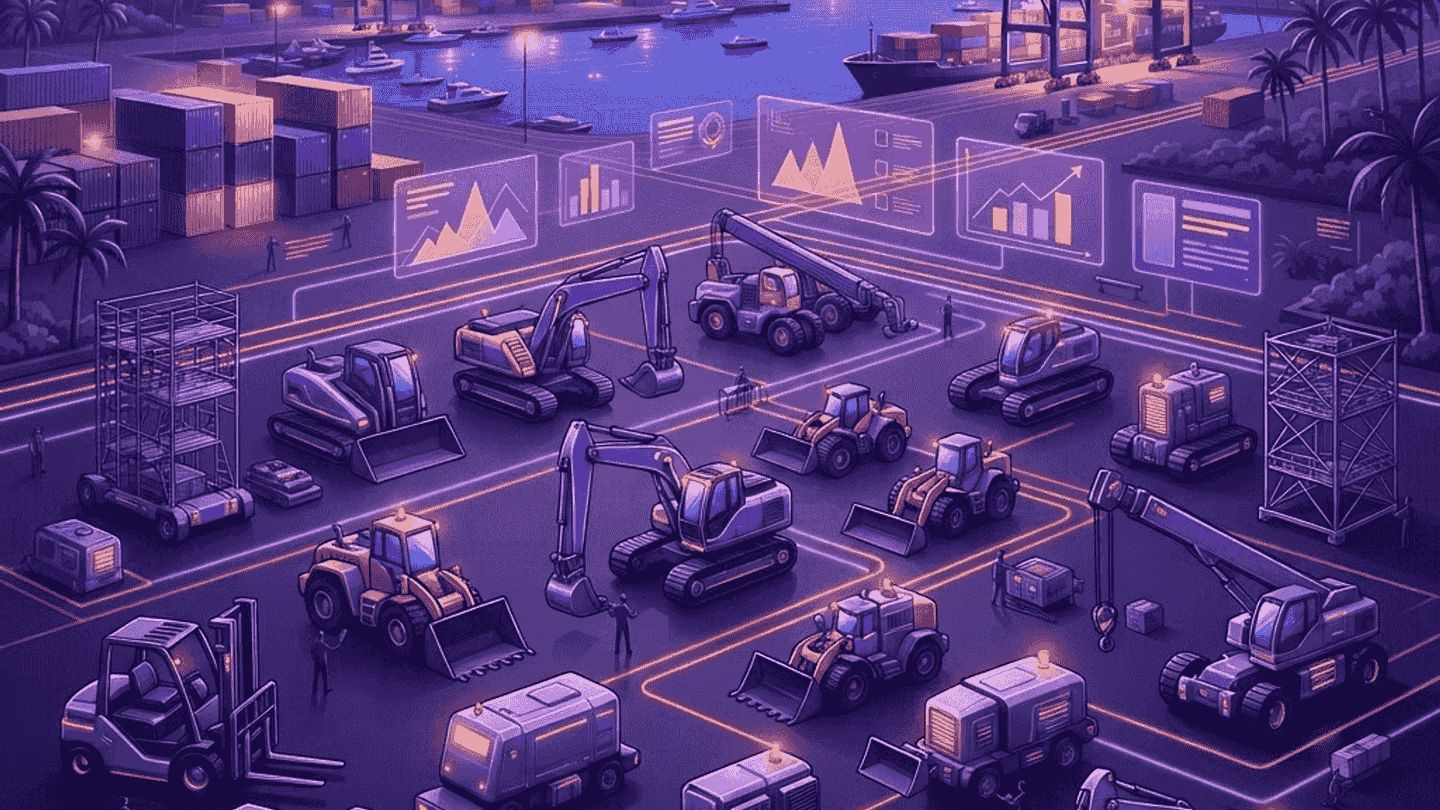
Equipment procurement in Honolulu is fundamentally a question about uptime. A generator, forklift, chiller, or excavator that fails on Oahu cannot be swapped from a nearby depot in a few hours. Parts may sit on a barge for a week or more, and specialized technicians are a finite local resource. As a result, the equipment wholesalers who dominate this market compete less on machine price and more on parts inventory, field service capacity, and training.
The Uptime Economics of an Island Market
Consider a mid-sized contractor whose only telehandler goes down during a concrete pour. The lost labor hours, schedule slippage, and potential penalty clauses typically exceed the price difference between suppliers by a wide margin. Sophisticated buyers in Honolulu therefore evaluate vendors using total cost of ownership: acquisition price, parts availability, mean time to repair, technician response time, resale value, and fuel or energy efficiency over the machine's life.
Hawaii's regulatory and environmental context adds further considerations. Emissions standards influence engine selection, noise limits matter in dense residential and resort areas, and corrosion protection is essential for equipment operating near the shoreline. Suppliers who specify marine-grade coatings, sealed electrical enclosures, and appropriate filtration extend service life considerably.
The 10 Best Equipment Wholesalers in Honolulu
1. Hawthorne Pacific
As the Caterpillar dealer for Hawaii, Hawthorne Pacific pairs heavy construction and power generation equipment with a substantial parts warehouse and field service organization. Contractors choose it primarily for support infrastructure: certified technicians, on-island component inventory, and rebuild programs that extend machine life. Power generation support is particularly relevant for hospitals, hotels, and data facilities requiring reliable standby capacity.
2. Bacon Universal Company
A long-established equipment dealer in Hawaii, Bacon Universal supplies excavators, loaders, compaction equipment, and attachments alongside rental options. Its combination of sales, rental, and service lets contractors flex capacity for project peaks without permanently expanding their fleet. Attachment availability is a meaningful advantage for specialty demolition and grading work.
3. Pacific Machinery
Pacific Machinery focuses on industrial and material handling equipment, including forklifts, aerial work platforms, and compressors. Warehouse operators, port-adjacent logistics firms, and manufacturers rely on scheduled preventive maintenance programs that reduce unplanned downtime. Operator certification training offered alongside equipment sales helps customers meet safety compliance obligations.
4. Airgas Hawaii
Airgas Hawaii supplies industrial gases, welding equipment, consumables, and safety products, categories that are consumed continuously rather than purchased once. Reliable cylinder exchange and local fill capability are critical for fabrication shops and marine repair operations. Bundling gas supply with welding machine service simplifies vendor management for smaller shops.
5. Hawaii Rents
Operating primarily as a rental house, Hawaii Rents also sells equipment and parts across construction, landscaping, and event categories. For contractors and property managers with intermittent needs, renting eliminates capital commitment and maintenance obligation. Its broad, general-purpose fleet makes it a practical first call for short-duration or unusual requirements.
6. Island Equipment Supply
Island Equipment Supply concentrates on light and mid-range equipment such as generators, pumps, compactors, saws, and pressure washers, serving contractors, facilities teams, and agricultural operations. Its differentiator is stocked parts depth on high-wear consumables, which keeps small machines working rather than sitting idle awaiting a filter or pump seal. Same-day counter availability is a recurring reason customers stay.
7. Pacific Foodservice Equipment
Serving Honolulu's large restaurant and hotel sector, this supplier handles commercial kitchen equipment: ranges, combi ovens, refrigeration, dishmachines, and ventilation. Kitchen refrigeration failure creates immediate inventory loss, so emergency service response is the core value proposition. Design and layout assistance also helps operators fit compliant equipment into constrained urban kitchen footprints.
8. Oahu Marine Equipment
This wholesaler focuses on marine propulsion, deck hardware, pumps, and electronics for commercial vessels, tour boats, and harbor operations. Saltwater service is unforgiving, and buyers need components rated for continuous immersion and spray exposure. On-island rebuild and repair capability meaningfully reduces vessel downtime compared with shipping units to the mainland.
9. Hawaii Medical Equipment Supply
Supplying clinics, care homes, and hospital departments, this distributor covers examination equipment, mobility devices, monitoring systems, and consumables. Regulatory compliance, calibration documentation, and preventive maintenance records are essential in this segment, and local service capability keeps devices in use. Reliable consumable supply is equally important given the consequences of a stockout in a clinical setting.
10. Kapolei Industrial Equipment
Located near Oahu's industrial corridor, this supplier serves manufacturing, warehousing, and utility clients with conveyors, hoists, pumps, and power transmission components. Engineering support for specifying replacement components on aging installations is a distinguishing service. Buyers dealing with legacy machinery value a partner who can cross-reference obsolete part numbers to current equivalents.
Trends in Equipment Distribution
Telematics has become standard on newer machines, giving fleet managers hour meters, fault codes, location data, and fuel consumption in real time. That data supports condition-based maintenance instead of fixed intervals, reducing both downtime and unnecessary service. Electrification is advancing fastest in material handling and small equipment, where battery power reduces emissions and noise in enclosed or residential settings. Rental penetration also continues to rise as contractors prioritize balance sheet flexibility over ownership.
How to Evaluate an Equipment Supplier
Ask three concrete questions. What is your average response time for a field service call in my area? What percentage of parts for this model are stocked on Oahu? How many certified technicians do you employ for this equipment line? Vague answers to these questions are a reliable warning sign.
Then verify training and documentation. Operator error causes a large share of equipment damage, and suppliers who provide hands-on training reduce your repair spend and safety exposure. Finally, discuss end-of-life value early. Machines with strong local resale demand and available service history retain value far better, which materially changes the true cost of the purchase over a five to seven year cycle.