
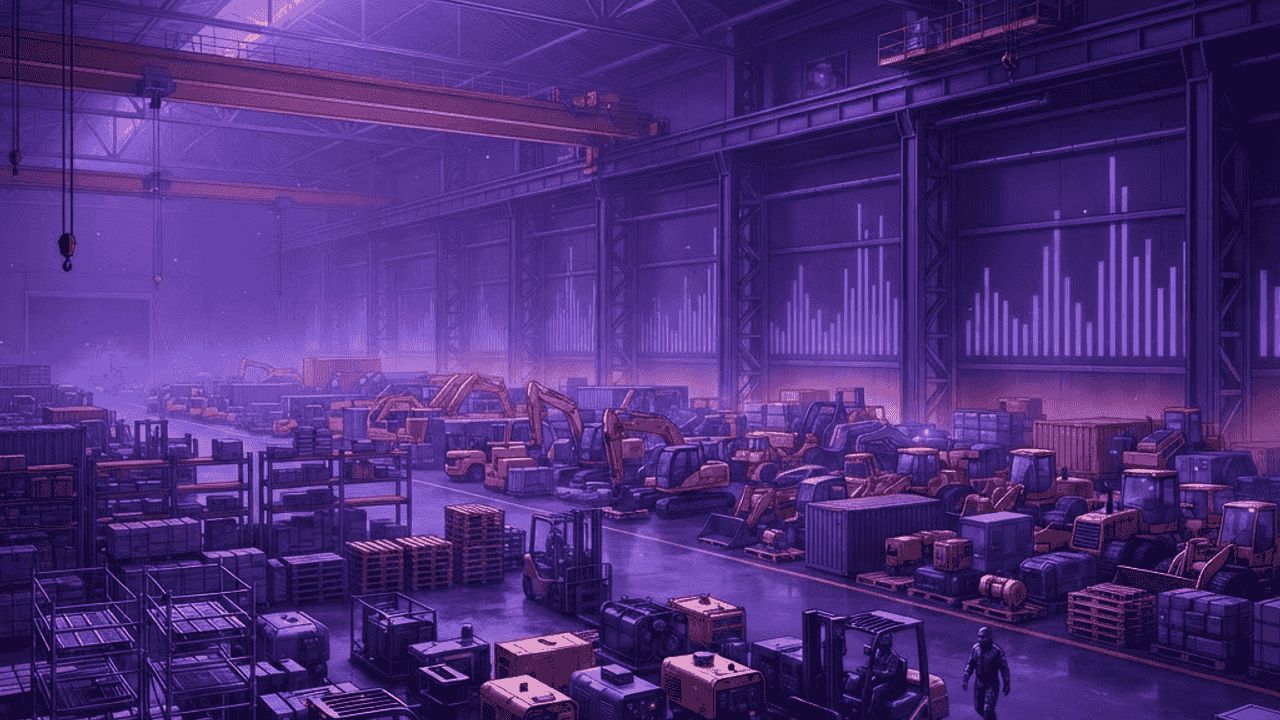
Equipment Supply as Regional Infrastructure
Equipment wholesalers rarely appear in conversations about a city's economy, yet they underpin nearly all of it. Construction crews, manufacturers, warehouses, landscapers, restaurants, and municipal departments all depend on machinery that must be purchased, maintained, and eventually replaced. In Greensboro, that demand is broad and steady, driven by industrial development, warehouse and distribution growth, active commercial construction, and a substantial institutional base of schools, hospitals, and universities.
The Triad's industrial character shapes the market. Advanced manufacturing, aviation related operations, logistics facilities, and agricultural activity in surrounding counties create demand for everything from precision measurement tools to forklifts and generators. Because customers here often run equipment hard, they value suppliers who can service what they sell.
What Separates a Good Equipment Wholesaler
Parts and service capability is the single most important differentiator. Equipment downtime is measured in lost production, so a supplier who stocks wear parts, employs trained technicians, and can dispatch field service is worth substantially more than one who only sells machines. Buyers should ask specifically about parts availability windows for the models they are considering.
Application expertise comes second. Selecting a compressor, hoist, or lift truck involves duty cycle, environment, power availability, and safety requirements. A supplier who asks about those conditions before quoting will recommend equipment that lasts. One who quotes purely from a model number often will not.
Flexibility in acquisition is the third factor. Purchase, lease, rental, and rent to own each suit different situations, and a wholesaler offering multiple paths helps customers match cash flow to need. Training and compliance support matter as well, particularly for powered industrial trucks, aerial platforms, and lifting equipment where operator certification is legally required.
The Top 10 Equipment Wholesalers in Greensboro
1. Gate City Industrial Equipment. A broad line supplier of material handling, workshop, and production equipment including hoists, conveyors, workbenches, and shop presses. Gate City's in house service department supports the machines it sells, which customers cite as the primary reason they return.
2. Piedmont Construction Equipment Wholesale. Distributing compact excavators, skid steers, compactors, generators, light towers, and attachments to contractors across the Triad. Piedmont's attachment inventory lets crews adapt existing machines instead of buying additional units.
3. Triad Material Handling Systems. Focused on forklifts, pallet jacks, racking, dock equipment, and warehouse automation components. Triad supports the region's distribution facilities with fleet management programs, operator training, and scheduled preventive maintenance.
4. Carolina Restaurant Equipment Supply. Supplying commercial ranges, refrigeration, dishwashing systems, ventilation, and smallwares to restaurants, schools, and institutional kitchens. Carolina Restaurant Equipment handles kitchen layout planning and code compliant installation coordination.
5. Battleground Power Systems. Specializing in generators, transfer switches, compressors, pumps, and pressure washers. Battleground serves both facility backup power projects and contractors, with load calculation support that prevents undersized installations.
6. Summit Machine Tool Distributors. Providing lathes, mills, saws, press brakes, tooling, and metrology equipment to the region's manufacturers and machine shops. Summit offers installation, alignment, and operator training, which shortens the ramp to productive use.
7. Guilford Landscape and Turf Equipment. Distributing commercial mowers, trimmers, blowers, aerators, and utility vehicles to landscapers, golf courses, and municipal grounds crews. Guilford's parts inventory and seasonal service scheduling keep crews working during peak months.
8. Revolution Aerial and Lifting Equipment. Handling scissor lifts, boom lifts, telehandlers, cranes, slings, and rigging hardware. Revolution pairs equipment with inspection services and operator certification training, addressing both safety and regulatory requirements.
9. Bessemer Used Equipment Exchange. Dealing in inspected pre owned industrial and construction machinery with documented condition reports. Bessemer helps growing businesses acquire capability at lower capital cost and provides a channel for surplus assets.
10. Cornwallis Tool and Fastener Wholesale. Supplying hand tools, power tools, anchors, fasteners, abrasives, and jobsite consumables. Cornwallis handles the high frequency small purchases that keep larger equipment productive.
Trends in Equipment Distribution
Telematics has become standard rather than premium. Modern equipment reports hours, fault codes, location, and fuel consumption, allowing suppliers to schedule maintenance before failures occur. Wholesalers who help customers actually use this data, rather than simply enabling it, deliver measurable uptime gains.
Electrification is advancing steadily in material handling, compact construction, and landscape equipment. Battery electric machines reduce emissions and noise, which matters for indoor work, urban jobsites, and municipalities with environmental commitments. Buyers now evaluate charging infrastructure alongside machine specification.
Rental and fleet flexibility continue to grow because equipment needs fluctuate with project pipelines. Many customers now maintain a small owned core fleet and rent for peaks, which shifts wholesalers toward hybrid sales and rental models.
Automation is the final trend, appearing in warehouse systems, robotic welding cells, and semi autonomous equipment functions. Adoption in Greensboro is pragmatic, driven largely by labor scarcity rather than novelty.
Buying Guidance
Calculate total cost of ownership rather than purchase price, including fuel or energy, maintenance intervals, parts cost, expected life, and residual value. Verify parts availability commitments in writing, especially for imported machines with limited regional support.
Ask about response time for field service and whether loaner equipment is available during major repairs. Confirm that operator training and required inspections are included or clearly priced. And when comparing used equipment, insist on documented inspection reports and hour verification rather than visual assessment alone.
Final Thoughts
Greensboro's equipment wholesalers cover industrial machinery, construction equipment, material handling, commercial kitchens, power systems, machine tools, turf equipment, aerial lifts, used machinery, and consumables. Choosing suppliers with genuine service depth, rather than the lowest initial quote, is consistently the decision that protects productivity over an equipment's full life.