
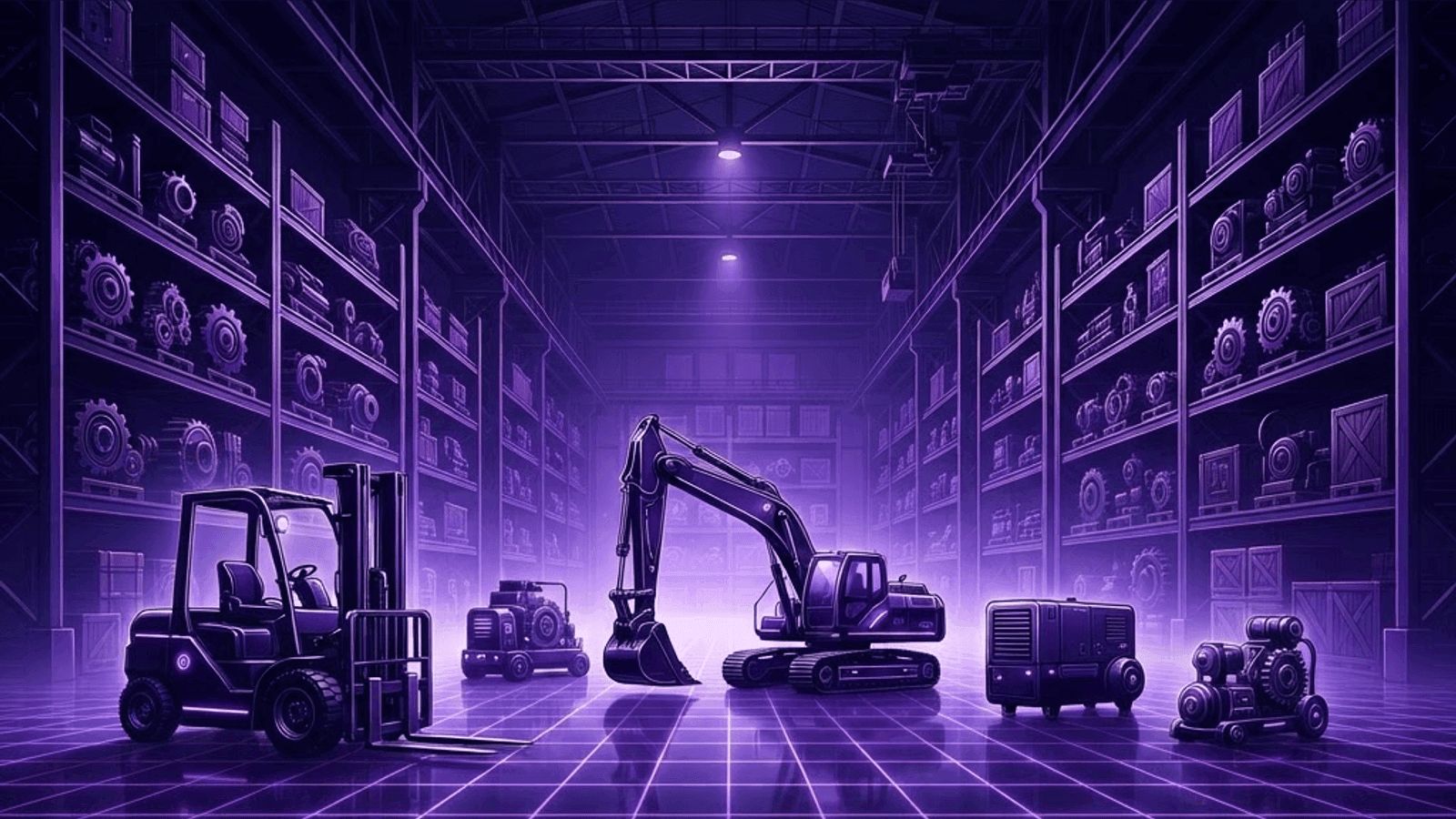
Equipment Distribution in Corona
Equipment wholesaling covers an enormous range, from forklifts and excavators to commercial kitchen appliances and shop tools. Corona supports a broad set of these distributors, driven by the industrial density of the Inland Empire and the constant construction activity across western Riverside County.
Unlike consumable goods, equipment purchases are capital decisions. Buyers evaluate total cost of ownership, parts availability, service response and residual value rather than purchase price alone. The strongest distributors in the market differentiate themselves through support after the sale, which is where equipment ownership succeeds or fails.
The Best Equipment Wholesalers in Corona
Corona Industrial Equipment Supply distributes material handling equipment including forklifts, pallet jacks, racking and dock equipment, serving the warehouse sector that defines much of the regional economy.
Inland Construction Equipment Distributors supplies compact excavators, skid steers, compaction equipment and attachments to contractors, with rental-to-purchase options that let buyers evaluate machines before committing.
Pacific Restaurant Equipment Wholesale provides commercial cooking equipment, refrigeration, prep tables and smallwares to restaurants and institutional kitchens, including kitchen layout planning support.
Temescal Shop Tools and Machinery wholesales metalworking and woodworking machinery, air compressors, welders and shop equipment to manufacturers, fabricators and maintenance departments.
Circle City Landscape Equipment distributes commercial mowers, trimmers, blowers and turf equipment to landscape contractors, backed by parts inventory and service capability that keeps crews productive.
Sierra Medical and Laboratory Equipment supplies examination, diagnostic and laboratory equipment to clinics and testing facilities, including installation and calibration services.
Vanguard Pumps and Fluid Handling provides pumps, valves, filtration and process equipment for water treatment, agriculture and industrial applications, with engineering assistance on system selection.
Foothill Air Compressor and Pneumatics focuses on compressed air systems, dryers, piping and pneumatic tools, an infrastructure category where correct sizing dramatically affects energy cost.
Meridian Cleaning and Facility Equipment wholesales floor scrubbers, sweepers, pressure washers and janitorial machinery to facility services companies and building operators.
Ridgeline Used and Refurbished Equipment rounds out the list by reconditioning and reselling equipment across categories, offering a practical path for buyers with capital constraints.
New, Used or Rented
The right acquisition strategy depends on utilisation. Equipment used daily generally justifies purchase, while equipment needed for occasional projects is usually cheaper to rent once maintenance, storage and insurance are counted. Used equipment can deliver excellent value, particularly for simple mechanical machines, but buyers should insist on inspection records, hour meters and, where possible, a third-party evaluation.
Refurbished equipment from a reputable distributor often includes a limited warranty, which substantially reduces risk compared with private sales. Ask specifically what was replaced during reconditioning rather than accepting a general assurance.
Service, Parts and Downtime
The most important question in equipment purchasing is rarely asked early enough: what happens when it breaks? Response time, technician availability, parts stocking levels and loaner equipment policies determine the real cost of ownership. A machine priced slightly higher from a distributor with local service capability will usually outperform a cheaper purchase that requires waiting weeks for parts.
Preventive maintenance agreements deserve consideration. They stabilise costs, extend equipment life and create documented service histories that improve resale value.
Financing and Tax Considerations
Most equipment distributors offer financing or leasing through partner lenders. Leasing preserves capital and simplifies upgrades, while purchasing builds equity and may offer tax advantages through accelerated depreciation provisions. Businesses should discuss options with their accountant before committing, since the correct structure depends on cash position, tax situation and expected equipment life.
Trends in Equipment Distribution
Electrification is advancing quickly in material handling and compact construction equipment, driven partly by emissions regulations and partly by lower operating cost. Telematics has become standard on larger machines, providing utilisation data that helps owners rightsize fleets. Automation continues to spread into warehousing, with autonomous mobile robots moving from pilot deployments into practical use. Finally, supply chain improvements have shortened lead times that had stretched considerably in recent years.
Right-Sizing Equipment to the Job
Buyers frequently purchase more capacity than they need, reasoning that headroom is safer. In practice, oversized equipment costs more to purchase, operate and maintain while often being harder to manoeuvre in the confined spaces typical of Inland Empire warehouses and urban jobsites. Undersized equipment, meanwhile, wears prematurely from operating continuously at maximum capacity.
The correct approach is to analyse actual duty cycles. How many hours per day will the machine run, at what load, in what environment? Distributors with experienced application specialists can translate that information into a specification, and many will arrange a trial or short-term rental so a buyer can validate the choice before committing capital.
Operator Training and Safety Compliance
Equipment safety is a regulatory matter as much as a practical one. Powered industrial truck operators require documented training and evaluation, and requirements extend to aerial lifts, cranes and various construction machines. Employers bear responsibility for certification, and inspections routinely examine records.
Many distributors offer training as part of an equipment package or as a standalone service. Beyond compliance, trained operators damage equipment less, work more productively and identify developing problems earlier. Given that operator error causes a substantial share of equipment repair costs, training is one of the highest return investments available to an equipment owner.
Final Thoughts
Equipment wholesalers in Corona serve nearly every industrial and commercial sector in the region. By evaluating utilisation honestly, weighing new against used and rental options, and prioritising service capability over purchase price, buyers can acquire equipment that supports productivity rather than creating unplanned downtime and expense.