
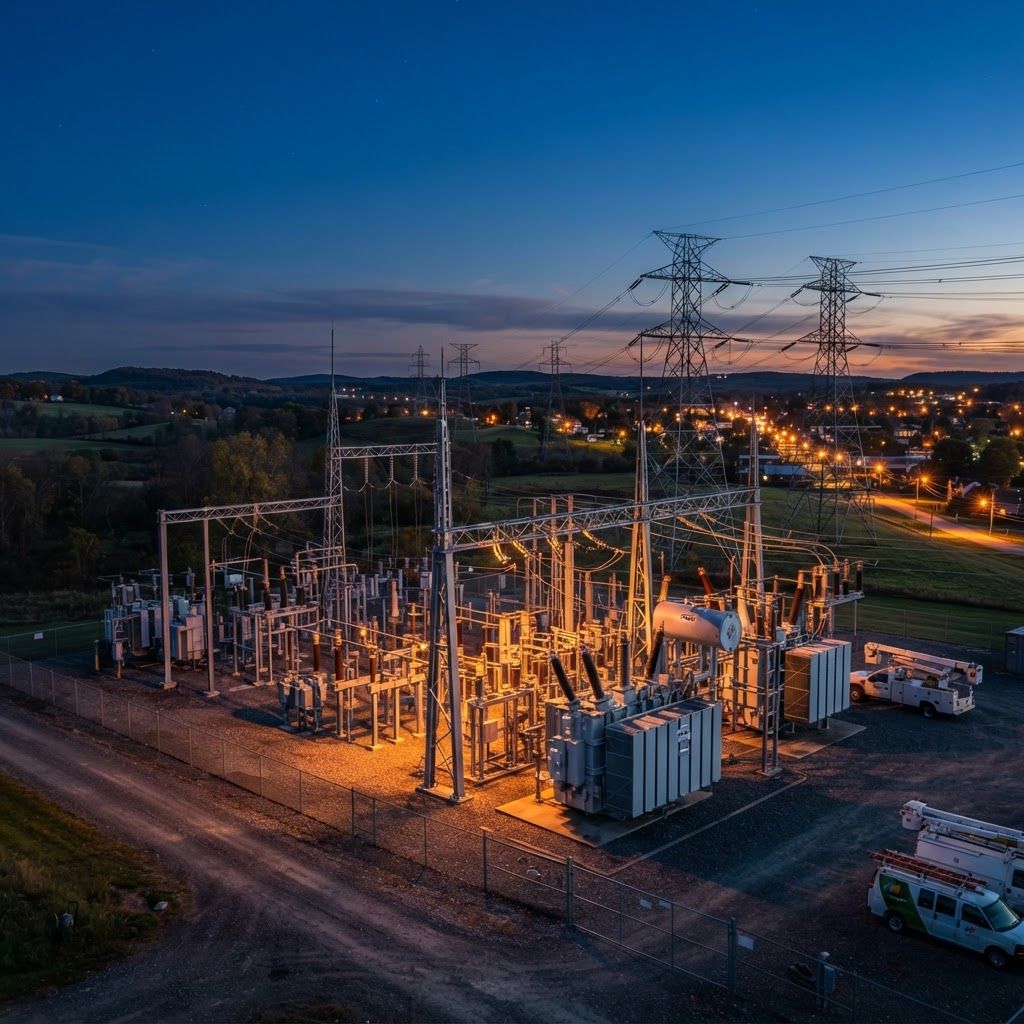
Understanding How Energy Supply Works in New York
Before evaluating suppliers, it helps to understand the structure of the market. In New York, electricity and natural gas bills separate into two components: delivery and supply. Delivery is handled by the regulated utility that owns the wires and pipes serving your address, and that portion is set by the Public Service Commission regardless of who supplies your energy. Supply is the commodity itself, and this is the part customers can choose.
Customers who make no choice receive default supply from their utility at a regulated pass-through rate that changes monthly with wholesale market conditions. Customers who choose an energy service company, commonly called an ESCO, purchase supply from a competitive provider that may offer fixed rates, variable rates, renewable content or bundled services. Both paths use the same wires, and reliability is identical because the utility handles all distribution and emergency response.
This distinction matters because most consumer confusion and most complaints in the retail energy market stem from misunderstanding it. A supplier cannot restore your power faster and cannot disconnect your service; they sell the commodity only.
The Buffalo Market Specifically
Western New York has an unusual advantage: the Niagara hydroelectric complex provides large volumes of low-cost, zero-emission generation, and default utility supply rates in the region have historically been among the more favorable in the state. That means the value proposition for switching suppliers is often narrower here than in high-cost downstate markets, and customers should be correspondingly more skeptical of aggressive savings claims.
Where competitive supply does deliver genuine value in Buffalo is in three scenarios: businesses seeking price certainty for budgeting, large users able to negotiate structured products tied to wholesale indices, and customers specifically seeking verified renewable supply beyond the default grid mix.
Ten Energy Suppliers and Providers
1. National Grid is the regulated electricity and natural gas delivery utility for much of Upstate New York, including large portions of the Buffalo area. Beyond delivery, it administers default supply service and a substantial portfolio of efficiency incentive programs for residential and commercial customers.
2. National Fuel Gas Distribution is the regulated natural gas utility for Buffalo and surrounding communities, headquartered locally. It provides delivery service, default gas supply and customer programs including budget billing and efficiency rebates, and its local headquarters presence generally translates into strong regional service responsiveness.
3. New York Power Authority supplies hydroelectric power under allocation programs to qualifying businesses, municipalities and institutions in Western New York. For eligible large users, these allocations represent some of the most attractive power costs available anywhere in the state and are tied to employment and investment commitments.
4. Constellation Energy is one of the largest competitive retail suppliers nationally and serves commercial and industrial customers in New York with fixed-price, index and structured products, along with renewable energy certificates and sustainability reporting support.
5. Direct Energy Business offers electricity and natural gas supply to commercial customers with a range of contract structures and consolidated billing options for multi-site operations, which is useful for regional businesses with locations across several utility territories.
6. Agera Energy successors and mid-market ESCOs compete for small commercial accounts in Western New York, typically differentiating on contract flexibility and broker relationships rather than price alone. Small business buyers should scrutinize renewal terms carefully in this segment.
7. Green Mountain Energy markets renewable-content electricity supply and appeals to residential and small business customers prioritizing verified clean attributes. Because Buffalo's grid is already substantially hydroelectric, buyers should ask precisely what additional environmental benefit a renewable product delivers.
8. Ambit Energy and similar network-marketing suppliers operate in New York through independent consultant sales models. These products can be competitive but the sales channel makes disclosure quality uneven, so reading the actual contract rather than relying on a representative's summary is essential.
9. Energy brokers and consultants based in Buffalo represent an important part of the market for commercial buyers, running competitive solicitations across multiple suppliers and negotiating terms. A good broker is compensated transparently and discloses supplier commissions; the ones who will not disclose should be avoided.
10. Community choice aggregation programs in Western New York municipalities allow local governments to procure supply on behalf of residents, using collective bargaining power to obtain fixed rates or renewable content. Participation is typically opt-out, and these programs have delivered meaningful savings in some communities.
How to Read an Energy Contract
Focus on five terms. The rate itself, expressed in cents per kilowatt-hour or dollars per therm or dekatherm, and whether it is fixed or variable. The term length and exact end date. The renewal provision, which is where most consumer harm occurs, since many contracts roll into a month-to-month variable rate that can be substantially above market. Early termination fees. And any monthly administrative charge, which effectively raises the rate for low-usage customers.
Variable rate products deserve particular caution. A low introductory rate followed by an unconstrained variable rate has been the source of most retail energy complaints in New York, and the state has tightened rules on ESCO marketing to residential customers as a result. If a rate can change at the supplier's discretion, treat the introductory number as marketing rather than pricing.
Reducing Cost Beyond Switching Suppliers
For most Buffalo households, efficiency delivers more savings than supplier shopping. Air sealing and attic insulation address the region's dominant cost driver, which is winter heating load in older housing stock. Utility-administered programs offer substantial rebates and, for income-qualified households, no-cost weatherization.
Commercial customers should examine demand charges, which are based on peak fifteen-minute usage rather than total consumption and often represent a large share of the electric bill. Load shifting, controls upgrades and battery storage can reduce demand charges without reducing production. Rate class review is also worthwhile; businesses frequently remain on a tariff that no longer matches their load profile.
Practical Recommendation
Start by reading your current bill carefully and identifying who supplies you and at what rate. Compare against the utility default rate over the past twelve months rather than the current month, since single-month comparisons are misleading. If you switch, prefer fixed-rate products with clearly stated renewal terms and calendar your end date. For commercial accounts, run a competitive process with a transparent broker rather than accepting an inbound offer. In a market as fundamentally well-supplied as Western New York, disciplined buying beats aggressive shopping.