
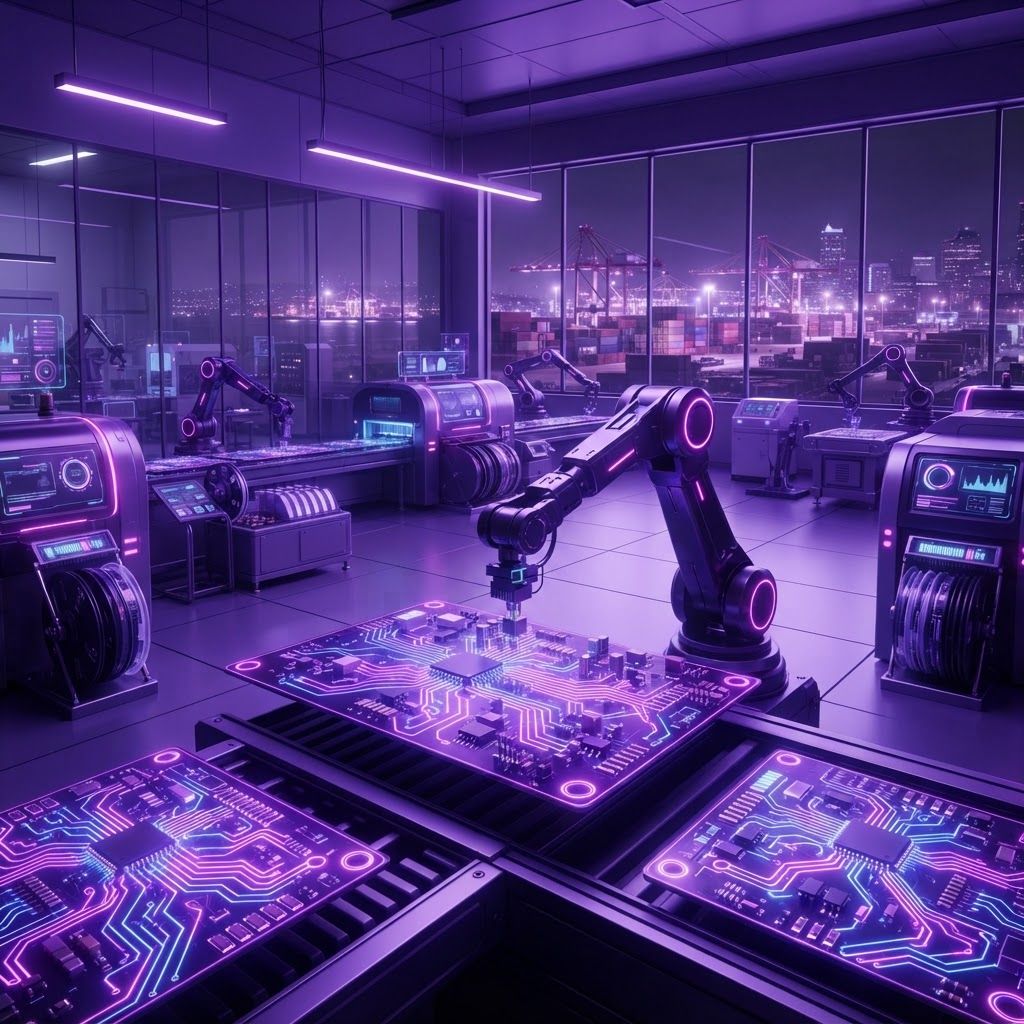
A Quiet but Capable Electronics Base
Electronics manufacturing in Tacoma rarely makes headlines, yet it supports industries that do. The region's contract manufacturers and specialty electronics firms build assemblies for marine navigation and vessel systems, aerospace suppliers, medical devices, industrial automation, environmental instrumentation, transportation and rail equipment, and defense programs. Much of this work is low-to-medium volume and high-complexity, precisely the category that benefits from proximity, engineering support, and rigorous documentation rather than the lowest possible unit price.
Several factors sustain the sector. Puget Sound's aerospace and maritime industries create steady demand for ruggedized electronics that survive vibration, salt exposure, and temperature extremes. Regional engineering talent supports design work alongside production. And the Port of Tacoma simplifies inbound component logistics and outbound shipping. Together these conditions favor manufacturers who can handle mixed technology assemblies, tight revision control, and demanding inspection standards.
Capabilities That Define the Market
Electronics manufacturing is not a single service. Printed circuit board assembly includes surface-mount and through-hole placement, reflow and wave soldering, and increasingly fine-pitch and ball-grid-array components requiring X-ray inspection. Cable and wire harness fabrication covers crimping, overmolding, shielding, and connector termination, often to aerospace or marine specifications. Box build and systems integration combines boards, harnesses, power supplies, and enclosures into finished units with functional testing. Design and engineering services span schematic capture, layout, signal integrity analysis, firmware, and design for manufacturability review. Test engineering develops fixtures, in-circuit test, functional test, and burn-in procedures. Repair, rework, and lifecycle support keeps long-lived industrial and marine equipment operating after original components go obsolete.
Ten Electronics Manufacturing Profiles Serving Tacoma
1. Commencement Circuit Assembly. A contract manufacturer focused on low-to-mid volume surface-mount assembly with automated optical inspection and thorough process documentation.
2. Rainier Cable and Harness. Builds wire harnesses, control cables, and custom interconnects to aerospace and marine workmanship standards.
3. Tideflats Marine Electronics Works. Produces and services ruggedized navigation, monitoring, and vessel control assemblies designed for salt and vibration environments.
4. Puget Industrial Controls. Manufactures control panels, programmable logic controller cabinets, and automation assemblies for manufacturing and water treatment facilities.
5. Harborline Electronic Systems. Provides full box build integration, functional testing, environmental screening, and configuration management for instrumentation customers.
6. Northwest Precision Electronics. Specializes in high-reliability assemblies requiring traceability, conformal coating, and documented process controls for medical and defense applications.
7. Foss Design Engineering. Offers circuit design, printed circuit board layout, firmware development, and prototype builds that transition into local production.
8. South Sound Test Solutions. Develops test fixtures, automated test software, and validation procedures for manufacturers scaling new products.
9. Stadium Electronics Repair Center. Handles component-level repair, obsolescence management, and refurbishment of legacy industrial and marine equipment.
10. Pierce Power Electronics. Builds power conversion assemblies, battery management systems, and charging electronics for electrification projects.
How to Select a Contract Manufacturer
Start by matching volume and complexity. A shop optimized for high-volume consumer runs will find a two-hundred-unit instrumentation build unattractive, while a high-mix shop may not price competitively at scale. Be explicit about annual volumes, expected revisions, and product lifespan.
Next, examine quality certifications and workmanship standards. Ask which soldering workmanship standard the shop builds to, whether operators hold current certification, and how inspection is performed and recorded. For regulated products, verify the relevant quality management system and audit history. Request a sample of the documentation package that accompanies delivered product, since traceability quality is often the clearest indicator of process discipline.
Investigate supply chain management seriously. Component availability has been the defining challenge of recent years, and capable manufacturers maintain approved vendor lists, monitor lifecycle status, flag obsolescence early, and propose validated alternates. Ask how they handle counterfeit risk, including sourcing policy and incoming inspection, because gray-market parts have caused expensive failures across the industry.
Finally, evaluate engineering collaboration. The best partners perform design for manufacturability review before quoting, suggesting changes that reduce cost and improve yield. A manufacturer who simply builds to print without comment is leaving value on the table.
Cost Drivers Buyers Often Overlook
Unit price is only part of the equation. Setup and stencil costs, minimum buy quantities on components, panelization efficiency, test fixture development, conformal coating, and rework labor all influence total cost. Design choices matter enormously: standardizing on fewer unique components, avoiding hand-placed parts, allowing adequate spacing for automated inspection, and designing test points into the board can reduce assembly cost significantly. Experienced local manufacturers will explain these tradeoffs during quoting rather than absorbing them silently.
Trends Reshaping Regional Electronics
Three developments stand out. Electrification is expanding demand for power electronics, battery management, and charging systems, a category where Tacoma has growing capability tied to port and fleet projects. Supply chain regionalization has increased interest in domestic assembly for products where lead time certainty outweighs unit cost. And automation within the shops themselves, including automated optical inspection, X-ray, and data-driven process control, is improving quality at volumes that were previously uneconomic to inspect thoroughly.
Final Thoughts
Tacoma's electronics manufacturers earn business through engineering partnership, documentation rigor, and the ability to build difficult products reliably in modest quantities. For companies developing instrumentation, marine systems, industrial controls, or electrification hardware, that combination is worth more than a marginally lower quote from a distant supplier. Choose the partner who asks hard questions about your design before accepting the order, and the production phase will be far less eventful.