
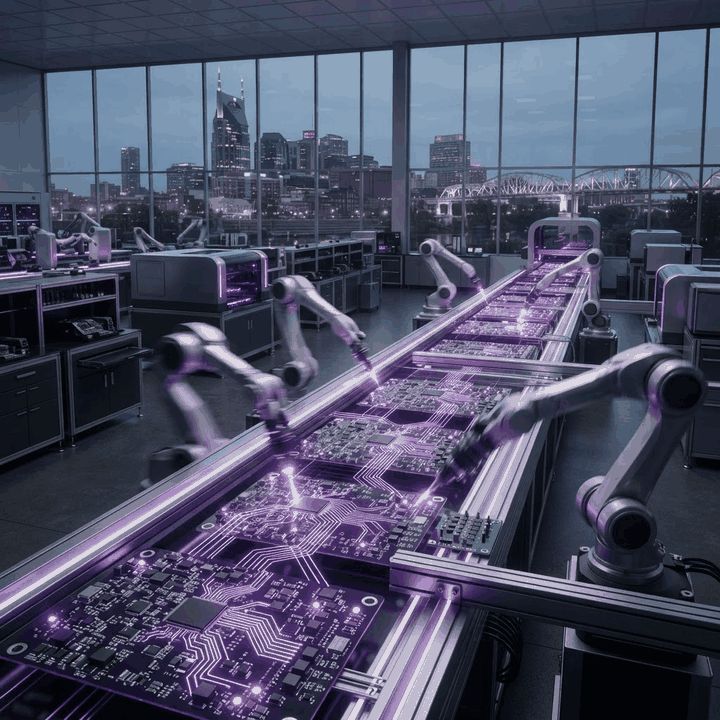
Nashville's Electronics Manufacturing Opportunity
Nashville's growth in automotive production, healthcare technology, logistics, and industrial automation creates steady demand for electronic assemblies and components. The region's manufacturers range from contract electronics specialists to global component companies with Tennessee operations. Buyers may need printed circuit board assembly, cable harnesses, controls, sensors, power electronics, testing, box-build integration, or high-volume automotive modules.
Choosing a supplier requires more than comparing unit prices. Engineering support, process control, traceability, component sourcing, test coverage, intellectual-property protection, and business continuity all influence the true cost of a relationship. These ten companies illustrate the range of capabilities relevant to Nashville-area product teams.
1. Flex
Flex is a global design, engineering, and manufacturing partner serving industries that include automotive, healthcare, industrial, communications, and consumer technology. Its scale can support complex products that require coordinated sourcing and manufacturing across markets. Nashville businesses evaluating Flex should determine whether their program volume and maturity align with a large global partner. Its value is strongest when supply-chain reach and engineering depth justify the added organizational complexity.
2. Jabil
Jabil is one of the world's major electronics manufacturing services companies. It offers design, supply-chain, manufacturing, and product-lifecycle capabilities across regulated and high-growth sectors. For Middle Tennessee health-tech or industrial companies, Jabil's quality systems and global footprint can be attractive. Buyers should assess facility-specific experience because capabilities, certifications, and program fit vary across the network.
3. Sanmina
Sanmina specializes in complex electronics manufacturing, including printed circuit board assemblies, systems integration, enclosures, and engineering services. Its focus on sophisticated, mission-critical products makes it relevant to medical, industrial, communications, and defense-adjacent applications. Nashville procurement teams should compare design-for-manufacture support, test engineering, traceability, and low-to-medium-volume capabilities for complex builds.
4. Benchmark Electronics
Benchmark Electronics provides engineering and manufacturing services for medical, aerospace, defense, semiconductor, and advanced industrial markets. Companies developing highly engineered products may value a partner that can contribute before production begins. Early design collaboration can improve testability, component availability, compliance, and manufacturing yield. Clear ownership of drawings, firmware, tooling, and validation documentation should be established contractually.
5. Kimball Electronics
Kimball Electronics manufactures electronic assemblies for automotive, medical, and industrial customers. Those sectors align well with Tennessee's economic strengths. Its experience in regulated and reliability-sensitive programs is a useful differentiator where field failures carry substantial cost. Prospective customers should review relevant quality certifications, launch processes, supplier management, and the exact plant proposed for production.
6. DENSO
DENSO has a significant manufacturing presence in Tennessee and supplies advanced automotive components and systems. Its products span electrification, thermal systems, electronics, safety, and mobility technologies. Although it is primarily a tier supplier rather than a general contract manufacturer, DENSO is central to the state's electronics ecosystem. Its scale supports technical careers, supplier development, and sophisticated production methods within reach of Nashville.
7. Schneider Electric
Schneider Electric manufactures and supplies power-management, electrical-distribution, automation, and control technologies. Nashville-area commercial and industrial customers encounter its products in facilities, data systems, and manufacturing equipment. The company's strength lies in integrating hardware with energy-management software and engineering expertise. Buyers should consider interoperability, cybersecurity, serviceability, and lifecycle support.
8. ABB
ABB produces electrification, motion, automation, and robotics technologies used across modern industry. Its components and systems can help Tennessee manufacturers improve productivity, power quality, and process control. For Nashville factories, ABB may serve as an equipment and technology partner rather than a contract builder of branded consumer electronics. Local integrator capability and application engineering are important to successful deployment.
9. Eaton
Eaton manufactures power-management products used in buildings, vehicles, industrial systems, and data infrastructure. As electrification expands, dependable switching, protection, distribution, and backup-power equipment becomes more valuable. Nashville developers, healthcare facilities, data operations, and manufacturers can assess Eaton solutions based on safety ratings, lead times, maintainability, efficiency, and compatibility with existing systems.
10. Shoals Technologies Group
Shoals Technologies Group, based in the Nashville area, manufactures electrical balance-of-system products for solar, energy storage, and electric-vehicle charging. Its engineered components simplify electrical connections and deployment in large energy projects. Shoals demonstrates how local electronics and electrical manufacturing can participate in fast-growing clean-infrastructure markets. Buyers should evaluate product certification, installation advantages, field reliability, and technical support.
Questions to Ask an Electronics Manufacturer
Provide expected annual volume, target cost, lifecycle, test requirements, regulatory markets, and a realistic launch schedule. Ask how the supplier manages obsolete or counterfeit components, approves substitutions, protects firmware and files, and traces materials to finished serial numbers. Review first-article, pilot, and production-validation procedures. If the product is connected, cybersecurity and secure provisioning should be built into manufacturing rather than added later.
Supply resilience is especially important after years of component shortages and freight disruption. Strong partners offer visibility into constrained parts, alternate designs, buffer strategies, and recovery plans. Nashville companies should favor suppliers that communicate early, document changes, and measure quality consistently. The best relationship combines engineering collaboration with disciplined manufacturing and a shared commitment to improving yield over the product's full life.