
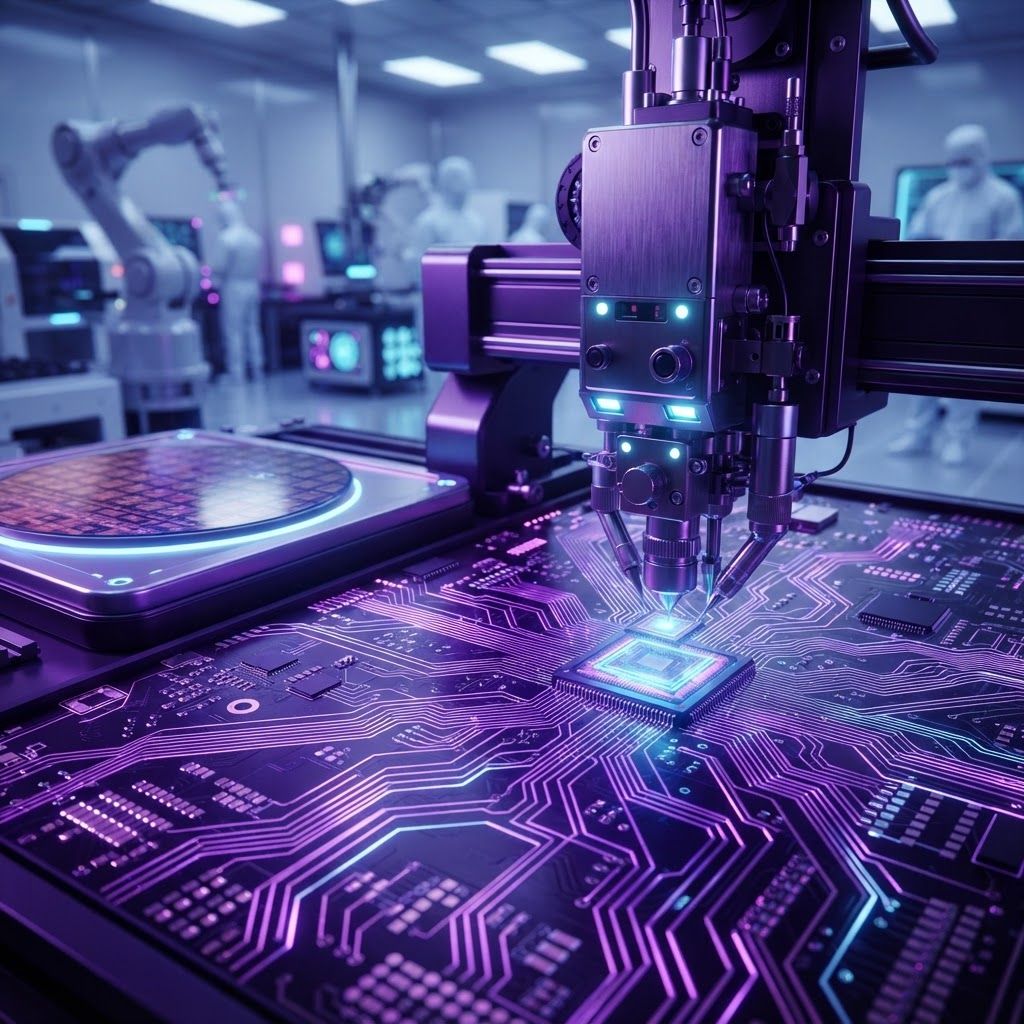
Electronics Manufacturing in North Texas
The Dallas-Fort Worth region has been an electronics center for generations, anchored historically by semiconductor and telecommunications development and sustained today by defense, aerospace, medical device, industrial control and communications work. McKinney sits within that corridor and has its own established industrial base, including significant defense electronics operations that have operated in the city for decades.
The regional advantage is a combination of engineering talent, an experienced technician workforce, established supply relationships and logistics access. For a company needing electronics built to a specification, the practical benefit is the ability to visit the factory floor, review first articles in person and resolve engineering questions with the people actually performing the work.
Understanding the Manufacturing Stack
Printed circuit board fabrication produces the bare board, including layer stackup, drilling, plating and surface finish. Assembly, commonly called electronics manufacturing services, populates boards with components using surface mount and through-hole processes, followed by reflow soldering, inspection and cleaning.
Box build and system integration takes assembled boards and combines them with enclosures, wiring harnesses, displays, power supplies and firmware into a finished product ready for shipment.
Test engineering is where quality is actually determined. In-circuit test, functional test, automated optical inspection, X-ray inspection for hidden joints, and environmental stress screening all serve different failure modes. A manufacturer without test capability is only guessing at yield.
Supporting services include design for manufacturing review, prototyping, cable and harness assembly, conformal coating and potting, component procurement and obsolescence management, and regulatory testing coordination for emissions and safety compliance.
Top 10 Electronics Manufacturers in McKinney
1. Collin Circuit Assembly
A contract assembler handling surface mount and mixed technology builds from prototype through moderate production volumes, with automated optical and X-ray inspection in house.
2. Craig Ranch Defense Electronics
Produces ruggedized electronics for defense and aerospace applications under documented quality systems, including environmental qualification and traceability requirements typical of that sector.
3. Redbud Prototype Electronics
Focused on rapid prototyping and low-volume builds, including quick-turn assembly, hand placement of difficult components and iterative revision support for hardware development teams.
4. Trinity Semiconductor Test Services
Provides device characterization, burn-in, failure analysis and test program development for semiconductor customers, serving both design houses and manufacturers.
5. Eldorado Medical Device Electronics
Builds electronics for medical devices under quality systems appropriate to regulated products, including design history documentation and validated process controls.
6. North Texas Cable and Harness
Manufactures wire harnesses, cable assemblies and interconnect solutions for industrial and transportation applications, including custom overmolding and continuity testing.
7. Virginia Street Industrial Controls
Designs and manufactures control panels, sensor interfaces and automation electronics for industrial equipment makers, combining electrical design with assembly.
8. Historic Square Electronics Engineering
A design services firm providing schematic capture, board layout, signal integrity analysis, firmware development and design for manufacturing review, working alongside separate assembly partners.
9. Adriatica Power Electronics
Specializes in power conversion products including supplies, converters and battery management electronics, with thermal analysis and efficiency validation capability.
10. Wilson Component Distribution and Sourcing
Sources electronic components including hard-to-find and obsolete parts, with authentication procedures addressing counterfeit risk in the secondary market.
How to Select a Build Partner
Match volume expectations honestly. A high-volume factory will deprioritize a two-hundred-unit build, while a prototype shop cannot scale to fifty thousand units. Ask for the manufacturer's typical order size and where your project falls within it.
Request a design for manufacturing review before committing. A competent partner will identify component placement problems, panelization improvements, test point access issues and part availability risks early. Changes at that stage are inexpensive. Changes after tooling are not.
Interrogate test strategy specifically. Ask what inspection and test steps apply to your board, what defects each catches, what the expected first pass yield is and how failures are analyzed rather than simply reworked. Ask to see a sample test report.
Evaluate supply chain management seriously. Component lead times remain volatile, and a manufacturer's ability to identify approved alternates, manage last-time-buy decisions and authenticate parts from secondary sources directly affects your schedule and reliability. Insist on authorized distribution wherever possible and documented authentication when it is not.
Confirm quality certifications relevant to your market, workmanship standards applied, electrostatic discharge controls, traceability depth and how engineering change orders are processed. Finally, visit the facility. Floor organization, inspection discipline and staff tenure communicate more than any capability presentation.
Trends in Electronics Manufacturing
Supply chain resilience has become a design requirement, with engineers now specifying multiple qualified sources from the outset rather than optimizing solely on cost. Component miniaturization continues to raise placement and inspection precision requirements, increasing the value of X-ray capability. Automation and machine vision inspection have improved defect detection while reducing labor dependency. Domestic and nearshore production has gained share for defense, medical and industrial products where lead time and traceability outweigh unit cost. And firmware and connectivity have expanded, making security considerations part of hardware manufacturing rather than a separate software concern.
Preparing a Complete Manufacturing Package
Delays and defects frequently trace to incomplete documentation rather than factory capability. A production-ready package includes fabrication drawings with stackup and impedance requirements, an assembly drawing, a bill of materials with manufacturer part numbers and approved alternates, pick and place data, aperture files, and clear notes on finish, cleaning and coating.
Specify the exceptions explicitly. Components that are polarity sensitive, moisture sensitive, hand-placed, or must be installed after testing all need documentation. Identify which measurements are critical and how they will be verified. A manufacturer that receives an unambiguous package can quote accurately and build correctly the first time, which is almost always cheaper than a fast quote followed by rework.
Final Thoughts
Electronics manufacturing rewards engineering rigor over price shopping. Choose a partner whose volume range, test capability and industry experience align with your product, complete a design for manufacturing review before tooling, and evaluate supply chain competence as seriously as assembly capability. McKinney and the surrounding region offer genuine depth across prototype, regulated and defense-grade production.