
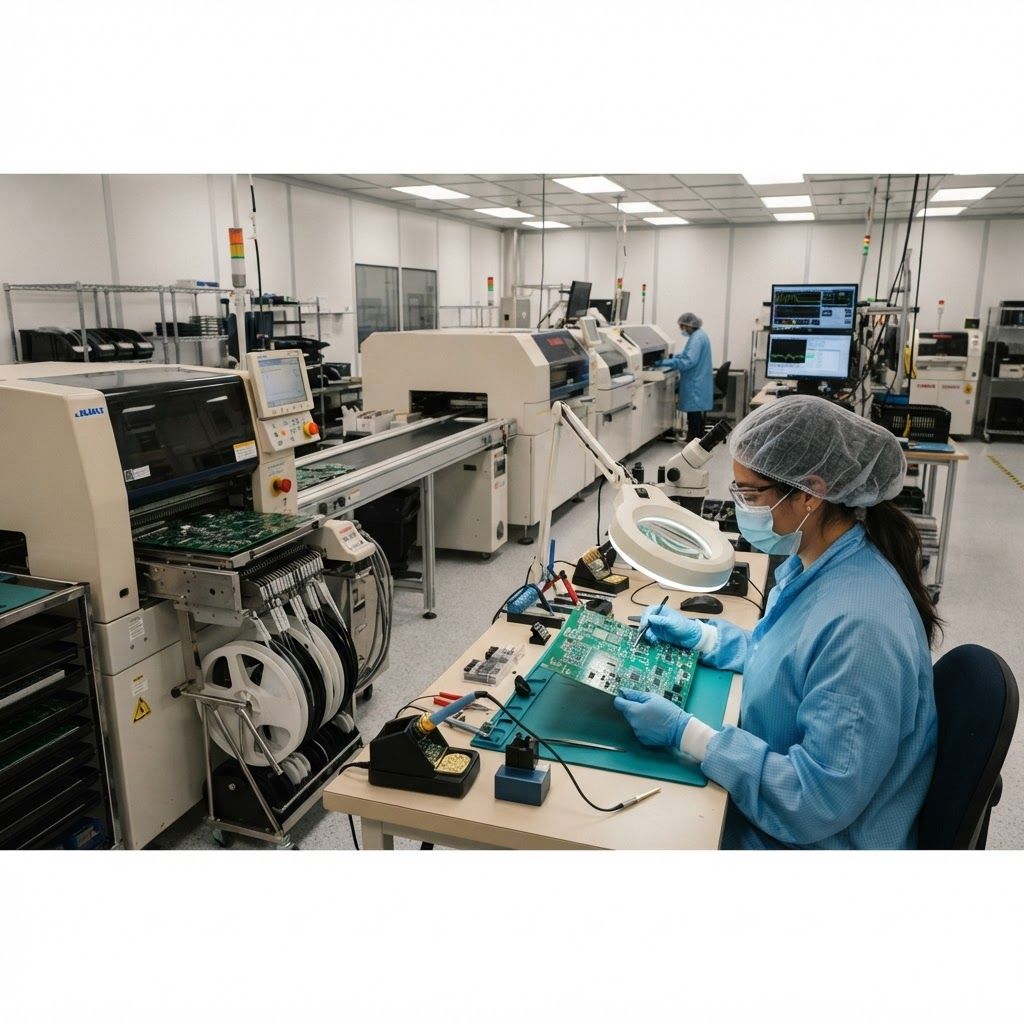
An Engineering Culture Built on Practical Problems
Electronics manufacturing in Lubbock did not grow out of consumer gadgets. It grew out of problems that needed solving on farms, in oilfields, in hospitals and inside industrial plants across West Texas. That origin story shaped the local industry into something notably pragmatic: circuit boards designed to survive dust and heat, control panels built for irrigation systems, sensor packages for grain storage, and instrumentation that has to work reliably a long way from the nearest technician.
The city's engineering talent pipeline reinforces this. A steady flow of electrical, computer and mechanical engineering graduates supports both established firms and startups, while the region's manufacturing base provides immediate customers. For companies seeking a domestic electronics partner without the cost structure or scheduling backlog of major metros, Lubbock offers a compelling middle path.
The Top 10 Best Electronics Manufacturers in Lubbock
1. Caprock Electronics Assembly
A contract electronics manufacturer offering surface-mount and through-hole assembly, conformal coating, functional testing and box build. They serve low-to-medium volume programs where engineering support matters more than absolute lowest unit price, and their documentation practices make them a good fit for regulated products.
2. Llano Circuit Technologies
Printed circuit board design and layout specialists with in-house prototyping. Their team handles signal integrity review, thermal analysis and design-for-manufacturability feedback, which routinely saves clients from expensive respins later in the development cycle.
3. Hub City Industrial Controls
Builders of control panels, motor starters, PLC cabinets and automation enclosures for agriculture, food processing and light industry. Panels are wired and tested to recognized standards, and the company provides field commissioning support across the region.
4. South Plains AgTech Systems
Developers and manufacturers of precision agriculture hardware: soil moisture sensors, irrigation controllers, telemetry gateways and yield monitoring devices. Products are engineered for solar power, cellular connectivity and multi-season outdoor exposure.
5. Red Raider Embedded Solutions
A hardware and firmware house building custom embedded platforms around microcontrollers and single-board computers. Services span schematic capture through firmware validation, and they support clients who need one partner across both hardware and software layers.
6. Panhandle Power Electronics
Manufacturers of power supplies, inverters, battery management boards and charging systems. Their work supports renewable energy installations, remote monitoring stations and mobile equipment where efficiency and thermal management are critical.
7. Yellowhouse Medical Devices
Contract manufacturing for medical and laboratory instrumentation, with quality systems and traceability appropriate to the sector. They emphasize controlled processes, component lot tracking and thorough validation documentation.
8. Texas Plains Cable and Harness
Wire harness, cable assembly and connector overmolding services. Harnesses are built to print with continuity testing on every unit, supporting equipment manufacturers who need reliable interconnects for harsh environments.
9. Monarch Test and Measurement
Producers of custom test fixtures, data acquisition units and calibration equipment. Their fixtures help other manufacturers verify their own products efficiently, making them an important quiet contributor to the regional supply chain.
10. Cotton Belt Electronics Repair and Refurbishment
Component-level repair, obsolescence management and refurbishment for industrial electronics. When a legacy drive or controller is no longer available new, this kind of capability keeps expensive production equipment running for years longer.
Trends in Electronics Manufacturing
Supply chain resilience has become the defining concern of the past several years. Component shortages taught manufacturers to design with alternates in mind, hold strategic inventory and maintain closer relationships with distributors. Reshoring interest has grown accordingly, particularly for products where intellectual property protection, engineering change speed or defense-related requirements make offshore assembly unattractive.
Connectivity is the second major trend. Nearly every new industrial and agricultural product now includes some form of remote monitoring, which pushes manufacturers to develop competence in wireless design, cybersecurity fundamentals and over-the-air update infrastructure. Finally, automated optical inspection and improved test coverage have raised quality expectations even at modest volumes.
How to Select an Electronics Manufacturing Partner
Match your volume and complexity to the shop's sweet spot. A prototype house and a high-volume assembler operate on different economics, and forcing a mismatch produces frustration on both sides. Then look closely at engineering support, because early design feedback usually delivers more value than a small savings per board.
- Ask about inspection capability, test coverage and first-article procedures.
- Confirm component sourcing practices and counterfeit avoidance policies.
- Clarify who owns design files, tooling and test fixtures.
- Request realistic lead times including component procurement, not just build time.
- Discuss end-of-life and obsolescence planning before production begins.
Final Thoughts
Lubbock's electronics manufacturers succeed by staying close to real operational problems and building hardware that has to survive difficult conditions. That practicality is an asset for any buyer who values engineering communication, responsive change management and domestic production. Define your requirements clearly, evaluate partners on process discipline rather than promises, and start with a pilot build. The right local partner can shorten development cycles considerably while keeping your supply chain within a single time zone.