
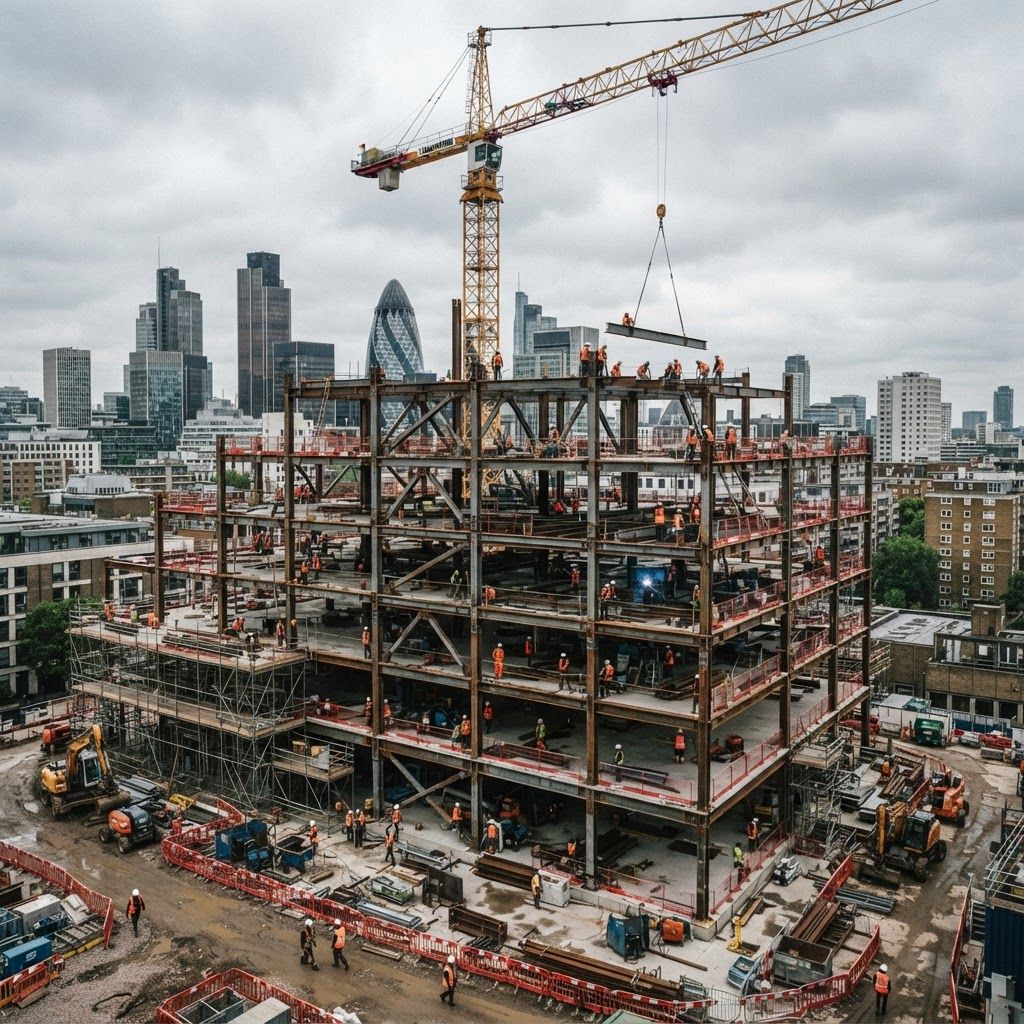
A Genuine Construction Center
St. Louis punches above its metropolitan weight in commercial construction. Several nationally ranked contractors are headquartered in the region, and the local market sustains sophisticated work across healthcare, life sciences, higher education, advanced manufacturing, logistics and mixed-use development. The concentration of major health systems, universities and Fortune 500 corporate campuses produces a steady pipeline of technically demanding projects, while the region's position as a rail, river and interstate hub drives continuous industrial and distribution construction.
For an owner selecting a builder, that depth is an advantage. It also means the field is stratified. The contractor best suited to a hospital tower is rarely the right choice for a twelve thousand square foot retail buildout, and evaluating firms without regard to project scale wastes everyone's time.
Delivery Methods Shape Everything
Before shortlisting contractors, an owner should settle on a delivery method, because it determines when the builder joins the project and how risk is allocated. Design-bid-build separates design from construction and awards on price after drawings are complete. It maximizes price competition but offers no builder input during design and tends to generate change orders where documents are incomplete.
Construction manager at risk brings the builder on during design under a preconstruction agreement, then converts to a guaranteed maximum price. Owners gain constructability review, early budget validation and realistic scheduling in exchange for less pure price competition. Design-build consolidates design and construction under one contract, which compresses schedule and gives the owner a single point of accountability. Integrated project delivery goes further, aligning owner, designer and builder through shared risk and reward.
Most complex St. Louis institutional and healthcare work now uses construction manager at risk or design-build. Industrial and speculative development frequently uses design-build for speed.
Ten Leading Commercial Construction Companies
1. McCarthy Building Companies is headquartered in St. Louis and ranks among the largest builders in the United States. Its healthcare, higher education, water treatment and advanced industrial portfolios are extensive, and it has been an early adopter of prefabrication, virtual design and construction, and lean scheduling practices.
2. Clayco is a St. Louis-based design-build firm that self-performs design through affiliated practices, giving it unusual speed on industrial, corporate campus and mixed-use work. Owners with aggressive schedules and defined program requirements often find its integrated model compelling.
3. Alberici Constructors brings deep expertise in heavy industrial, automotive, energy and water infrastructure alongside commercial building work. Its capacity for technically complex projects with demanding tolerances distinguishes it in the regional market.
4. Tarlton Corporation is a longstanding St. Louis general contractor with strong concrete self-perform capability. That in-house structural capacity gives it schedule control on projects where the concrete frame drives the critical path.
5. PARIC Corporation works across healthcare, senior living, education, hospitality and multifamily construction. The firm has invested heavily in virtual design and construction, using coordinated models to resolve conflicts before field installation.
6. BSI Constructors has built institutional, cultural and civic projects throughout the region for decades. Its familiarity with historic structures and complex renovation within occupied facilities is a meaningful asset for owners with existing campuses.
7. S. M. Wilson & Co. concentrates on education, healthcare and retail construction with particular strength in phased work on active school and hospital campuses. Managing construction around students and patients is a specialized skill, and the firm has built its practice around it.
8. Kadean Construction serves the industrial, distribution and commercial interior markets. It is a practical choice for warehouse, light manufacturing and tenant improvement work where speed and cost discipline outweigh architectural complexity.
9. Brinkmann Constructors operates a negotiated-work model across retail, multifamily, senior living and industrial sectors, emphasizing preconstruction budgeting accuracy. Developers value its ability to validate pro forma assumptions early.
10. Holland Construction Services works throughout the metro area including the Illinois side, handling multifamily, education, healthcare and commercial projects with a reputation for accessible project management at mid-market scale.
Evaluating a Commercial Contractor
Request project references in your specific building type and of comparable dollar value, then contact the owner's representative rather than only the named reference. Ask about change order volume as a percentage of contract, schedule performance against the baseline, and how disputes were resolved.
Examine the project team, not the company. Commercial construction quality is determined by the project executive, superintendent and project manager actually assigned. A strong firm with an overextended team underperforms a mid-sized firm with an experienced, available one. Ask for resumes and confirm those individuals are contractually committed.
Review safety metrics seriously. Experience modification rate and recordable incident rate are proxies for operational discipline generally, not merely safety. Contractors with poor safety performance typically have quality and schedule problems as well.
Technology and Preconstruction
Building information modeling has moved from differentiator to expectation on projects of any complexity. What still differentiates firms is how the model is used: clash detection across mechanical, electrical, plumbing and fire protection trades before fabrication, prefabrication of overhead assemblies and bathroom pods, laser scanning of existing conditions in renovation work, and four-dimensional scheduling that ties the model to sequence.
Preconstruction services deserve close attention. Accurate conceptual estimating during design prevents the painful redesign cycle that follows a bid coming in twenty percent over budget. Contractors with dedicated preconstruction departments and current regional cost data provide materially better early guidance.
Market Conditions to Anticipate
Skilled labor availability remains the binding constraint across the St. Louis market, particularly for electricians, pipefitters and sheet metal workers. Long-lead equipment, especially electrical switchgear, transformers and certain mechanical units, continues to require early procurement commitments. Contractors who identify long-lead items during design and lock pricing early protect both budget and schedule.
Sustainability requirements are increasingly common, driven by corporate commitments rather than local mandate. Contractors experienced with LEED, WELL and energy code documentation reduce the administrative burden on owners.
Final Perspective
St. Louis offers commercial builders of genuine national capability alongside strong regional and mid-market firms. Match scale to scope, choose a delivery method deliberately, and interview the individuals who will run the job rather than the firm's marketing team. Invest in preconstruction, because decisions made during design govern the majority of final cost. Owners who do this consistently get projects that finish close to the number and date they were promised.