
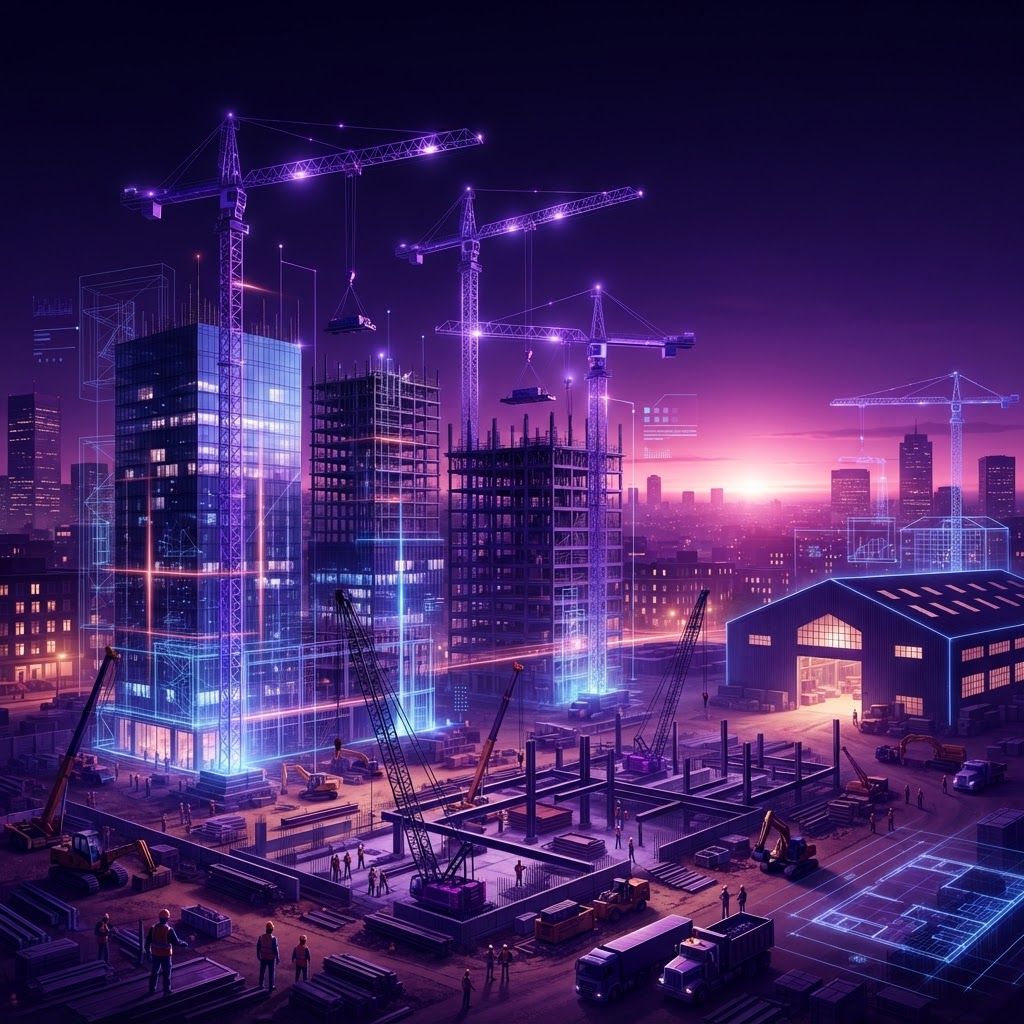
Salem as a Commercial Construction Market
Salem occupies an unusual position among Tamil Nadu cities. It combines a substantial industrial base built around steel, textiles and engineering with a rapidly expanding service economy covering retail, healthcare and education. That combination generates a diverse commercial construction pipeline spanning showrooms, office buildings, hospitals, educational campuses, cold storage facilities and industrial sheds.
Commercial construction operates under fundamentally different pressures from residential work. Every week of delay carries a measurable revenue cost, so programme certainty matters as much as build quality. Regulatory requirements are heavier, covering fire safety, accessibility, parking provision, structural certification and occupancy clearances. Coordination complexity is also higher, since mechanical, electrical and plumbing systems in a commercial building are far more extensive.
Core Capabilities to Look For
The first capability is genuine programme management. Ask prospective contractors how they plan and track schedules, whether they produce a critical path programme and how they handle slippage. Firms that can articulate a recovery strategy before problems arise are considerably more reliable than those who improvise.
The second is technical coordination. Commercial buildings involve service routes through beams and shafts that must be planned before concrete is poured. Contractors experienced in coordinated services drawings avoid the expensive core-cutting and rework that plagues poorly planned projects.
The third is compliance literacy. A competent commercial contractor understands fire escape requirements, sprinkler and hydrant provisions, structural stability certification and the documentation required for occupancy approval. This knowledge prevents late-stage surprises that can hold a completed building empty for months.
Ten Commercial Construction Companies Serving Salem
Salem Prime Infra focuses primarily on commercial and institutional buildings and has developed strong programme discipline. The firm is regularly engaged for retail and office projects with fixed opening dates.
Everest Engineering Works brings substantial industrial construction capability, including pre-engineered steel buildings, factory sheds and warehouse structures. Its fabrication experience suits Salem's manufacturing sector particularly well.
Kongu Builders and Developers handles mid-scale commercial projects with a well-established subcontractor network, allowing multiple trades to run concurrently without the coordination breakdowns common on busy sites.
Annai Engineering and Construction offers integrated design and build services for commercial clients, which shortens the pre-construction phase and reduces the risk of design and site conflicts.
Vaigai Infra Projects has experience in healthcare and educational buildings, sectors that carry demanding technical requirements around services, hygiene and accessibility.
Bharath Commercial Builders is known for retail and showroom construction, including fast-track fitout coordination where a building shell and interior works overlap to compress the overall programme.
Sakthi Infra Solutions undertakes structural work for multi-storey commercial buildings and maintains in-house quality testing practices for concrete and steel.
Meenakshi Projects serves clients building small commercial complexes and mixed-use developments, offering a balance of cost efficiency and dependable finish quality.
Green Field Commercial Construction specialises in energy-conscious commercial buildings, incorporating daylight optimisation, efficient envelope design and provisions for rooftop solar installations.
Salem Steel Structures completes the list with specialised expertise in structural steel and long-span roofing, relevant for warehouses, exhibition spaces and industrial facilities across the district.
Trends Shaping Commercial Building
Pre-engineered buildings have transformed industrial construction timelines. A steel-framed warehouse that once took many months can now be erected far faster with better dimensional accuracy, and Salem's proximity to steel processing capacity makes this especially attractive locally.
Energy performance has moved from a marginal concern to a commercial priority. Rising tariffs and corporate sustainability commitments are driving demand for better insulation, high-performance glazing, efficient lighting and solar integration. Contractors comfortable with these systems have a clear market advantage.
Digital delivery is also advancing. Building information modelling, once confined to metro projects, is increasingly used on larger Salem commercial buildings to detect clashes between structure and services before construction begins. The savings in avoided rework typically exceed the modelling cost several times over.
Contracting and Risk Management
Commercial contracts should be considerably more detailed than residential ones. Define the scope with reference to a complete drawing and specification set. Establish a clear variation procedure so that changes are priced and approved before execution rather than argued about at final billing.
Include liquidated damages for delay, but pair them with realistic extension-of-time provisions for genuinely unforeseeable events. Require the contractor to submit a monthly programme update and photographic progress record. Verify insurance coverage for workers, the works themselves and third-party liability, and confirm that subcontractors are covered too.
Retention is standard practice and serves an important purpose. Hold an agreed percentage until the defect liability period concludes, and ensure the contract lists the handover documentation required, including test certificates, warranties, as-built drawings and operation manuals for installed systems.
Final Thoughts
Commercial construction rewards preparation. The businesses that experience smooth builds in Salem are almost always those that invested time in complete design documentation, selected contractors on demonstrated capability rather than headline price, and maintained active involvement throughout execution. A commercial building is a revenue-generating asset, and the quality of its construction directly determines both its operating cost and its long-term value.