
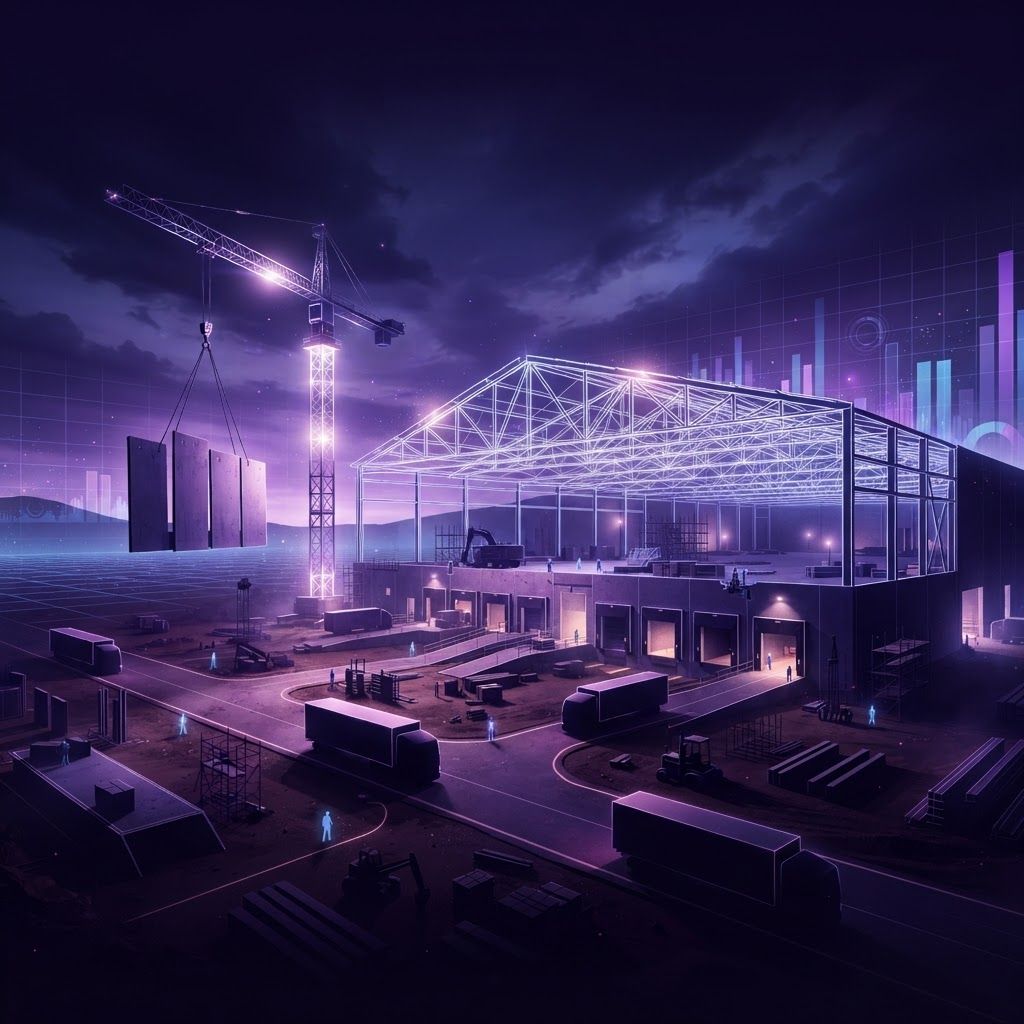
Why Fontana Is a Commercial Construction Hub
Few cities in Southern California have been reshaped by logistics as thoroughly as Fontana. Its position along Interstate 10 and Interstate 15, proximity to the ports of Los Angeles and Long Beach, and availability of large parcels have made it a magnet for distribution centers, manufacturing facilities, and the retail and service infrastructure that supports a growing workforce.
That demand profile defines the local commercial construction market. Companies working here regularly handle tilt-up concrete warehouses, cold storage facilities, truck yards, light industrial buildings, retail centers, medical and dental offices, restaurants, and office tenant improvements. Each category carries distinct code, structural, and systems requirements.
The Scope of Commercial Construction Services
Commercial general contractors deliver far more than construction labor. Their services typically span preconstruction estimating, constructability review, value engineering, scheduling, permitting coordination, subcontractor procurement, safety management, quality control, commissioning, and closeout documentation.
On larger industrial projects, they also manage civil work: grading, storm water management, paving, utility extensions, and site lighting. For a distribution facility, the yard, dock configuration, and truck circulation are as commercially important as the building shell itself, and experienced contractors plan those elements with operational throughput in mind.
Delivery Methods and Contract Structures
Developers choose among several delivery models. Design-bid-build separates design from construction and awards the build to the lowest qualified bidder, offering price clarity when documents are complete. Design-build consolidates both under one contract, accelerating schedule and reducing coordination gaps. Construction management at risk brings the builder in early for preconstruction input while establishing a guaranteed maximum price.
For speculative industrial development in Fontana, design-build and construction management approaches have gained ground because speed to occupancy directly affects returns. Tenant improvement work, by contrast, often runs on negotiated contracts with landlords under tight schedules driven by lease commencement dates.
Qualification Criteria for Commercial Builders
Selecting a commercial contractor is a due diligence exercise. Bonding capacity indicates financial strength and the ability to take on a project of a given size. Experience modification rate, a workers compensation insurance metric, reflects safety performance and is a widely used screening tool.
Beyond financial and safety indicators, developers should review relevant project history in the same building type. A contractor experienced in tilt-up warehouse construction is not automatically qualified for a restaurant build-out with complex mechanical and grease exhaust requirements. Requesting the specific superintendent and project manager who will be assigned, rather than a corporate resume, provides a more accurate picture of execution capability.
Industrial and Warehouse Specialization
Tilt-up construction dominates industrial development in the region. Concrete panels are cast on the slab, lifted into place, and connected to a structural steel roof system. The method is fast and cost-effective at scale but demands precision in slab work, panel layout, embed placement, and crane logistics.
Specialized considerations follow. Fire protection design for high-piled storage, ESFR sprinkler systems, clear height requirements for modern racking, dock equipment, energy-efficient lighting with occupancy controls, and increasingly electric truck charging infrastructure all require contractors who have delivered comparable facilities and understand inspection sequencing.
Retail, Office, and Tenant Improvement Work
Tenant improvement projects are their own discipline. They involve working within occupied or partially occupied buildings, coordinating with landlords and property managers, meeting accessibility standards, and completing work on schedules measured in weeks rather than months.
Success here depends on scheduling discipline and long-term subcontractor relationships. Contractors who can mobilize electricians, mechanical crews, and finish trades on short notice consistently outperform those bidding the work cold. Restaurant and medical build-outs add layers of health department, mechanical, and specialty equipment coordination.
Permitting, Code, and Regulatory Navigation
Commercial permitting in California involves plan check across building, structural, mechanical, electrical, plumbing, fire, and energy disciplines, plus civil and storm water review on new sites. Air quality regulations, storm water pollution prevention plans, and traffic studies may apply depending on scope.
Contractors with substantial Fontana experience anticipate correction cycles and prepare submittals accordingly. They also understand deferred approval strategies, allowing foundation work to begin while shell details continue through review, which can compress overall schedule meaningfully when managed properly.
Safety, Quality, and Schedule Control
Commercial job sites operate under formal safety programs: site-specific plans, daily briefings, fall protection, crane and rigging protocols, and documented training. Strong safety culture correlates closely with overall project performance because it reflects organizational discipline.
Quality control on commercial work relies on inspection and testing programs, special inspections for concrete and welding, and systematic punch list management. Schedule control depends on critical path planning, early procurement of long-lead items such as structural steel, switchgear, and rooftop HVAC units, and weekly look-ahead coordination with all trades.
Sustainability and Building Performance
Commercial buildings in California face rigorous energy requirements, and many developers pursue additional certification for market positioning. Cool roofing, high-efficiency mechanical systems, LED lighting with advanced controls, solar-ready roof structures, and water-efficient landscaping have become standard rather than premium features.
For industrial tenants, operational cost matters as much as construction cost. Contractors who can model the payback of enhanced insulation, daylighting, or rooftop solar readiness add genuine value during preconstruction.
Selecting the Right Partner
Developers and business owners should evaluate commercial contractors on relevant experience, financial capacity, safety record, assigned personnel, preconstruction rigor, and references from comparable completed projects. Price matters, but schedule certainty and change order discipline usually have greater financial impact over the life of a project.
In a market where a warehouse delivered three months early can transform a pro forma, the best commercial construction companies in Fontana compete on predictability. That reliability, more than any single capability, is what earns them repeat business in one of the region's most competitive building environments.