
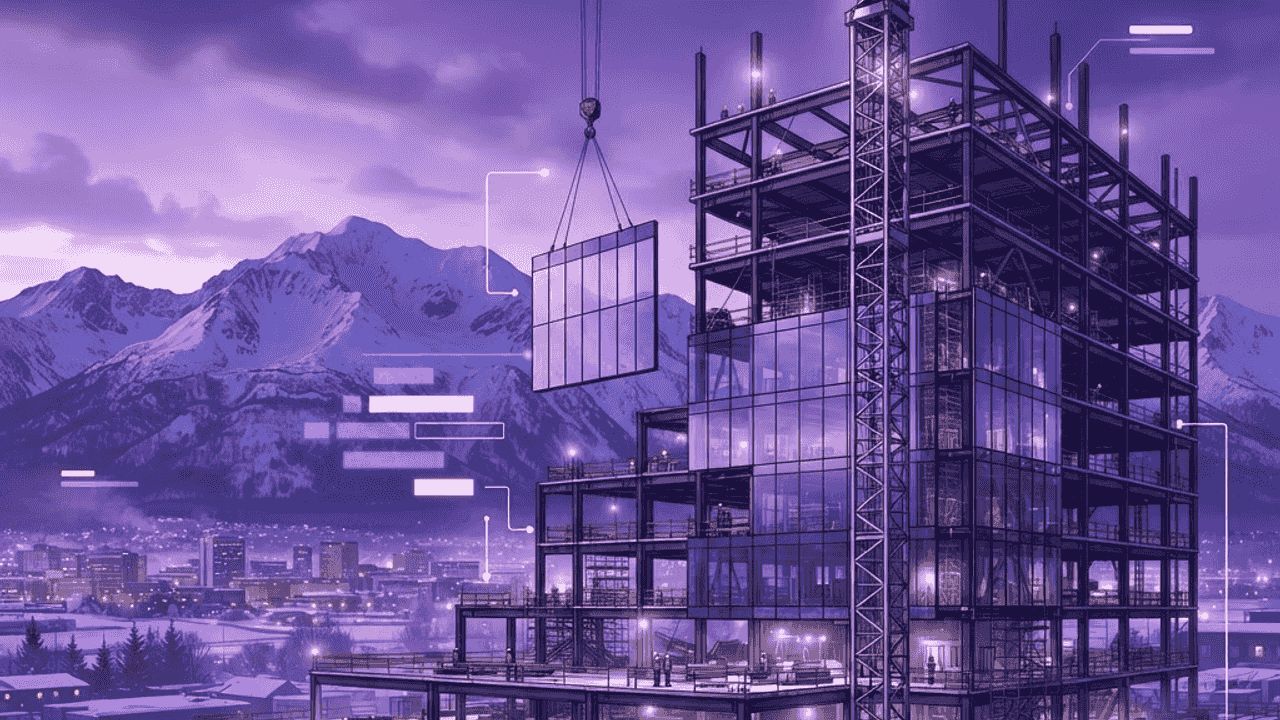
The Anchorage Commercial Construction Environment
Commercial construction in Anchorage operates under constraints that shape both cost and delivery method. Seismic design requirements are among the most demanding in the country, influencing structural systems, bracing, connection detailing, and the anchorage of mechanical equipment. Cold-climate performance requirements affect envelope design, snow load engineering, roof drainage, and the sizing of heating and ventilation systems. Frost depth governs foundation design and site utility installation.
Logistics add another layer. Structural steel, curtain wall systems, elevators, and major mechanical equipment typically arrive by barge, and procurement schedules must account for lead times that leave no room for late decisions. A change order that would cost two weeks in Seattle can cost two months here.
The season compresses everything further. Excavation, foundation work, and site utilities need to happen within a window that closes with the first hard frost. Contractors who fail to hit that window face either expensive winter protection measures or a delay until the following spring. Sequencing skill is therefore among the most valuable capabilities a commercial builder can offer.
What Owners Should Look For
Preconstruction capability is the first differentiator. The most valuable service a commercial contractor provides often happens before ground breaks: constructability review, cost modeling, value engineering, procurement planning, and phasing strategy. Firms with strong preconstruction teams identify problems while they are still inexpensive to solve.
Bonding capacity and financial strength matter on projects of meaningful size. They indicate whether a contractor can carry the cash flow demands of a large build and whether an owner has recourse if performance falters.
Safety performance is both an ethical and practical measure. Contractors with strong safety records typically have better trained crews, better supervision, and better productivity, and their insurance costs reflect it.
Trade relationships determine schedule reliability in a market with a limited skilled labor pool. Firms that keep subcontractors working across successive projects secure crews when demand peaks.
Finally, experience with the specific building type matters. Healthcare, education, aviation, industrial, and retail construction each carry distinct code requirements, systems complexity, and phasing challenges. A contractor with relevant precedent projects brings solutions rather than experiments.
The Ten Best Commercial Construction Companies in Anchorage
1. Neeser Construction is one of Alaska's best-known commercial builders, with an extensive portfolio across healthcare, education, retail, and institutional work. Its capacity to manage large, complex projects while coordinating major mechanical and structural systems anchors its reputation.
2. Cornerstone General Contractors brings substantial experience in public and institutional construction, including facilities with demanding technical requirements. Strong project controls and preconstruction services are hallmarks of the firm's approach.
3. Davis Constructors and Engineers pairs construction delivery with in-house engineering capability, which is particularly valuable on projects where structural and seismic considerations drive design. That integration reduces friction between design intent and field execution.
4. Roger Hickel Contracting has built a strong record across commercial, institutional, and healthcare projects, with a reputation for collaborative delivery methods that align owner, designer, and builder interests early.
5. Watterson Construction works across commercial, industrial, and institutional sectors, with notable depth in projects requiring complex building systems coordination and phased occupancy.
6. Criterion General specializes heavily in commercial interiors and tenant improvements alongside new construction. Renovation within operating buildings demands rigorous phasing, dust and noise control, and access management, and firms with this focus deliver it reliably.
7. Alcan Builders serves the commercial and industrial market with experience on projects in demanding locations, including work requiring logistics planning beyond the road system. That capability is distinctly Alaskan and genuinely difficult.
8. Kiewit Building Group represents the national contractor presence in the Alaska market, bringing large-project resources and specialized capability to infrastructure-adjacent and heavy commercial work.
9. Chugach Alaska Corporation Construction Services reflects the significant role Alaska Native corporations play in the state's construction economy, delivering facilities, infrastructure, and government contract work across a wide scope.
10. Regional Specialty Contractors collectively complete the list. Anchorage supports capable firms focused on specific niches such as industrial process facilities, cold storage, aviation support structures, and seismic retrofit. For projects centered on those requirements, a specialist often outperforms a generalist.
How to Structure a Successful Commercial Project
Choose the delivery method deliberately. Design-bid-build offers price competition on a fully documented design but limits builder input during design. Construction manager at risk brings the contractor in early for constructability and budget guidance, which in Anchorage frequently pays for itself through better procurement timing. Design-build consolidates responsibility and can compress schedule when scope is clear.
Lock long-lead procurement early. Structural steel, elevators, switchgear, air handling units, and curtain wall systems should be released as soon as design permits. Barge scheduling is unforgiving, and a late release cascades through the entire schedule.
Plan the winter strategy explicitly. Decide before award whether the project will be enclosed and heated for winter work or paused, and budget accordingly. Temporary heat and enclosure are legitimate costs that belong in the estimate rather than surfacing as change orders in November.
Invest in commissioning. Cold-climate mechanical systems perform as designed only when properly balanced and verified. Skipping commissioning to save money produces buildings that cost more to operate for their entire service life.
Trends in the Local Commercial Market
Seismic retrofit and resilience work remains steady as owners upgrade older building stock. Energy performance is increasingly central, with high-performance envelopes, heat recovery systems, and building automation reducing operating costs meaningfully in a long heating season. Modular and prefabricated assemblies continue to expand because factory production reduces weather exposure and shortens site duration. And digital tools, particularly building information modeling used for clash detection and prefabrication coordination, have become standard on larger projects.
The common thread is planning. In a market where materials arrive by sea and the ground freezes on schedule, the contractors who consistently succeed are those who resolve decisions early and manage procurement and sequencing with discipline.