
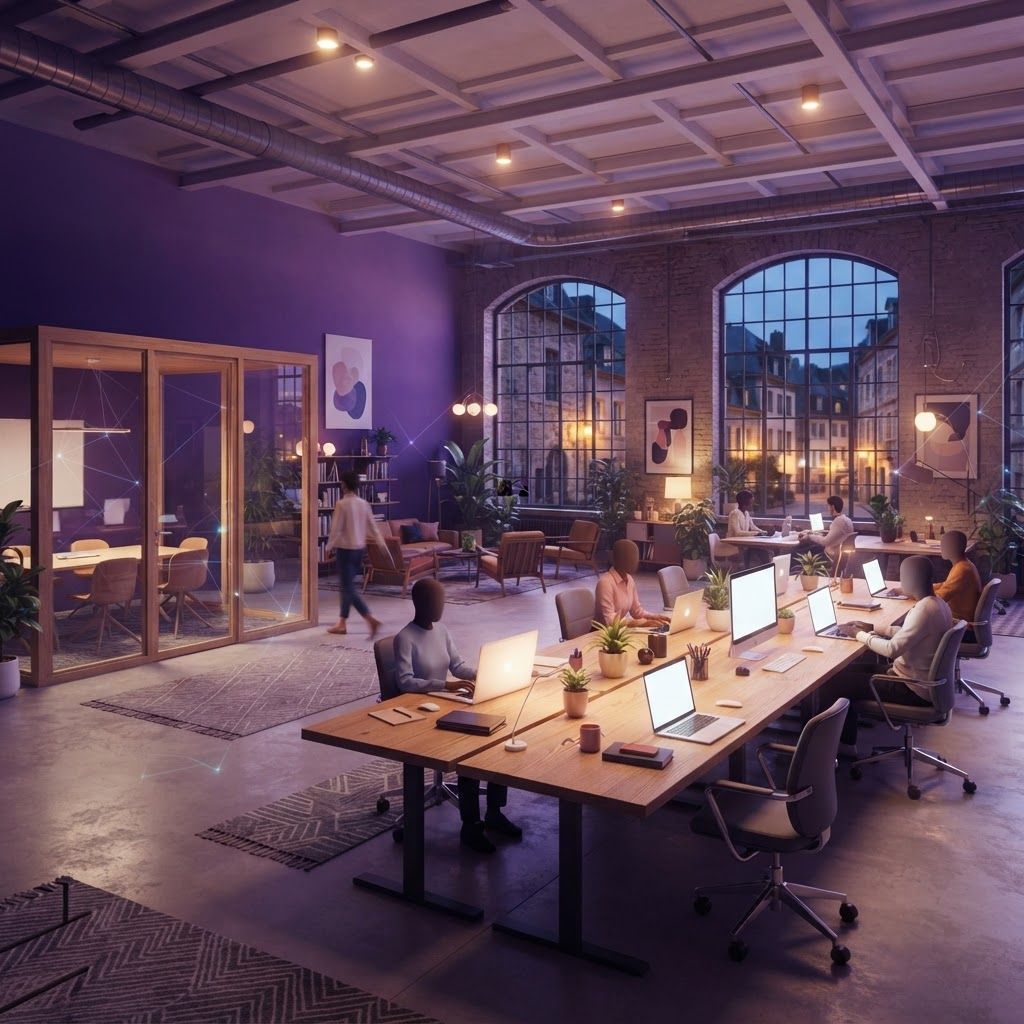
Why Co-Working Took Hold in McKinney
Co-working was once an urban phenomenon, concentrated in downtown cores where young companies clustered. Hybrid work changed that fundamentally. A substantial share of McKinney's professional population now works remotely for employers headquartered in Dallas, Plano, Frisco or entirely out of state, and the practical problems of working from a suburban home have become clear: household distraction, inadequate acoustic separation for calls, no professional meeting space, and genuine isolation.
McKinney is well suited to absorbing that demand. It has a large, highly educated professional population, a walkable historic downtown with characterful buildings, and mixed-use development at Craig Ranch and along the Highway 121 corridor that supports flexible office. The result is a co-working market with more variety than a city of its size would historically have supported.
Categories of Flexible Workspace
Open co-working provides a shared floor with unassigned or assigned desks, communal amenities and a social atmosphere. It is the least expensive option and works well for people who need a workspace and some human contact but take relatively few private calls.
Dedicated desk memberships assign a specific desk that you can leave equipment at, providing consistency without the cost of an enclosed office.
Private offices are lockable enclosed rooms within a flexible workspace, appropriate for people whose work involves confidential conversation, frequent video calls, or a small team.
Executive suites sit at the premium end, offering enclosed offices with reception service, mail handling, administrative support and formal conference facilities. Professional services firms, particularly legal, financial and consulting practices, favour this format because client-facing presentation matters.
Virtual office plans provide a business address, mail handling and occasional meeting room access without daily workspace, which suits sole practitioners who work from home but need a professional address.
Day pass and part-time plans have become increasingly common as hybrid workers need space only two or three days weekly.
The Top 10 Co-Working Spaces in McKinney
1. The Warehouse at McKinney
Located in the historic downtown district, this type of adaptive-reuse workspace combines exposed brick, high ceilings and industrial character with modern infrastructure. Open co-working, dedicated desks, private offices, meeting rooms and event space are typically offered, and the location within walking distance of the square's restaurants and coffee shops is a genuine daily quality-of-life advantage.
2. Craig Ranch Executive Suites
Positioned within McKinney's premier mixed-use development, this category of workspace serves professionals who want a polished, business-oriented environment with strong amenities nearby. Private offices, conference facilities, reception service and proximity to hotels, restaurants and fitness facilities make it well suited to client-facing professionals and small firms.
3. Regus McKinney
Regus operates the largest flexible workspace network globally, and its presence in the McKinney area brings the advantages of scale: consistent standards, professional reception, well-equipped meeting rooms, and network access allowing members to use locations across the metroplex and beyond. For professionals who travel or need occasional space in multiple cities, the network access is meaningful.
4. Venture X McKinney
Venture X positions itself at the design-forward premium end of co-working, with high-specification interiors, extensive amenity provision, private offices and open co-working, and a strong community programming calendar. It appeals to established professionals and small firms who want the collaborative atmosphere of co-working without a startup-hostel aesthetic.
5. WorkSuites McKinney
A Texas-based flexible workspace operator with strong Dallas-Fort Worth coverage, WorkSuites focuses on private offices and executive suites with full-service support: reception, mail, administrative assistance and conference facilities. Its regional focus means pricing and lease flexibility are often more negotiable than with global operators.
6. The Cove Co-Working
Independent local co-working operators typically compete on community rather than amenity specification. Smaller member counts, curated networking events, owner-operator involvement and a genuine sense of belonging characterise the better ones. For freelancers and solo consultants in McKinney, that community aspect is frequently the primary value rather than the desk itself.
7. Downtown McKinney Creative Studios
The historic district supports several smaller workspaces oriented toward creative professionals: designers, photographers, writers, marketing consultants and small agencies. These spaces often include studio areas, natural light prioritisation and flexible layouts, and their location on or near the square places members in one of the more distinctive commercial districts in North Texas.
8. Common Desk
A Texas-founded co-working brand known for hospitality-driven service, strong coffee programmes and a deliberately warm design language, Common Desk has expanded across the Dallas-Fort Worth region. Its emphasis on the human experience of the workspace rather than merely its specification has produced strong member retention, and its community events are substantive.
9. Roam Innovative Workplace
Roam blends co-working with substantial meeting and event infrastructure, which makes it useful for professionals who need to host client sessions, training or team offsites in addition to daily desk work. Meeting room quality, audiovisual provision and catering support are typically stronger in this format than in desk-focused co-working.
10. McKinney Public Library and Cafe Co-Working
Worth including honestly: for professionals who need occasional space rather than a membership, McKinney's library facilities offer free quiet workspace and study rooms, and the downtown coffee shop scene provides informal options. These lack the privacy, call facilities and professional address of paid workspace, but for part-time needs the economics are unbeatable.
Trends in Flexible Workspace
Suburban co-working demand has outpaced urban demand as hybrid workers refuse long commutes but still want to leave the house. This is the structural shift that made a market like McKinney viable, and it appears durable rather than transitional.
Enterprise use of flexible space has grown substantially, with corporations taking private suites in suburban locations as satellite offices to reduce employee commuting. Several McKinney workspaces derive meaningful revenue from corporate rather than individual members.
Call and video infrastructure has become a primary differentiator. Phone booths, acoustically treated meeting rooms and reliable high-bandwidth connectivity now matter more to members than kitchen aesthetics, and operators have invested accordingly.
Hybrid membership models offering limited monthly days rather than unlimited access have expanded, better matching how people actually work and lowering the entry price point.
Choosing a Workspace
Take a day pass or trial before committing, and visit at your actual working hours, because noise levels vary enormously between mid-morning and mid-afternoon. Test the wireless network speed and, critically, take a video call from the space you intend to use.
Assess call privacy honestly. If your work involves several hours of calls daily, open co-working will fail regardless of how appealing the space looks, and you need either a private office or a facility with genuinely available phone booths.
Clarify what is included versus metered: meeting room hours, printing, coffee, parking, after-hours access and guest policy all vary. Check contract flexibility, since the entire premise of flexible workspace is undermined by a long lock-in.
Finally, consider commute realistically. A space fifteen minutes from home that you use daily beats a superior space thirty minutes away that you gradually abandon. McKinney's options are geographically spread, so proximity is a legitimate primary criterion.