
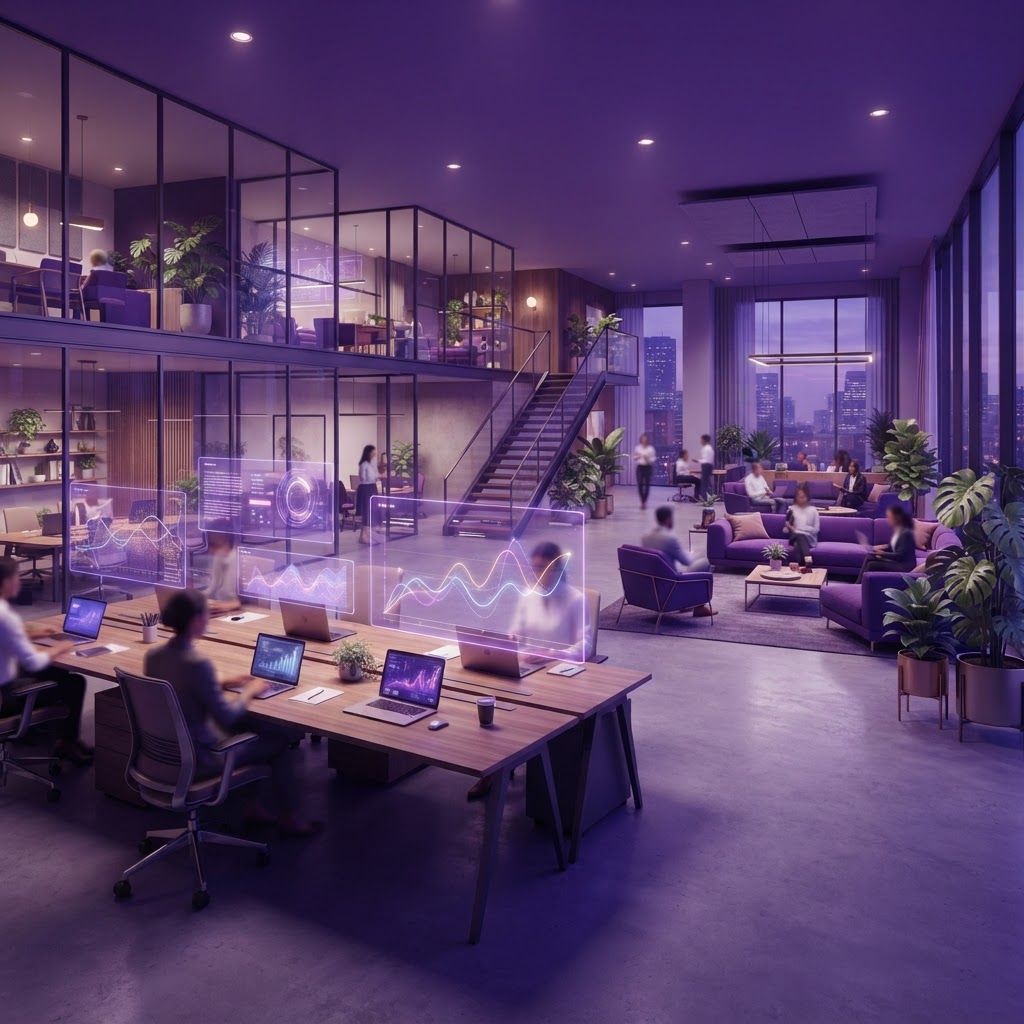
Why Co-working Has Taken Hold in Fontana
Fontana sits at one of the busiest crossroads in the Inland Empire, where the I-10, I-15 and Route 210 corridors converge and where warehousing, freight brokerage, construction and e-commerce fulfillment employ tens of thousands of people. That economic profile has produced an unusually large population of independent operators: owner-operators who need a quiet place to handle compliance paperwork, freight agents who work the phones, real estate professionals, insurance brokers, remote technology workers and small teams that outgrew a home office but cannot justify a five-year lease.
Co-working answered that demand. Instead of committing capital to build-outs, furniture and utilities, a business pays a predictable monthly fee for a desk or private suite and gets internet, conference rooms, printing, mail handling and cleaning bundled in. For a two-person freight brokerage or a solo bookkeeper, the math is compelling. Just as importantly, flexible workspace absorbs volatility: teams scale up during peak shipping season and scale down afterward without renegotiating anything.
What the Best Fontana Workspaces Get Right
The strongest operators in the market share a handful of traits. Connectivity comes first: business-grade fiber with a backup circuit, segmented Wi-Fi networks and enough bandwidth that a full house of video calls does not degrade. Acoustic design comes second. A workspace that looks beautiful but transmits every phone conversation across an open floor is unusable for anyone who sells for a living, which is why the better locations invest in sound-absorbing ceilings, phone booths and dedicated call rooms.
Access policy matters more than most first-time members expect. Logistics runs around the clock, and a dispatcher covering East Coast hours needs entry at five in the morning. Twenty-four-hour keycard or app-based access, monitored entry and well-lit parking are practical necessities rather than luxuries. Finally, the best spaces treat meeting rooms as a service, not an upsell trap, offering a reasonable monthly credit allowance and simple booking rather than metered charges that make client meetings feel expensive.
Ten Standout Co-working Options Serving Fontana
Regus operates the most recognizable flexible workspace network in the region, with Inland Empire centers convenient to Fontana commuters. Its appeal is consistency: professional reception, formal meeting rooms, enterprise-grade connectivity and a global membership that lets a member use centers in other cities while traveling. Businesses that host clients regularly gravitate here for the polished front-of-house presentation.
Spaces, Regus's design-forward sibling brand, targets creative and technology teams with open atriums, lounge-style breakout areas, barista service and more relaxed interiors. It suits marketing agencies, design studios and product teams that want a workspace to double as a recruiting asset.
Office Evolution built its reputation on the small-business end of the market. Day offices, virtual mailbox plans and month-to-month private suites make it a natural fit for consultants, attorneys and independent insurance agents who need a professional address and occasional meeting space without a full-time footprint.
Premier Workspaces focuses on executive suites and administrative support, offering live call answering, mail management and furnished private offices. It is a strong option for professional-services firms that value staffed reception and a conservative, corporate atmosphere.
Barrister Executive Suites has long served Southern California's legal and financial community. Confidential private offices, conference rooms suited to depositions and client meetings, and notary and administrative support make it a specialist choice for practices with privacy obligations.
WORK Inland Empire represents the independent, community-driven end of the market. Local operators of this type typically emphasize member events, referral networks and relationships with regional chambers and small-business development organizations, which is often where members find their next contract.
The Vault Coworking and similarly positioned boutique operators in the Inland Empire appeal to members who want character over corporate uniformity, with distinctive interiors, smaller member counts and a noticeably more social atmosphere.
Venture X occupies a premium tier, pairing hospitality-grade finishes with serious infrastructure: dedicated fiber, professional conference facilities, wellness rooms and podcast or content studios. Growing teams that expect to hire through the year often choose it for the ability to expand into larger suites in place.
Pacific Workspaces emphasizes flexibility and value, blending open co-working memberships, part-time desk plans and virtual office services so members pay only for the access pattern they actually use.
Intelligent Office rounds out the list with a hybrid model built for distributed teams, combining virtual receptionists, live call handling and on-demand meeting rooms for businesses whose staff rarely gather in one place.
Pricing Models and What They Actually Include
Fontana-area workspaces generally offer four tiers. Virtual office plans provide a business address and mail handling at the lowest cost. Hot desk or open co-working memberships give access to unassigned seating during business hours. Dedicated desks assign a permanent seat with storage. Private offices, priced per seat or per suite, add a lockable door and typically the largest meeting-room allowance.
Read what sits outside the base rate. Common add-ons include after-hours HVAC, extra keycards, mail forwarding, day-pass allotments for visiting colleagues, printing beyond a monthly page count and parking for a second vehicle. A plan that looks inexpensive can become the more costly option once a team of four adds guest passes and meeting hours.
Choosing the Right Space for Your Business
Start with commute and client geography. A space near the Sierra Avenue or Cherry Avenue interchanges reduces travel time for members who visit warehouses and job sites during the day, while locations closer to Ontario suit teams flying frequently. Then audit your work pattern honestly: if you take twenty calls a day, private-office acoustics matter more than a beautiful lounge. If you host clients weekly, reception quality and conference-room availability should drive the decision.
Tour at your actual working hours rather than at a quiet mid-morning appointment, run a speed test on the guest network, and ask how often the busiest meeting room is booked. Request a trial day or a one-week pass before committing, and confirm the notice period for cancellation and the process for upgrading to a larger suite.
Where the Market Is Heading
Two trends are reshaping flexible workspace in the Inland Empire. First, hybrid work has pushed established companies to lease satellite suites closer to where employees live, and Fontana benefits directly from that decentralization as an alternative to a Los Angeles or Orange County commute. Second, workspace operators are specializing, with logistics-oriented centers adding freight-technology infrastructure and secure document storage while creative-leaning spaces add studio and production facilities.
For businesses in Fontana, the practical implication is encouraging: there is now enough supply and enough differentiation that the right workspace is less a compromise than a genuine strategic choice.