
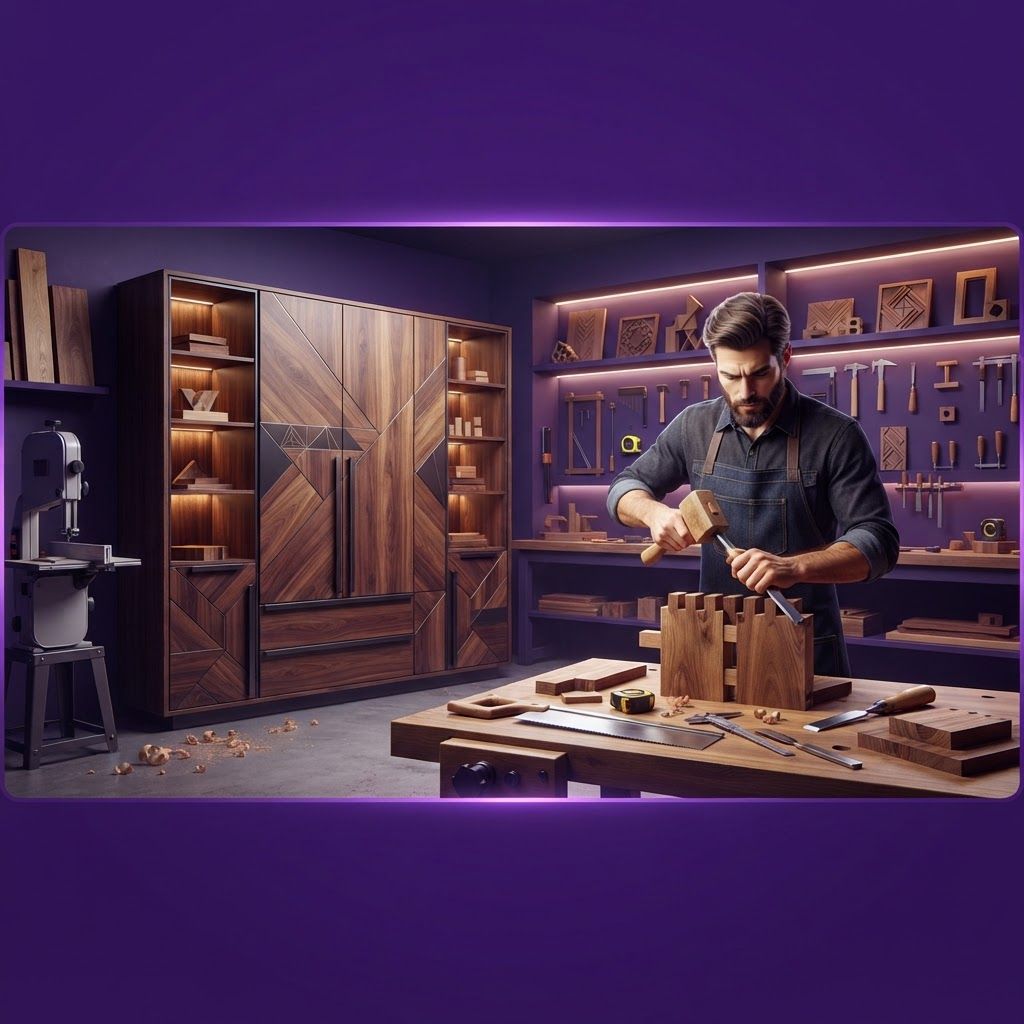
Carpentry Shapes Daily Living
Structural work determines whether a building stands, but carpentry determines how comfortably people live in it. Storage that matches actual belongings, doors that close smoothly for years, kitchen units at the right working height and furniture proportioned to the room all come from good joinery. Poor carpentry, by contrast, produces sagging shelves, doors that stick in humid weather and wardrobes that waste half their internal volume.
Salem has a strong carpentry tradition, with skilled craftsmen producing everything from traditional teak doors to contemporary modular systems. The market now spans two distinct approaches: site-built carpentry executed by carpenters working on the premises, and factory-produced modular joinery assembled on site. Both have legitimate applications, and understanding the difference helps clients choose sensibly.
Site Carpentry Versus Modular Production
Site carpentry offers complete flexibility. Awkward corners, sloping ceilings and irregular dimensions can be accommodated exactly, and the client can adjust details as work progresses. The trade-off is that finish quality depends entirely on individual craftsman skill and site conditions, and dust from cutting and polishing affects the whole property.
Modular production delivers factory-controlled precision with machine-cut panels, properly applied edge banding and consistent finishes. Installation is fast and clean. The limitation is that standard module sizes may not use every millimetre of an irregular space, though good designers minimise this waste.
Many Salem carpentry firms now offer a hybrid approach, using factory-produced carcasses with site-built filler pieces, which captures most of the advantages of both.
Ten Carpentry Services in Salem
Meenakshi Modular Carpentry operates a workshop producing wardrobes, kitchen units and office storage with factory-standard edge finishing and quality hardware.
Sakthi Wood Works is known for traditional solid wood joinery including doors, window frames and staircases, with genuine craftsmanship in detailing.
Kongu Carpentry Services handles a broad mix of residential furniture and built-in storage, valued for reliable scheduling and site tidiness.
Bharath Interiors Carpentry specialises in modular kitchens, combining layout planning with production and installation as a single service.
Annai Joinery Works serves commercial clients with reception counters, workstations and retail display units built to withstand heavy use.
Green Field Wood Solutions emphasises responsibly sourced materials and low-emission boards, appealing to clients concerned about indoor air quality.
Vaigai Furniture Makers produces custom furniture designed around specific room dimensions and client requirements rather than catalogue templates.
Everest Commercial Joinery undertakes larger institutional projects including educational and healthcare furniture with durability as the primary design criterion.
Sri Murugan Carpentry provides repair and restoration alongside new work, refurbishing older wooden furniture and fittings rather than replacing them.
Salem Craft Woodworks rounds out the list with design-led bespoke pieces for clients seeking distinctive, individually made furniture.
Judging Joinery Quality
Material selection is the starting point. Marine grade plywood is appropriate for kitchens and bathrooms where moisture is present, while commercial grade plywood suits dry areas. Particle board and medium density fibreboard have their place but perform poorly in damp conditions. Solid wood remains unmatched for doors and structural furniture elements.
Hardware quality is where cost differences frequently hide. Hinges, drawer channels and handles are used thousands of times over a product's life, and inexpensive versions fail within a few years. Soft-close hinges and full-extension drawer runners from established manufacturers cost more initially but transform daily usability.
Finish inspection is straightforward if you know what to look for. Check that edges are banded on all exposed sides including the back edges of shelves. Run a hand along joints to feel for misalignment. Open and close every door and drawer to check consistent gaps and smooth operation. Look inside cabinets to see whether internal surfaces are finished or left raw.
Planning Carpentry Work
Measure your actual storage needs before designing. Count the clothes, utensils and equipment that must be accommodated, then design around that reality rather than generic assumptions. Shelf spacing, hanging heights and drawer depths should reflect what will genuinely be stored.
Consider ventilation in humid areas. Kitchen and bathroom joinery benefits from ventilation gaps and moisture-resistant materials. In Salem's climate, provision for airflow behind wardrobes placed against external walls helps prevent mustiness.
Agree the specification in writing, listing board type and grade, hardware brands, finish type and the exact dimensions of each unit. Carpentry disputes almost invariably stem from unwritten assumptions.
Trends in Carpentry
Modular systems continue to gain share, driven by faster installation and predictable finish quality. Acrylic and laminate surfaces in matte finishes have largely replaced high-gloss options, partly for practical reasons since they show fingerprints less readily.
Space optimisation features such as pull-out pantry units, corner carousels and lift-up overhead cabinets are increasingly requested in Salem kitchens as households recognise how much usable capacity thoughtful hardware adds.
Final Thoughts
Carpentry is a long-term purchase that is touched every day. The gap between adequate and excellent joinery is largely a matter of material honesty, hardware quality and measurement precision. Visit a carpenter's workshop or completed projects, examine the details closely, document the specification, and choose craftsmanship over the lowest quotation. Well-made joinery still looks and works well after a decade, while cheap work becomes an irritation within months.