
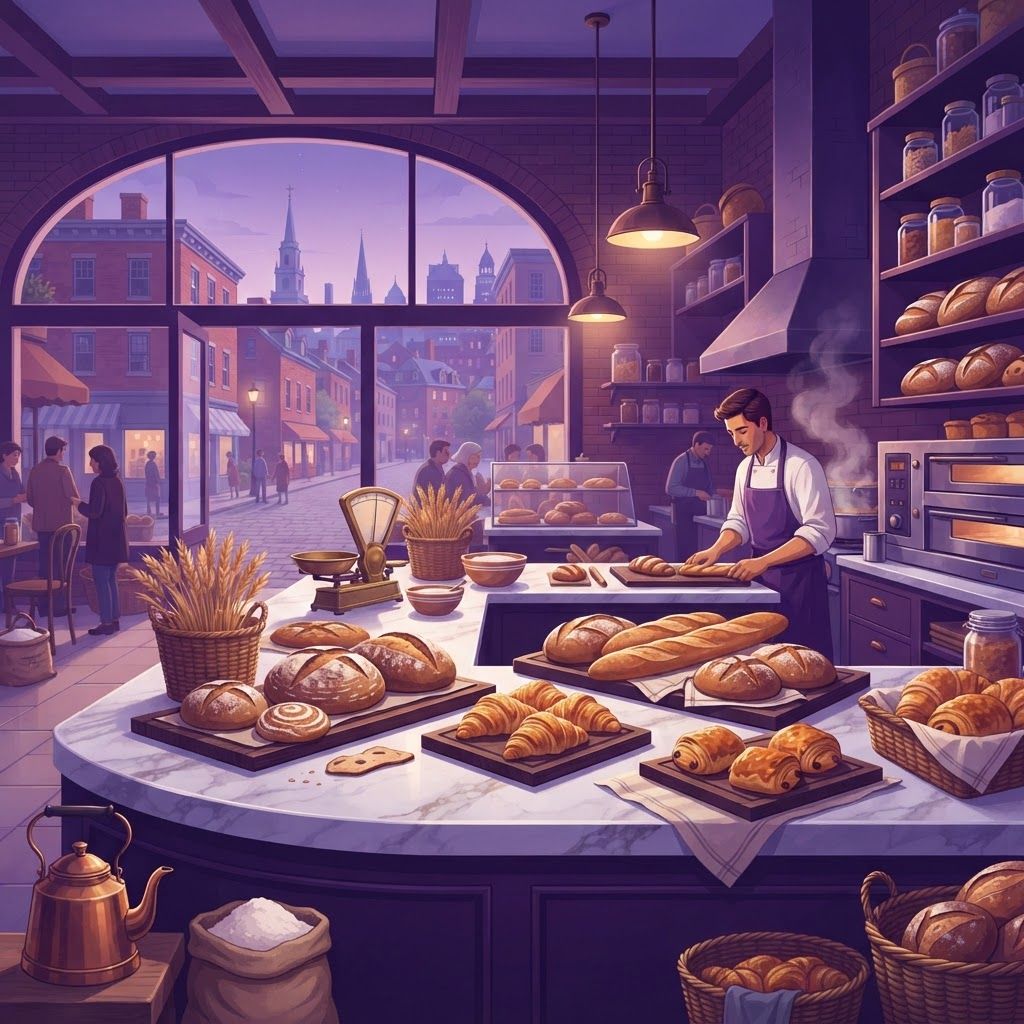
A City Built on Bread and Pastry
Providence has one of the most interesting bakery cultures in New England, and the reason is demographic history. Waves of Italian, Portuguese, Cape Verdean, Irish, and more recently Southeast Asian and Latin American immigrants each brought baking traditions that took root and persisted. Federal Hill became the most visible expression of this, but the pattern repeats across Silver Lake, the West End, and Olneyville.
Layered on top of that heritage is a newer influence. Johnson and Wales University operates one of the country's most respected culinary programs in the city, producing pastry chefs and bakers who frequently stay. The result is a market where a century-old Italian bakery selling pizza strips and zeppole can operate two blocks from a bakery producing naturally leavened country loaves with a forty-eight hour fermentation.
What to Look For in a Great Bakery
Quality signals are consistent across styles. Bread should have an open, irregular crumb when the style calls for it, a crust with genuine color rather than pale softness, and flavor that develops rather than tasting flat. Laminated pastries should shatter visibly when broken, with distinct layers and no greasiness. Cream fillings should taste of dairy and vanilla rather than stabilizer. And the best bakeries sell out, because they bake to demand rather than to shelf life.
The Ten Best Bakeries in Providence
Scialo Bros Bakery on Atwells Avenue is the historic heart of Federal Hill baking. Operating from brick ovens that have been in continuous use for generations, it produces Italian cookies, cannoli, pastiera, and celebration cakes that define the neighborhood's identity. The wedding cookie trays alone have anchored family gatherings across Rhode Island for decades.
Seven Stars Bakery is arguably the most influential modern bakery in the state. With locations serving the East Side, Hope Street, and Rumford, it built its reputation on naturally leavened breads, exceptional morning pastries, and a commitment to quality ingredients. The ginger biscuits and sticky buns have achieved something close to regional landmark status.
Pastiche Fine Desserts on Federal Hill occupies a different niche, focusing on European-style cakes, tarts, and seasonal fruit desserts served in a warm room with a working fireplace. The fruit tarts and layered cakes are the draw, and the atmosphere makes it as much a destination as a bakery.
Ellie's in downtown Providence brings a French patisserie sensibility, producing croissants, macarons, quiches, and elegant plated pastries alongside a full cafe menu. The lamination work is among the most technically accomplished in the city.
Tricycle Ice Cream and adjacent dessert kitchens have expanded into baked goods, but the more important story is the number of small production kitchens supplying cafes across the city with high quality pastry, creating a distributed bakery network.
Olga's Cup and Saucer established a template for seasonal, ingredient-driven baking in Providence, with rustic tarts, scones, and breads that reflect New England produce cycles.
Portuguese bakeries in the East Providence and Fox Point tradition supply malasadas, pastéis de nata, sweet bread, and papo secos that represent one of the region's most distinctive and underappreciated baking cultures.
Cake Bar and specialty cake studios serve the celebration market with custom work, and the technical decorating standard in Providence is notably high thanks to the culinary school pipeline.
Silver Lake Italian bakeries continue to produce the everyday staples of Rhode Island life: pizza strips sold by the sheet, spinach pies, and wandi during holidays. These are neighborhood institutions rather than destinations, which is exactly their value.
Sin Bakery brings a playful, dessert-forward approach with elaborate cakes, brownies, and pastries that appeal to a younger audience while maintaining serious technique.
Rhode Island Baking Specialties
Several items deserve specific mention because they are genuinely regional. Pizza strips, squares of focaccia-like dough topped with seasoned tomato sauce and served at room temperature without cheese, appear at nearly every Rhode Island gathering. Zeppole, filled with pastry cream and topped with an amarena cherry, dominate bakery counters around Saint Joseph's Day. Doughboys, fried dough dusted with sugar, are a summer shoreline tradition. And Portuguese sweet bread appears throughout the year but peaks around Easter.
The Business Behind the Counter
Bakeries operate on difficult economics. Ingredient costs fluctuate, labor starts before dawn, and unsold product is a total loss. The bakeries that endure in Providence manage this through wholesale relationships with restaurants and cafes, which provide predictable baseline volume, and through celebration cake business, which carries higher margins.
Many local bakeries have also shifted toward pre-order systems for specialty items, reducing waste while guaranteeing availability for customers willing to plan ahead.
Visiting Well
A few practical suggestions. Arrive early for laminated pastry, since croissants and morning buns are best within hours of baking and popular items disappear by mid-morning. Order celebration cakes well in advance, particularly around holidays and graduation season. Ask what came out of the oven most recently rather than defaulting to a familiar item. And explore beyond Federal Hill, because some of the best baking in the city happens in neighborhoods that receive far less attention.
Conclusion
Providence rewards anyone willing to explore its bakeries. The combination of preserved immigrant traditions, a serious culinary school, and a population that genuinely cares about food has produced a bakery culture with both depth and range. Whether the goal is a perfect croissant, a tray of Italian cookies, or a loaf of naturally leavened bread, the city delivers at a level that consistently surprises visitors.