
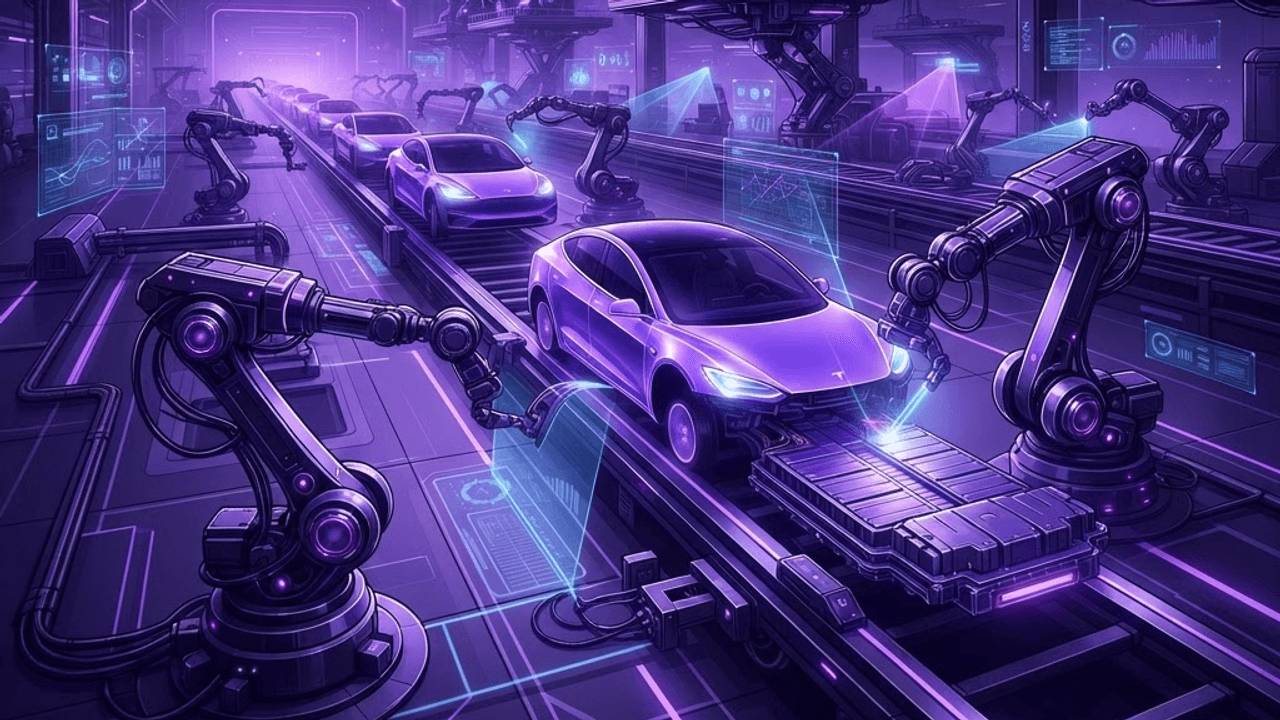
The Automotive Industry Reinvented in Silicon Valley
Automotive manufacturing in Sunnyvale does not involve stamping plants or assembly lines. What the city hosts instead is arguably more influential: the research, engineering and software development that is redefining what a vehicle is. Electric powertrains, autonomous driving systems, advanced driver assistance, in-vehicle computing platforms and connected services are developed here by both established automakers and technology companies that entered the sector from outside.
This concentration exists because the modern vehicle has become a computing platform on wheels. Software now determines much of the driving experience, from energy management to safety systems to over-the-air feature delivery. That reality drew traditional manufacturers to establish innovation centers in Silicon Valley, placing engineering teams close to the semiconductor, artificial intelligence and software talent the industry increasingly requires.
Automotive Companies with a Silicon Valley Presence
Tesla has its manufacturing and engineering operations in the Bay Area and remains the most prominent example of a vehicle company built around software, electric powertrain and direct distribution. Its influence on industry direction has been substantial.
Rivian maintains significant engineering operations in the region focused on electric trucks, sport utility vehicles and commercial delivery platforms. Lucid Motors develops luxury electric vehicles with emphasis on powertrain efficiency and battery technology.
Waymo has advanced autonomous driving technology from the region and operates driverless services in multiple markets. Zoox develops purpose-built autonomous vehicles designed without traditional driver controls.
Nvidia supplies the computing platforms increasingly used for autonomous driving and in-vehicle intelligence, making it a foundational automotive technology supplier despite not building vehicles. Bosch operates research and engineering activities in the area covering sensors, driver assistance and mobility systems.
Mercedes-Benz Research and Development North America has long maintained a Sunnyvale presence working on autonomous driving, user interface and connected vehicle technology. Toyota Research Institute conducts research in automated driving, robotics and materials relevant to future vehicles.
Rounding out the list, Ford and General Motors both operate Silicon Valley technology and innovation centers focused on software, electrification and mobility services, reflecting how thoroughly traditional manufacturers have embraced the region as an engineering base.
Technologies Developed in the Region
Electric powertrain engineering covers motor design, power electronics, thermal management, battery pack architecture and charging systems. Efficiency improvements here translate directly into range and cost.
Battery technology development addresses cell chemistry, pack integration, thermal safety, fast charging capability and state of health estimation. Battery management software has become as important as the cells themselves.
Autonomous driving and advanced driver assistance combine sensors including cameras, radar and lidar with perception, prediction and planning software. Validation at scale, using both real-world miles and simulation, represents an enormous engineering effort.
Vehicle software platforms increasingly consolidate functions that were previously distributed across dozens of separate controllers, enabling over-the-air updates and continuous feature improvement after purchase.
Connected services including navigation, energy routing, remote diagnostics, fleet management and vehicle-to-grid capability extend the vehicle beyond transportation into the broader energy and data ecosystem.
Trends Shaping Automotive Development
Software-defined vehicle architecture is the dominant structural shift. Centralized computing with abstracted hardware allows manufacturers to improve vehicles after delivery and to develop features on software timelines rather than model year cycles.
Charging infrastructure standardization has progressed, simplifying the experience for electric vehicle owners and reducing a longstanding adoption barrier.
Artificial intelligence has moved deeper into both driving systems and manufacturing, applied to perception, simulation, quality inspection and supply chain optimization.
Supply chain regionalization continues, with battery and component production expanding domestically in response to policy incentives and resilience concerns.
Safety validation methodology has matured, with regulators and developers converging on more rigorous frameworks for demonstrating that automated systems perform acceptably across diverse conditions.
What This Means for the Local Ecosystem
For engineers, the concentration of automotive technology employers in the area creates unusual career mobility across vehicle manufacturers, suppliers, semiconductor companies and autonomy developers.
For suppliers and startups, proximity to decision-making engineering teams shortens the path from concept to design win, though automotive qualification requirements remain demanding and timelines long.
For residents, the practical effect is visible daily. Autonomous test vehicles operate on local streets, electric vehicle adoption in Santa Clara County ranks among the highest nationally, and charging infrastructure has expanded accordingly.
Evaluating Automotive Technology Partners
Companies seeking to supply this ecosystem should understand that automotive qualification differs sharply from consumer electronics. Functional safety standards, extended temperature and vibration requirements, long production lifecycles and rigorous change control all apply. A component that performs well in a laboratory demonstration may require years of validation before it appears in a production vehicle.
Engineering organizations evaluating partners should examine demonstrated experience with automotive quality management systems, traceability practices and the documentation depth that manufacturers require during audits. They should also assess whether a supplier can sustain production for a decade or more, since vehicle platforms remain in service far longer than typical consumer products.
For software providers, the critical questions concern update infrastructure, cybersecurity practices and the ability to validate changes across an installed fleet without introducing regressions. Over-the-air capability creates enormous flexibility, but it also raises the consequences of a defective release, and manufacturers scrutinize development processes accordingly.
Final Thoughts
The automotive presence in Sunnyvale represents a genuine transformation of an industry rather than a branch office of it. Electrification, autonomy and software-defined architecture are being engineered here, by companies that build vehicles and by companies that supply the intelligence within them. For anyone tracking where transportation is heading, this region offers the clearest view, and for businesses in the supply chain, participating in that ecosystem increasingly requires understanding software and systems engineering as deeply as mechanical design.