
More Than a Century of Vehicle Production
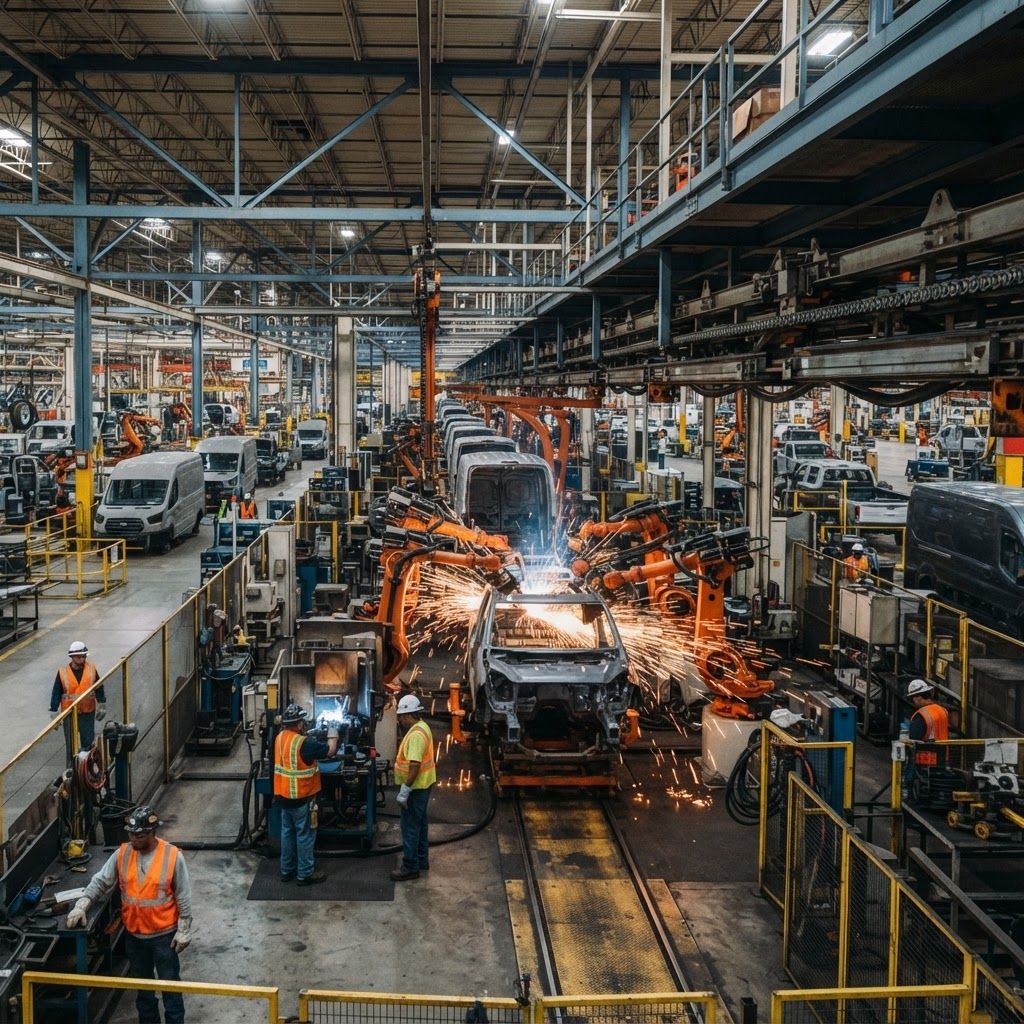
St. Louis has one of the longest continuous automotive manufacturing histories in the United States. The region has built vehicles under multiple nameplates since the earliest decades of the industry, and at its mid-century peak it ranked among the largest auto production centers in the country, second in some years only to Detroit. Plants across the metro produced passenger cars, trucks, and military vehicles, and generations of families built careers on those lines.
The modern picture is more concentrated but far from diminished. General Motors operates its Wentzville Assembly plant in St. Charles County, a major facility producing midsize pickup trucks and full-size vans that employs thousands of workers and has received substantial capital investment. Ford's Kentucky Truck heritage in the broader region and historical plants in Hazelwood shaped the local supplier base that persists today. Around active assembly sits a network of stamping, injection molding, seating, electrical, and logistics operations that constitute the bulk of automotive employment.
How the Automotive Supply Chain Works Locally
Vehicle manufacturing is organized in tiers. Original equipment manufacturers perform final assembly, engineering, and brand management. Tier one suppliers deliver complete systems directly to the assembly line, often sequenced to match production order: seats, instrument panels, exhaust systems, axles, and wiring harnesses. Tier two suppliers provide components and subassemblies to tier ones, including stampings, molded plastics, machined parts, fasteners, and electronic modules. Tier three suppliers furnish raw and semi-finished materials such as steel coil, aluminum extrusion, resin, and specialty coatings.
The St. Louis region hosts participants across all these tiers, plus a substantial aftermarket sector: remanufacturers of engines, transmissions, and electrical components; parts distributors serving multi-state territories; and specialty vehicle modifiers building ambulances, utility bodies, mobility conversions, and commercial upfits. Logistics providers offering sequencing centers, milk-run collection, and just-in-time delivery are integral, since a modern assembly plant depends on materials arriving within tight windows.
What Marks a Strong Automotive Manufacturer or Supplier
Quality management is non-negotiable. IATF 16949 certification, the automotive-specific quality standard, is effectively required for direct supply. Beyond the certificate, buyers should look for functioning core tool discipline: production part approval processes completed properly, failure mode and effects analysis kept current rather than filed once, measurement system analysis performed on gauges, and statistical process control applied to characteristics that actually matter.
Delivery performance ranks equally high. Automotive customers measure suppliers on parts per million defect rates and on-time delivery with unforgiving precision, because a line stoppage costs thousands of dollars per minute. Suppliers that maintain capacity buffers, cross-trained labor, preventive maintenance programs, and contingency logistics plans earn long-term programs.
Cost discipline through continuous improvement is the third pillar. Automotive contracts frequently include annual price reduction expectations, which can only be met through genuine productivity gains: cycle time reduction, scrap elimination, tooling optimization, and automation. Suppliers that treat lean manufacturing as a real operating system rather than a poster on the wall survive these pressures.
Trends Transforming the Industry
Electrification is the defining shift. Battery pack assembly, electric drive units, thermal management systems, and high-voltage wiring create entirely new component categories while reducing demand for traditional powertrain parts. Suppliers with machining expertise concentrated in engine components face genuine transition risk, while those in electrical, thermal, and structural components see opportunity. Midwestern battery and component investment has accelerated, and workforce retraining has become a strategic priority for both companies and unions.
Software content has grown dramatically. Vehicles now contain extensive networked computing, over-the-air update capability, and advanced driver assistance sensors. This has pulled software engineering, cybersecurity, and functional safety expertise into a manufacturing industry that historically valued mechanical skill above all.
Supply chain strategy has shifted toward resilience. Semiconductor shortages demonstrated the fragility of extended lean chains, and manufacturers responded with strategic inventory, dual sourcing, and increased regional sourcing. Automation and advanced manufacturing, including collaborative robotics, vision-guided assembly, additive manufacturing for tooling and fixtures, and digital twin simulation, continue to spread through plants of all sizes.
Guidance for Buyers and Partners
Companies seeking automotive suppliers in the region should evaluate capacity honestly, request process capability data on the specific features that drive function, and audit the facility with a cross-functional team including quality and manufacturing engineering. Review the supplier's own supply base, since a strong shop dependent on a fragile sub-supplier carries hidden risk.
Discuss tooling ownership, program volumes and take-or-pay provisions, engineering change handling, raw material index adjustments, and end-of-production service part obligations before signing. Clear terms on these points prevent the disputes that consume the most management attention later.
Careers and Workforce
Automotive manufacturing remains a source of strong middle-class employment in the region, spanning skilled trades such as tool and die, maintenance electricians, and industrial mechanics; production roles with structured advancement; and technical positions in quality, process engineering, controls, and supply chain. Apprenticeship programs run jointly by employers, unions, and community colleges provide accessible entry points, and electrification has created demand for high-voltage safety and battery handling credentials.
The Road Ahead
St. Louis will remain a meaningful automotive center because it combines assembly capacity, a deep supplier network, central logistics with river, rail, and interstate access, and an experienced workforce. The composition of what is built here will keep changing as propulsion and software evolve. Companies that invest in flexible capacity, digital process control, and continuous workforce development will define the next chapter of a very long local story.