
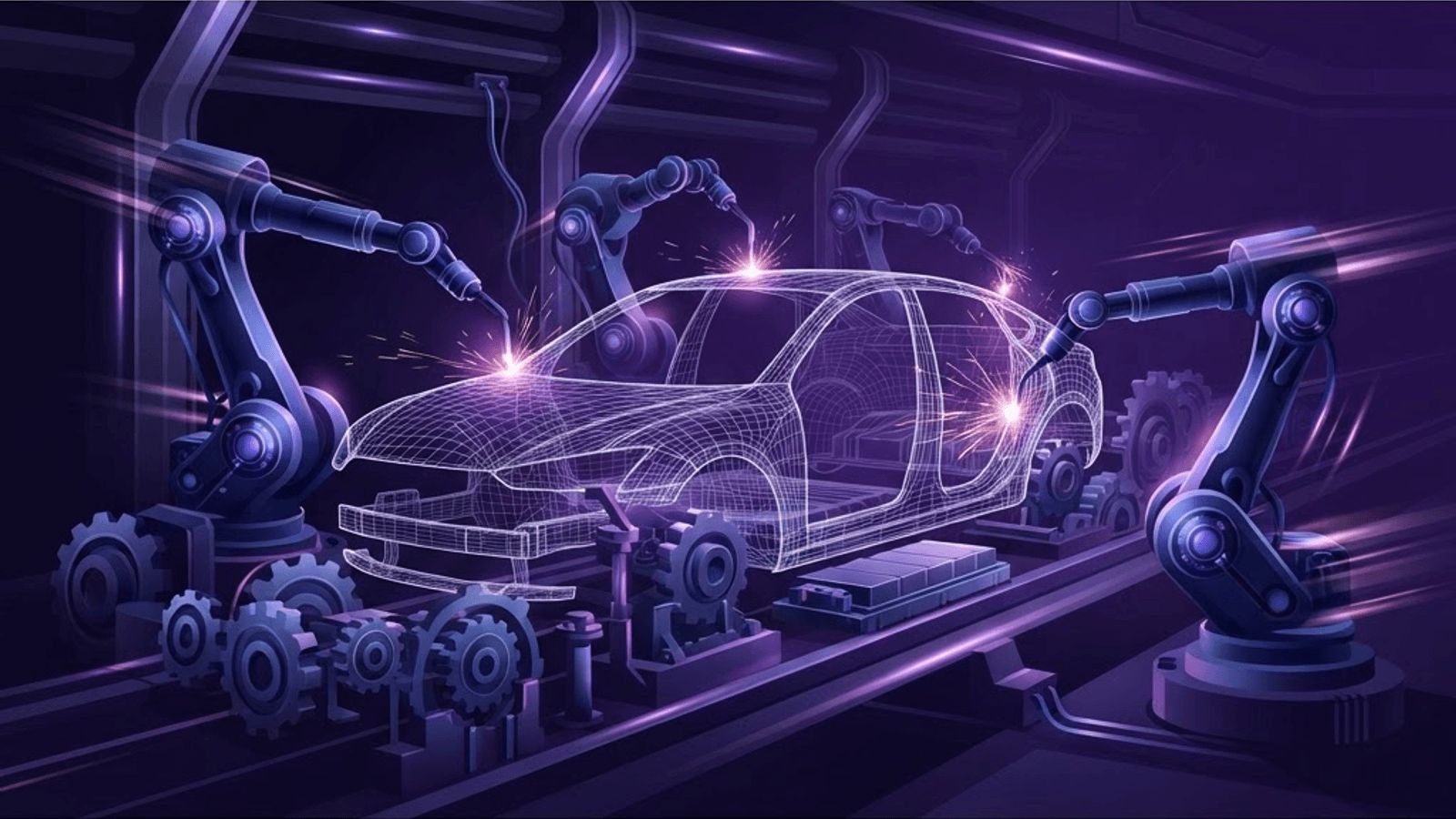
Murfreesboro's Place in the Automotive Corridor
Few regions in the United States have transformed as completely through automotive investment as Middle Tennessee. Vehicle assembly operations anchored the industry decades ago, and an extensive supplier network grew around them: stampers, molders, machinists, seat and interior producers, electronics assemblers, and logistics providers. Rutherford County sits directly within that network, and automotive manufacturing remains one of the largest sources of skilled employment in the area.
The industry is now navigating its most significant transition since the introduction of mass production. Electrification changes the bill of materials fundamentally, removing engines and transmissions while adding battery systems, power electronics, and thermal management. Suppliers built around internal combustion components are diversifying, and new entrants are building capability in battery assembly, electric drive units, and high-voltage wiring. Middle Tennessee has attracted substantial investment in exactly these areas.
How the Supply Chain Is Organized
Original equipment manufacturers assemble complete vehicles. Tier one suppliers deliver complete systems directly to assembly plants, such as seats, instrument panels, or braking systems. Tier two suppliers produce components that feed tier one operations, including stampings, moldings, castings, and machined parts. Tier three providers supply raw materials and basic processing. Aftermarket manufacturers serve replacement parts and accessories independent of assembly schedules.
Understanding this hierarchy matters because requirements differ sharply by tier. Direct suppliers to assembly plants operate under demanding quality, delivery, and documentation standards, with production part approval processes and just-in-time sequencing that leaves little margin for error.
The Top 10 Automotive Manufacturers Serving Murfreesboro
1. Stones River Automotive Systems
A tier one supplier producing interior assemblies and modules delivered in sequence to assembly plants. Their operation combines injection molding, assembly, and logistics coordination under tight delivery windows.
2. Rutherford Precision Stamping
Producing stamped metal components including brackets, reinforcements, and structural parts, with progressive die tooling and in-house tool maintenance. Dimensional stability across long production runs is their core competency.
3. Cedar Bluff Injection Molding
Manufacturing plastic components for interior and under-hood applications, including multi-shot and insert molding. Their engineering team supports part design for moldability, which reduces both tooling cost and cycle time.
4. Gateway Electric Drive Components
Producing components for electric powertrains, including motor housings, busbars, and thermal management parts. This operation represents the region's shift toward electrification-focused manufacturing.
5. Blackman Battery Assembly Solutions
Assembling battery modules and packs with cell handling, welding, thermal interface application, and end-of-line electrical testing under controlled conditions suited to high-voltage work.
6. Oaklands Machining and Powertrain Parts
CNC machining of precision components for transmissions, axles, and chassis systems, with statistical process control and coordinate measuring inspection on critical dimensions.
7. Heritage Seating and Trim
Manufacturing seat frames, foam, and trim covers, integrating textile, foam, and metal processes. Seating is among the most logistics-intensive automotive categories given the variety of configurations required.
8. Salt Creek Automotive Electronics
Assembling control modules, sensors, and wiring interfaces for vehicle systems, operating under automotive-specific quality standards with full traceability on every unit produced.
9. Middle Tennessee Aftermarket Manufacturing
Producing replacement parts and accessories for the service market, including brake components, filtration, and performance products. Aftermarket production offers volume stability less tied to new vehicle cycles.
10. Murfree Tooling and Automation
Building dies, fixtures, assembly equipment, and robotic work cells for automotive plants. As production lines retool for new platforms, this capability determines how quickly a plant can change over.
What Automotive Suppliers Must Deliver
Quality expectations are formalized and non-negotiable. Suppliers must maintain certified quality management systems specific to the automotive sector, complete production part approval documentation, demonstrate process capability statistically, and maintain traceability sufficient to isolate any suspect production window.
Delivery performance is equally strict. Assembly plants hold minimal inventory, so a missed shipment can halt a line at enormous cost. Suppliers maintain safety stock, contingency logistics, and escalation procedures because the consequences of failure are severe and immediate.
Cost discipline is continuous. Long-term agreements typically include annual price reduction expectations, which requires ongoing productivity improvement through automation, scrap reduction, and cycle time gains rather than one-time negotiation.
The Electrification Transition
The shift toward electric vehicles is reshaping supplier strategy across the region. Engine and transmission component makers face declining long-term volume and are pursuing diversification into structural components, thermal systems, or entirely different industries. Meanwhile demand is growing for high-voltage wiring, power electronics cooling, battery enclosures, and lightweight structures.
Workforce development has become central to managing this transition. High-voltage safety training, battery handling procedures, and advanced automation skills are now required where mechanical assembly expertise once sufficed. Regional training partnerships have expanded specifically to address this gap.
Outlook
Middle Tennessee's automotive sector retains strong fundamentals: established infrastructure, logistics advantages, a skilled workforce, and proximity to assembly operations. The suppliers positioned to thrive are those investing in flexible equipment that can serve both conventional and electric platforms, deepening engineering capability rather than competing purely on price, and building the quality systems that make them difficult to replace.
For businesses in and around Murfreesboro, the automotive supply chain remains one of the most significant economic engines in the region, and one undergoing genuine reinvention rather than simple decline.