
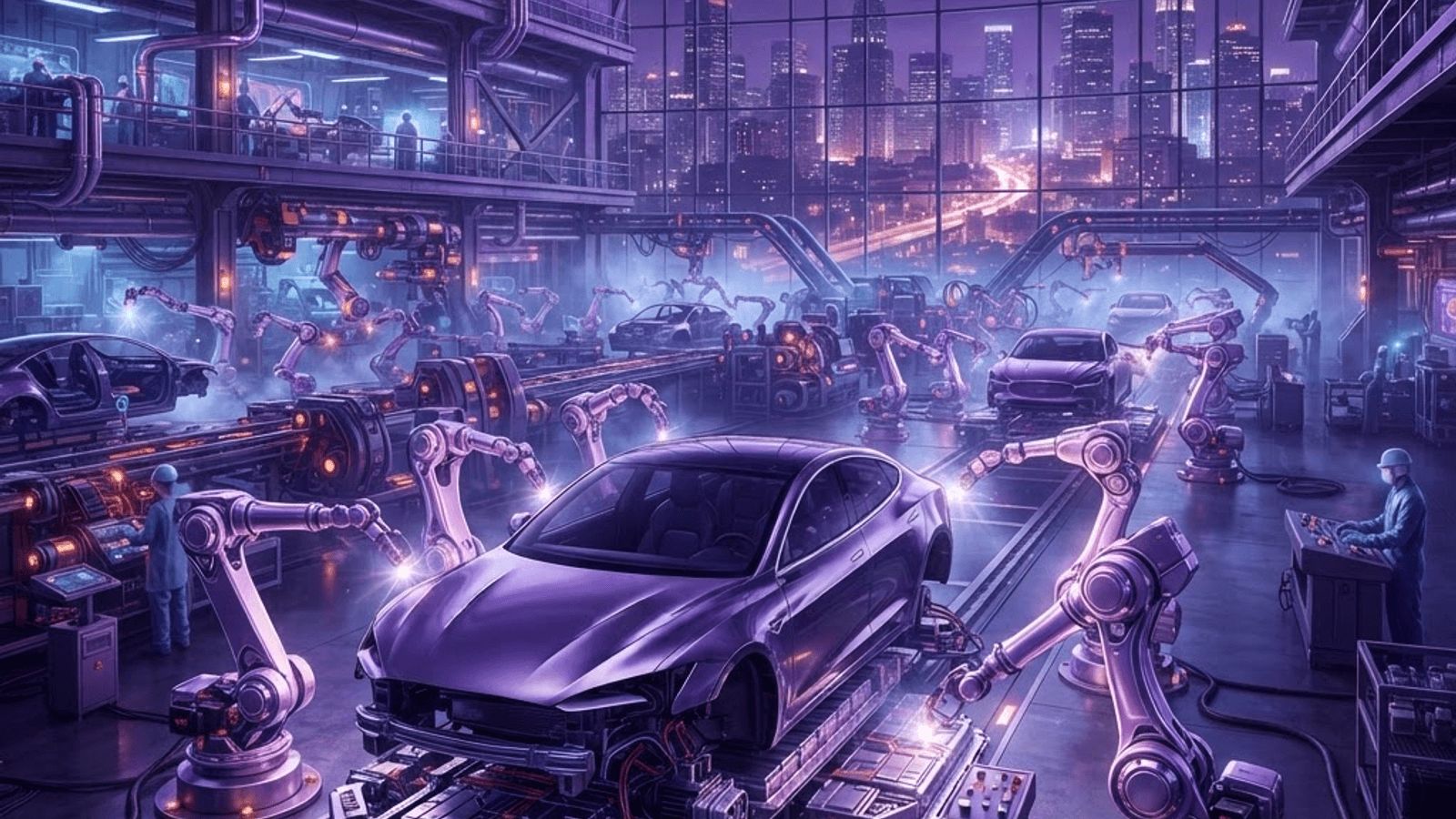
Fremont's Automotive Legacy and Present
Fremont has been a vehicle manufacturing city for more than sixty years. The site that now anchors the local automotive economy began as a General Motors assembly plant, later became the New United Motor Manufacturing joint venture between General Motors and Toyota, and is today one of the highest-output automotive assembly facilities in North America. That continuity means Fremont has something rare in the United States: multiple generations of workers, engineers, and suppliers with direct vehicle manufacturing experience.
The NUMMI period left a particularly important legacy. It introduced Toyota production system methods, including continuous improvement, standardized work, pull-based material flow, and empowering line workers to halt production when a defect appears, to an American workforce. Those practices spread throughout Bay Area manufacturing and remain visible across the region's industrial operations today.
How the Automotive Ecosystem Is Structured
Vehicle manufacturing depends on a layered supplier network. Original equipment manufacturers design and assemble vehicles. Tier one suppliers provide major systems such as seats, powertrain components, and electronics modules directly to assembly plants. Tier two and three suppliers provide components and materials to tier one companies. Around them sit contract manufacturers, tooling and die makers, machining and stamping shops, logistics providers, and engineering services firms. Increasingly, software and autonomy companies have become integral, since a modern vehicle's differentiation is substantially digital.
The Top 10 Automotive Manufacturers and Suppliers Connected to Fremont
1. Tesla
Tesla's Fremont factory is the city's defining industrial operation, assembling multiple vehicle models along with substantial in-house component production including stamping, casting, seats, and drive units. Its vertical integration strategy, producing internally what most manufacturers outsource, has influenced industry thinking about supply chain control and manufacturing speed.
2. Lucid Motors
Headquartered in the Bay Area, Lucid develops premium electric vehicles with an emphasis on powertrain efficiency and energy density. Its engineering presence contributes to the regional talent pool in electric drive systems, power electronics, and battery pack design.
3. Rivian
Rivian maintains significant Bay Area engineering operations focused on electric trucks, SUVs, and commercial delivery vehicles. Its work on software-defined vehicle architecture and fleet applications reflects where the industry is heading, with software capability treated as core rather than supplemental.
4. Zoox
Zoox develops purpose-built autonomous vehicles rather than retrofitting conventional designs, which requires integrating vehicle engineering, sensing, and autonomy software as one system. Its Bay Area operations connect the region's software strength directly to vehicle manufacturing.
5. Waymo
Waymo's autonomous driving technology represents the software and sensing side of automotive manufacturing, with hardware integration partnerships alongside its own systems development. Its presence sustains regional demand for sensor engineering, validation, and simulation expertise.
6. Battery Cell and Pack Manufacturers
Battery systems are the highest-value component in an electric vehicle, and the Bay Area hosts substantial cell chemistry research, pack engineering, and thermal management development. Companies in this segment work on energy density, fast charging capability, safety architecture, and increasingly on recycling and material recovery.
7. Power Electronics and Drive Unit Suppliers
Inverters, converters, onboard chargers, and motor controllers determine vehicle efficiency and performance. Fremont's electronics manufacturing base supplies and assembles these systems, and the discipline overlaps closely with renewable energy power electronics, allowing engineering talent to move between sectors.
8. Precision Machining and Stamping Suppliers
Vehicle production consumes machined components, stamped structures, brackets, and fasteners in enormous quantity. Fremont-area machining and metal forming shops supply these parts, and their tolerance capability and volume consistency directly affect assembly quality and line efficiency.
9. Automotive Wire Harness and Interconnect Manufacturers
Modern vehicles contain extensive wiring, and high-voltage systems in electric vehicles impose demanding requirements for insulation, shielding, and connector reliability. Harness manufacturers serving automotive customers work to strict validation standards because interconnect failure in a high-voltage system is a safety issue.
10. Automotive Engineering and Testing Services Firms
Engineering services providers support vehicle development with simulation, prototype fabrication, durability and environmental testing, and regulatory certification. For newer manufacturers without complete in-house capability, these firms provide validation depth that would otherwise take years to build.
Careers in Fremont Automotive Manufacturing
The sector offers a genuinely wide range of career paths. Production roles include assembly technicians, material handlers, quality inspectors, and equipment operators, many accessible without a four-year degree and with structured advancement into team lead and technical positions. Skilled trades include maintenance technicians, electricians, welders, and robotics technicians, and these roles are consistently in demand.
Engineering paths span manufacturing engineering, process and industrial engineering, quality engineering, electrical and battery systems, controls, and software. Supporting functions include supply chain, logistics, environmental health and safety, and program management. Local community colleges and technical programs, including those in the Fremont area, offer credentials in mechatronics, welding, and industrial maintenance that map directly onto these openings.
Becoming a Supplier
Companies seeking to supply automotive manufacturers should understand the requirements before approaching. Quality system certification appropriate to automotive production is typically expected, along with documented process control and capability data. Production part approval processes require detailed submissions demonstrating that a part can be made repeatably within specification. Capacity commitments, traceability, and change control discipline are non-negotiable, since a supplier problem can halt an assembly line.
Practically, most successful suppliers start with lower-risk components or aftermarket and service parts, build a performance record, and expand into production content. Demonstrating on-time delivery, responsive corrective action, and transparent communication matters more in this industry than price alone, because the cost of a line stoppage dwarfs component savings.
Trends Shaping the Next Decade
Several shifts are underway. Electrification continues to change the supplier mix, reducing demand for engine and transmission components while expanding battery, power electronics, and thermal management content. Software-defined vehicle architecture is consolidating dozens of controllers into fewer high-performance computers, changing electronics sourcing significantly. Manufacturing automation is advancing with more capable robotics and machine vision inspection. Battery recycling and material recovery are becoming genuine industries as early electric vehicle fleets age. And supply chain regionalization continues, with manufacturers seeking domestic and near-shore sources for critical components.
Final Thoughts
Fremont occupies a distinctive position as both a historic and a leading-edge automotive manufacturing city, combining large-scale assembly with the software and power electronics expertise the industry now requires. For workers, the sector offers accessible entry paths and strong technical careers. For suppliers, it offers proximity to demanding customers whose standards, once met, open doors across the industry.