
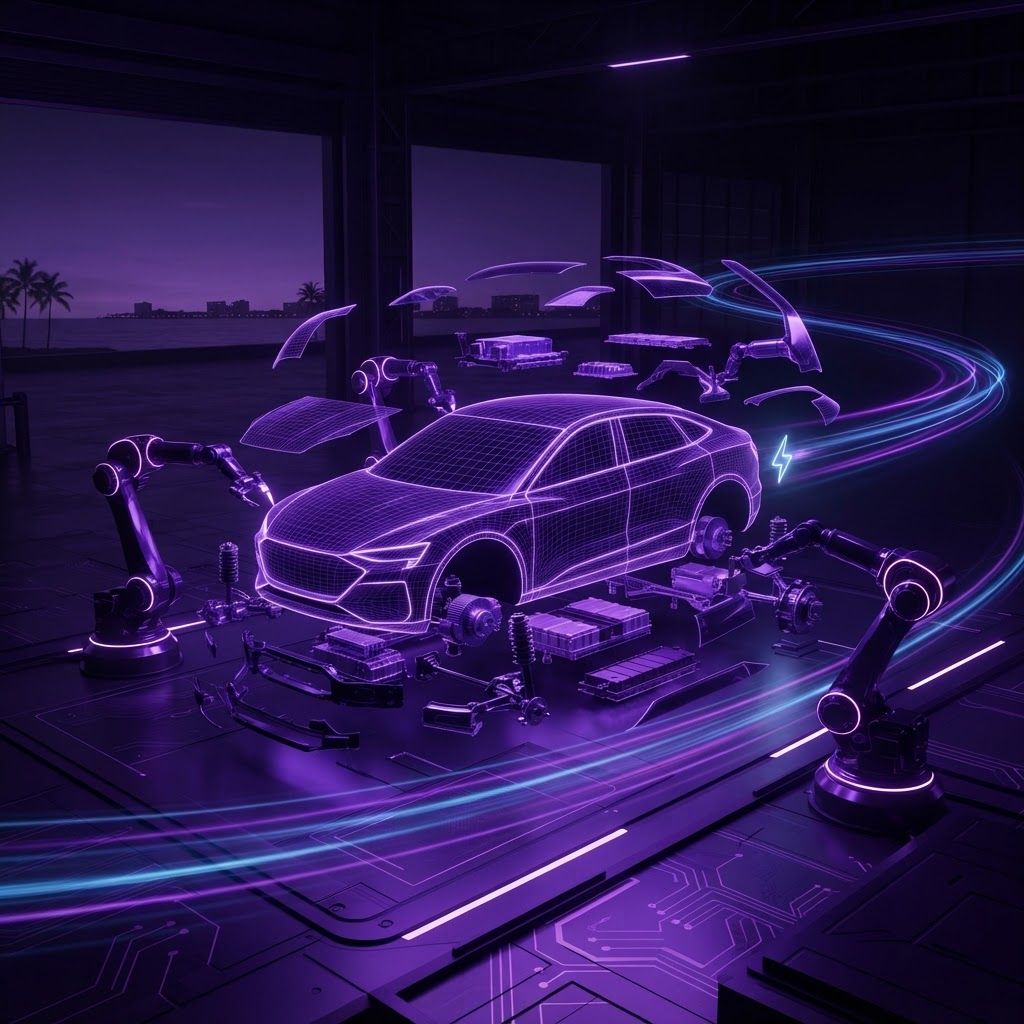
Specialty Vehicle Manufacturing in South Florida
There is no large automotive assembly plant in Broward County, and that fact shapes everything about the local industry. What Fort Lauderdale offers instead is a dense concentration of specialty manufacturers, upfitters, restorers, and performance engineers. These operations take base vehicles and chassis and transform them into ambulances, mobile medical units, luxury transport coaches, electric conversions, restored classics, and purpose-built commercial fleets.
Demand comes from the region itself. A tourism economy needs shuttles and limousines. A marine industry needs specialized transport and service vehicles. A wealthy residential base supports high-end restoration and customization. An export corridor to Latin America and the Caribbean creates steady volume for vehicles adapted to those markets.
Ten Automotive Manufacturers and Specialty Builders
1. Commercial vehicle upfitters in the Fort Lauderdale industrial corridor convert cargo vans and chassis cabs into service vehicles with shelving, power systems, refrigeration, and equipment mounting. Marine service companies and trades contractors are the primary customers.
2. Ambulance and emergency vehicle manufacturers serving South Florida build and remount patient transport modules with medical gas systems, electrical distribution, and lighting engineered to demanding standards. Reliability requirements here are absolute.
3. Luxury coach and limousine builders produce executive shuttles and party coaches with custom interiors, entertainment systems, and climate control sized for a subtropical climate. Fit and finish expectations mirror the yacht industry next door.
4. Electric vehicle conversion specialists retrofit classic and commercial vehicles with battery electric drivetrains. Low-speed electric vehicles for gated communities, resorts, and campuses are a particularly strong niche in South Florida.
5. Classic car restoration shops in Broward perform frame-off restoration, metal fabrication, paint, and mechanical rebuilds. The region's collector market and year-round driving season sustain a deep pool of skilled craftspeople.
6. Performance engineering firms build engines, forced induction systems, and suspension packages for track and street use, often supporting the regional motorsport community with fabrication and tuning.
7. Marine transport and trailer manufacturers produce heavy-duty boat trailers and hydraulic transport equipment. Corrosion resistance is the core engineering requirement, since these trailers are immersed in salt water repeatedly.
8. Food truck and mobile business builders convert chassis into commercial kitchens, mobile retail units, and service vehicles compliant with health and fire codes. Ventilation, propane systems, and power generation are the technical heart of the work.
9. Vehicle armoring companies operating in South Florida install ballistic protection for clients in security-sensitive roles, frequently for export to Latin American markets. Weight management and suspension reengineering are critical to preserving handling and braking.
10. Accessibility conversion manufacturers adapt vehicles with wheelchair lifts, lowered floors, and hand controls, serving both individual customers and paratransit fleets across Broward County.
Engineering for the South Florida Environment
Vehicles built in and for this region face conditions that inland manufacturers rarely consider. Salt air accelerates corrosion on any exposed steel, so specialty builders specify galvanized or stainless components and apply cavity wax and undercoating routinely. Persistent ultraviolet exposure degrades paint, trim, and interior materials, making coating selection and glass treatment consequential rather than cosmetic.
Thermal load is equally significant. An air conditioning system adequate in a temperate climate will struggle in a vehicle parked in direct sun on an August afternoon. Builders oversize cooling capacity, add insulation, and specify heat-rejecting glazing as standard practice rather than as upgrades.
Electrical corrosion is the quiet failure mode. Sealed connectors, marine-grade terminals, dielectric grease, and properly routed harnesses prevent the intermittent faults that plague vehicles assembled without regard for humidity.
Electrification and the Commercial Fleet
Electric drivetrains are gaining ground fastest in predictable-route commercial applications rather than in personal vehicles. Airport shuttles, resort transport, delivery vans on fixed routes, and campus utility vehicles all have known daily mileage and return to a single depot overnight, which resolves the charging problem entirely.
Fort Lauderdale converters and upfitters are responding by developing depot charging infrastructure expertise alongside vehicle work. The vehicle is only part of the deliverable; electrical service capacity, charger placement, and load management often determine whether a fleet conversion succeeds.
Battery thermal management is a genuine regional engineering concern. High ambient temperatures accelerate cell degradation, so builders working in South Florida prioritize liquid-cooled packs and conservative charge rates over headline fast-charging specifications.
Compliance and Certification
Specialty vehicle manufacturing carries substantial regulatory obligation. Final-stage manufacturers must certify compliance with federal motor vehicle safety standards, maintain documentation, and affix appropriate labeling. Weight distribution and gross vehicle weight rating limits must be respected, a constraint frequently violated by inexperienced upfitters who add equipment without recalculating axle loads.
Commercial vehicles face additional requirements around lighting, visibility, and in some cases inspection. Food service vehicles must satisfy health department and fire safety review. Buyers should ask to see the manufacturer's certification process and documentation rather than assuming it exists.
Choosing a Builder
Ask how long the shop has operated and request to see vehicles delivered several years earlier. In an environment this corrosive, a five-year-old build reveals build quality that a showroom-fresh unit conceals.
Clarify the warranty structure, particularly how it interacts with the base vehicle manufacturer's coverage. A poorly executed modification can void chassis warranty, and a professional builder will explain precisely where the boundary lies.
Finally, evaluate documentation. A quality specialty manufacturer delivers wiring diagrams, component manuals, and a parts list with the vehicle. That package determines how easily any competent technician can service the vehicle years later, and its absence is a reliable signal of a shop cutting corners.