
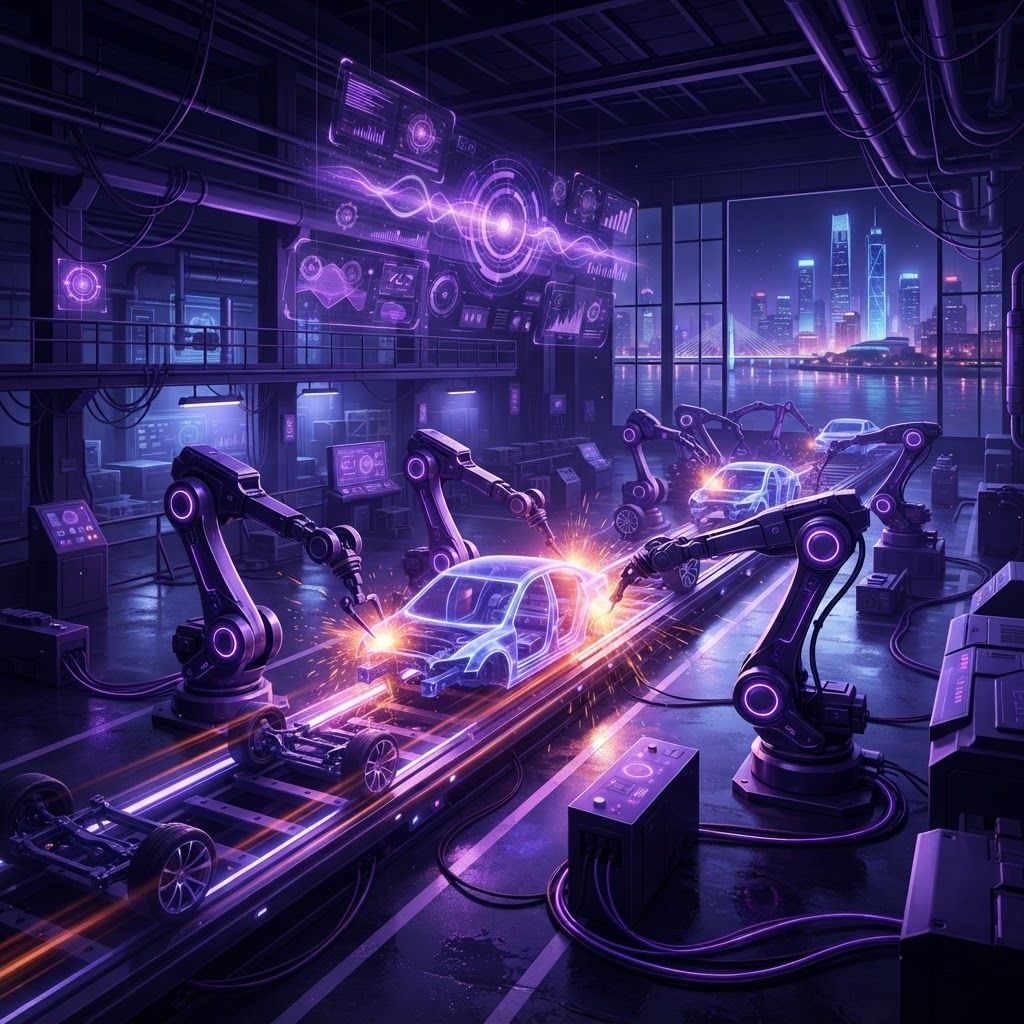
The Automotive Corridor Around Cincinnati
Cincinnati's position at the junction of Ohio, Kentucky, and Indiana places it inside one of the most concentrated automotive manufacturing corridors in North America. Within a few hours' drive are vehicle assembly plants, engine and transmission facilities, stamping operations, and hundreds of tier one and tier two suppliers. The region's rail access, interstate connectivity, river logistics, and skilled industrial workforce made it a natural fit as the industry expanded through the Midwest and upper South.
Locally, the automotive economy shows up in several forms: component manufacturing, precision machining, tooling and dies, plastics and injection molding, coatings and surface treatment, wiring and electronics, logistics and sequencing operations, and increasingly electrification-related production including battery components and power electronics.
Manufacturers and Suppliers Shaping the Region
Toyota's North American engineering and manufacturing operations in northern Kentucky have long been a defining presence, influencing supplier quality expectations, lean manufacturing adoption, and workforce development across the entire region.
Ford Motor Company operations in the broader Ohio and Kentucky area, including transmission and assembly facilities within regional reach, generate substantial supplier demand in southwest Ohio.
General Motors regional plants and their supply networks draw on Cincinnati area machining, stamping, and plastics capacity for components and subassemblies.
Bosch and its Ohio manufacturing operations supply braking systems, sensors, and electronic control modules, representing the technology-heavy end of the supplier base.
Dana Incorporated maintains Ohio operations producing driveline, sealing, and thermal management products for light and commercial vehicles.
Milacron and plastics equipment builders in the Cincinnati area supply injection molding machinery and hot runner systems used throughout automotive interior and exterior component production.
Meyer Tool and regional precision machining companies produce high-tolerance components and tooling that serve both aerospace and automotive powertrain applications.
Kirk and regional tool and die shops build stamping dies, fixtures, and check gauges, a capability that remains critical and increasingly scarce.
Mubea and fastener and spring manufacturers with Ohio and Kentucky facilities supply high-strength components where fatigue performance and dimensional consistency are paramount.
Regional coatings and heat treatment providers deliver plating, phosphating, painting, and induction hardening services that finish components before final assembly.
How Electrification Is Changing the Supply Base
The transition toward electric powertrains is reshaping regional automotive manufacturing in ways that reward adaptability. Demand for engine block machining, fuel system components, and exhaust hardware faces long-term pressure, while opportunity grows in battery enclosures, busbars and high-voltage connections, electric motor laminations and housings, thermal management systems, power electronics cooling, and lightweight structural components.
Suppliers that invested in aluminum machining, precision stamping of thin electrical steel, high-voltage insulation processes, and cleanliness-controlled assembly are positioned well. Those dependent on a single legacy internal combustion program face genuine risk, which is why many regional shops have deliberately diversified into aerospace, medical, and industrial markets alongside automotive.
Supplier Quality Expectations
Automotive supply is among the most demanding environments in manufacturing. Suppliers typically operate under sector-specific quality management standards, submit production part approval documentation, maintain control plans and failure mode analyses, demonstrate measurement system capability, and sustain statistical process control on key characteristics.
Beyond documentation, customers evaluate delivery performance ruthlessly, since a late shipment can stop an assembly line at enormous cost. Suppliers must therefore demonstrate capacity planning, contingency tooling, safety stock strategy, and business continuity plans covering equipment failure, labor disruption, and sub-tier supply interruption.
Cost expectations include annual productivity commitments, which means suppliers must continuously improve throughput and yield simply to maintain margin. This dynamic favors companies with disciplined continuous improvement cultures rather than those relying on price increases.
What Buyers and Partners Should Assess
When qualifying a regional automotive supplier, review quality certification status and audit history, capacity utilization and available machine hours, engineering support for design changes, tooling ownership and maintenance responsibility, and financial stability given the industry's cyclicality. Ask for launch history on recent programs, since disciplined launch execution predicts future performance better than general capability claims.
Discuss logistics explicitly, including packaging standards, labeling requirements, sequencing or kitting capability, and whether the supplier can support just-in-time delivery windows. For companies serving multiple assembly plants, proximity advantages only materialize if the supplier's shipping discipline matches customer expectations.
Final Thoughts
Cincinnati's automotive manufacturing base combines legacy machining and tooling strength with growing electrification capability, all within reach of major assembly operations. The suppliers thriving here are those investing in flexible equipment, diversifying end markets, and treating quality documentation and delivery reliability as non-negotiable. For buyers, the region offers depth of capability and logistics advantages that few areas in North America can match.