
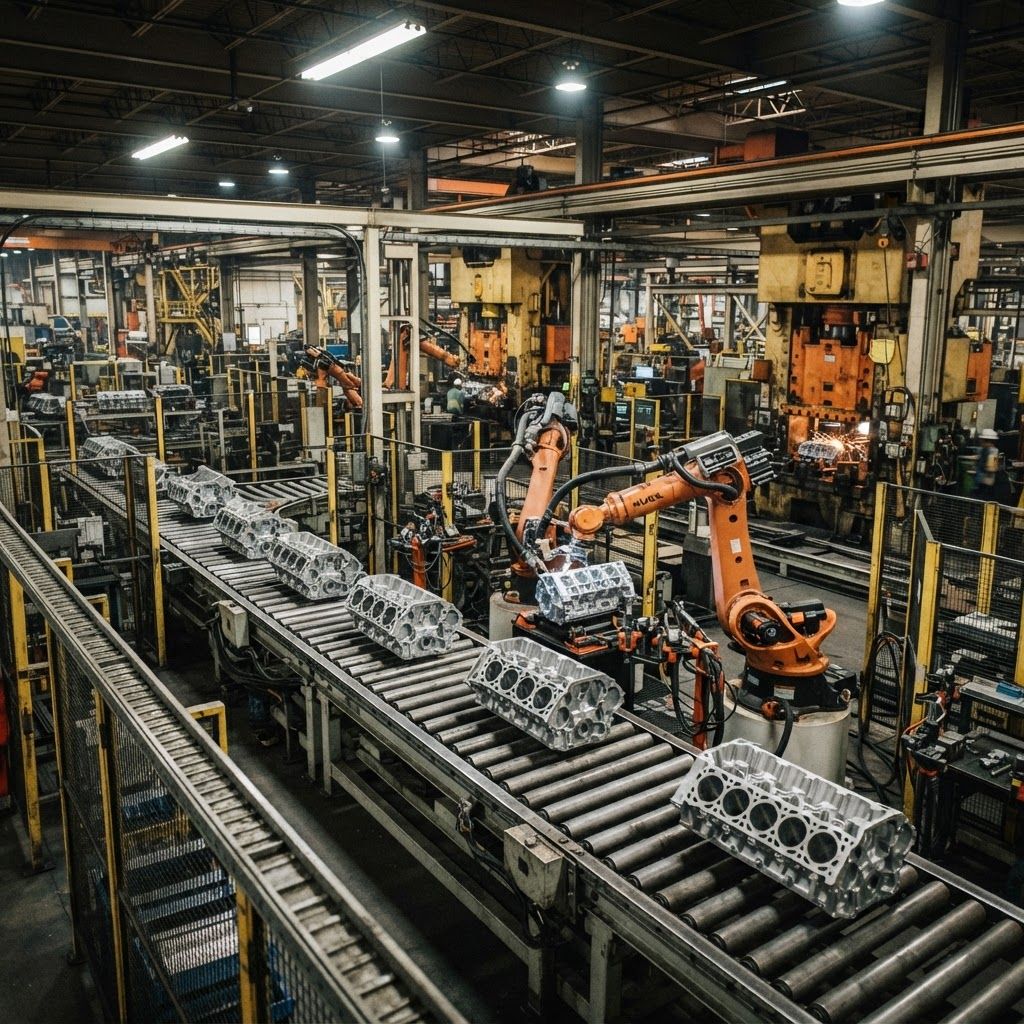
Buffalo's Enduring Place in the Auto Industry
Buffalo's automotive history is longer and more central than most people realize. The region was an early automobile manufacturing center, and through the twentieth century it became a major supplier of engines, stampings, axles, radiators and forgings to Detroit. While employment in the sector declined sharply from mid-century peaks, automotive manufacturing never left Western New York. It consolidated into a smaller number of larger, more capital-intensive facilities and a broad base of specialized suppliers.
Geography explains much of the persistence. Buffalo sits within a day's truck drive of assembly plants in Michigan, Ohio, Indiana, Ontario and Kentucky. Ontario's automotive cluster is immediately across the border, and the region's rail infrastructure supports heavy inbound and outbound freight. Low-cost hydroelectric power matters for energy-intensive processes like aluminum casting and heat treatment.
Ten Automotive Manufacturers and Suppliers
1. General Motors Tonawanda Propulsion Systems is the anchor of Buffalo's automotive sector and one of the longest continuously operating engine plants in the world. The facility has produced engines for well over a century and has received significant investment for current-generation powertrains, making it a critical node in North American propulsion manufacturing and a major regional employer.
2. Ford Buffalo Stamping Plant in Woodlawn produces sheet metal stampings for vehicle assembly plants across North America. Stamping operations require enormous presses, sophisticated die management and tight quality control, and the plant's continued operation reflects genuine competitiveness.
3. American Axle & Manufacturing has maintained operations in Western New York producing driveline and drivetrain components. Axle and driveline manufacturing combines forging, machining, heat treatment and assembly, drawing on precisely the capabilities the region developed historically.
4. Sumitomo Rubber and tire operations in the region represent the rubber and elastomer segment of automotive supply. Tire manufacturing is capital-intensive and energy-intensive, and Western New York's utility costs are a meaningful factor in facility economics.
5. Cummins operations in Western New York support engine components and related systems, reflecting the commercial vehicle and off-highway segment that is often overlooked in automotive discussions but represents substantial regional employment.
6. Steuben Foods and other regional processors illustrate how automotive-grade manufacturing discipline spreads across industries locally, but the more direct comparison is the region's foundries and casting operations, which supply engine blocks, housings and structural components to multiple vehicle programs.
7. Precision machining suppliers across Erie and Niagara counties form the tier-two and tier-three backbone of the sector, producing machined components to demanding tolerances with automotive quality systems. Many of these firms are family-owned and have supplied the same customers for generations.
8. Tool and die shops in the Buffalo area build and maintain the stamping dies, molds and fixtures that vehicle production depends on. Die-making expertise takes decades to develop and is one of the harder capabilities to relocate, which anchors work in the region.
9. Plastic injection molders serving automotive interiors and under-hood applications produce trim, housings, ducts and functional components. Automotive molding requires stringent process control, extensive validation and often in-line assembly of multi-component parts.
10. Buffalo Manufacturing Works and regional workforce partners support the sector through automation adoption, additive manufacturing for tooling, and technical training. As electrification changes required skills, this kind of shared infrastructure becomes increasingly important to supplier survival.
Electrification and What It Means Locally
The transition to electric vehicles is the defining strategic question for Buffalo's automotive base. The mechanical content of an electric powertrain differs substantially from an internal combustion one, with fewer machined parts, no exhaust system, no transmission in the traditional sense and a much larger role for battery systems, power electronics and thermal management.
For the region, this is neither an obvious threat nor an obvious opportunity. Engine plants face long-term uncertainty, though the timeline has extended as hybrid demand has proven more durable than many forecasts assumed. Meanwhile, electric vehicles require large aluminum and steel structural castings, battery enclosures, thermal management components, high-voltage cabling and power electronics cooling, all of which draw on regional capabilities in casting, stamping, machining and assembly.
Suppliers that have invested in aluminum processing, large-format welding, thermal systems and electronics integration are positioning well. Those wholly dependent on engine-specific machining face a genuine transition problem, and the most successful have diversified into aerospace, medical and industrial markets to reduce concentration.
Workforce and Skills
The most consistent concern voiced by Buffalo automotive manufacturers is skilled trades availability. Toolmakers, CNC programmers, maintenance electricians, controls technicians and quality engineers are in short supply, and the demographic profile of the existing workforce means retirements are accelerating.
Responses have included expanded apprenticeship programs, partnerships with Erie Community College and regional BOCES programs, and internal training pipelines that recruit from adjacent industries. Companies that treat training as a capital investment rather than an expense have measurably better retention and are better able to absorb new technology.
What Buyers and Partners Should Evaluate
For OEMs and tier-one buyers evaluating Western New York suppliers, the relevant questions are conventional but consequential. Confirm quality system certification, typically IATF 16949 for production parts. Review process capability data and PPAP documentation practice. Assess capacity honestly, including whether quoted capacity assumes additional shifts or equipment. Examine financial stability, since supplier insolvency is among the most disruptive events in an automotive supply chain.
Also evaluate engineering participation. Suppliers who contribute to design for manufacturability early reduce program cost and launch risk substantially. Buffalo's better suppliers actively market this capability, and it is worth testing during the quoting process.
Outlook
Automotive manufacturing in Buffalo is smaller than it was but genuinely durable, anchored by major powertrain and stamping facilities and supported by an unusually deep tooling and machining base. The region's cost structure, power advantages and location within the North American assembly footprint remain real. The determining factor over the next decade will be how quickly suppliers redeploy capability toward electrified and lightweight vehicle content, and the infrastructure to support that transition is largely already in place.