
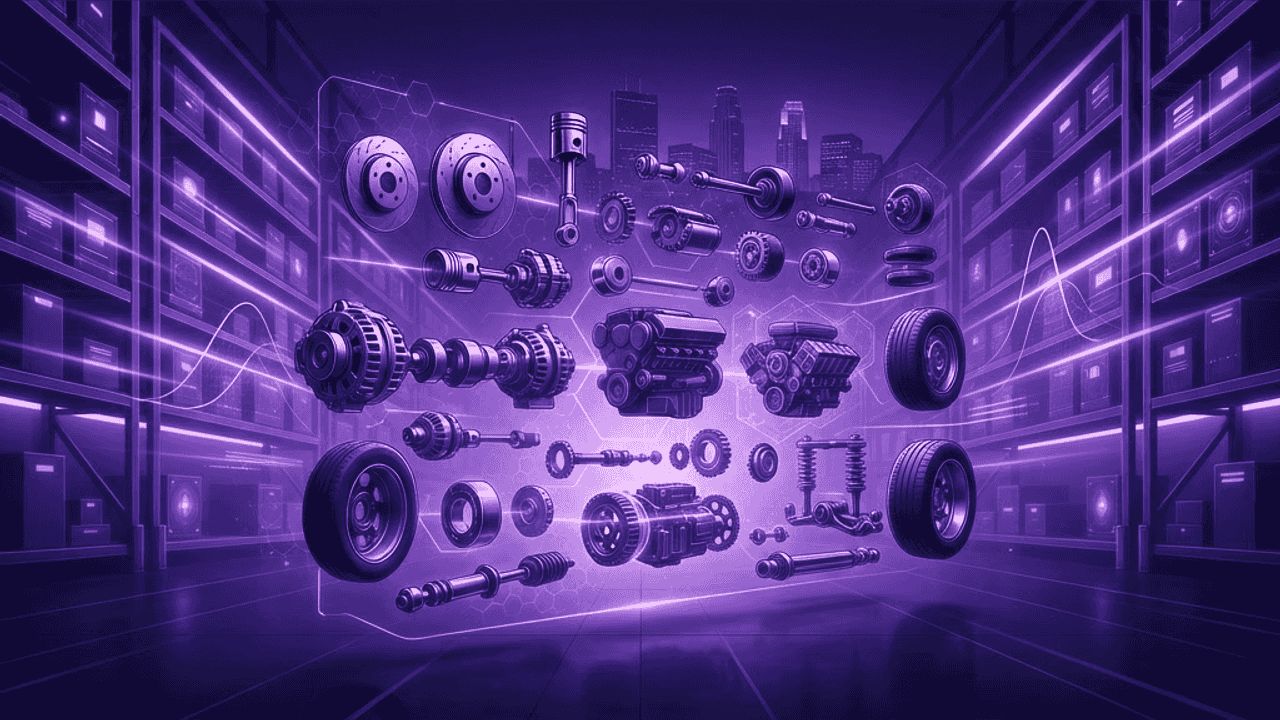
Few markets test automotive parts supply chains like Minneapolis. Road salt accelerates corrosion, freeze-thaw cycles punish suspension components, sub-zero mornings expose weak batteries and starters, and pothole season arrives every spring like clockwork. For repair shops, the difference between a profitable and unprofitable week often comes down to whether a wholesaler can deliver the right part within the hour.
This guide reviews the auto parts wholesalers that serve the Twin Cities most effectively, then explores industry trends and a practical framework for evaluating suppliers.
What Makes the Minneapolis Parts Market Unique
Three characteristics define demand here. First, seasonality is extreme: batteries, block heaters, wiper systems, tires and cooling components spike in predictable windows. Second, the regional vehicle mix skews heavily toward all-wheel-drive crossovers, pickups and work vans, which shifts demand toward drivetrain, brake and chassis components. Third, corrosion-related repairs are far more common than in temperate markets, driving steady volume in brake lines, exhaust components, fuel and suspension hardware.
Successful wholesalers respond with dense local inventory and multiple daily delivery routes rather than relying on regional distribution centers hundreds of miles away.
The 10 Best Auto Parts Wholesalers in Minneapolis
1. North Loop Auto Parts Distributors
A broad-line wholesaler with deep coverage of brakes, filtration, ignition, cooling and undercar components, North Loop is known for multiple same-day delivery runs across the metro. Their electronic catalog integrates with common shop management systems, which reduces lookup errors on year-make-model-engine variants.
2. Twin Cities OEM Parts Network
This wholesaler focuses on genuine and OEM-equivalent components sourced through dealer channels. Shops handling newer vehicles, ADAS-related repairs and warranty-sensitive work rely on them when aftermarket alternatives risk calibration or fitment problems.
3. Great Northern Truck & Fleet Parts
Specializing in medium and heavy-duty applications, Great Northern supports municipal fleets, delivery operators and contractors. Inventory spans air brake systems, hydraulics, filtration, lighting and drivetrain components, with will-call counters open early to catch pre-shift repairs.
4. Lakeside Import Auto Supply
Lakeside concentrates on European and Asian import platforms, stocking timing components, sensors, cooling parts and model-specific service kits. Their technical support team is a differentiator, helping technicians confirm supersessions and revision-level differences that generic catalogs miss.
5. Mississippi Valley Undercar Wholesale
Focused on brakes, steering, suspension and exhaust, this wholesaler carries corrosion-resistant coated rotors, stainless hardware and pre-bent brake lines suited to salt-belt conditions. For Minneapolis shops, that specialization translates directly into fewer comebacks.
6. Bridgeview Electrical & Battery Distributors
Bridgeview built its business around starting, charging and electrical systems, including AGM and lithium battery technologies, alternators, starters and wiring repair supplies. They maintain heavy winter stock positions and offer battery testing support for shop counters.
7. Prairie State Auto Body Supply
Serving collision repair, Prairie State supplies sheet metal panels, bumper covers, lighting assemblies, refinish materials, abrasives and fasteners. Their estimating support and parts-matching accuracy help body shops avoid supplement delays with insurers.
8. Metro Performance & Off-Road Parts
This wholesaler serves the enthusiast and upfit market with lift kits, tires and wheels, skid plates, tuning components and accessories. Demand is strong in a region where trucks are both work vehicles and recreation platforms.
9. Cedar Avenue Remanufactured Components
Cedar Avenue focuses on remanufactured engines, transmissions, transfer cases, calipers and steering racks. Their core exchange program and documented testing procedures give shops a lower-cost, warranty-backed alternative to new assemblies on older vehicles.
10. Riverfront Parts Warehouse
Riverfront operates a value channel with economy-tier parts, maintenance consumables and shop supplies in bulk. Independent garages use them for oil, fluids, filters, hardware and consumables where price per unit and delivery frequency matter more than brand prestige.
Trends Reshaping Automotive Parts Distribution
Vehicle complexity is the dominant trend. Advanced driver assistance systems mean that replacing a windshield, bumper cover, mirror or suspension component can require sensor calibration. Wholesalers who understand calibration implications, and who supply parts with correct sensor provisions, prevent expensive rework.
Electrification is also reshaping inventory. Hybrid and battery-electric vehicles reduce demand for exhaust, ignition and oil-related parts while increasing demand for cabin filtration, brake system service due to regenerative braking wear patterns, tires, coolant systems for battery thermal management and high-voltage service supplies.
On the operational side, data quality has become a competitive weapon. Accurate fitment data, real-time availability, digital invoicing and integration with shop management platforms reduce ordering friction. Meanwhile, parts proliferation continues: an average platform now has more variants than a decade ago, so wholesalers must balance breadth against inventory carrying cost, often using hub-and-spoke networks with hourly transfers.
How to Choose an Auto Parts Wholesaler
Start with delivery performance, not price. Measure how many delivery runs a supplier makes to your area each day, their average response time on hot-shot orders, and their first-time fill rate. A part that arrives two hours late can cost more in bay downtime than the part itself.
Next, evaluate quality tiers. A reputable wholesaler will clearly explain the difference between OEM, premium aftermarket, mid-tier and economy lines, and help you match tier to vehicle age and customer expectation. Ambiguity here creates warranty disputes.
Then assess warranty and returns. Look for clear labor reimbursement policies on premature failures, straightforward core return handling and reasonable restocking terms on electrical parts, which are often non-returnable.
Finally, weigh technical support and training. Access to service information, torque specifications, technical hotlines and continuing education for technicians is increasingly valuable as diagnostics grow more complex.
Final Thoughts
Minneapolis repair shops operate in one of the most demanding automotive environments in the country, and their parts supply strategy should reflect that. The strongest operators combine one broad-line wholesaler for daily coverage, a specialist for their dominant vehicle mix, an OEM channel for late-model work and a value source for consumables. Built well, that portfolio protects both cycle time and margin through every Minnesota season.