
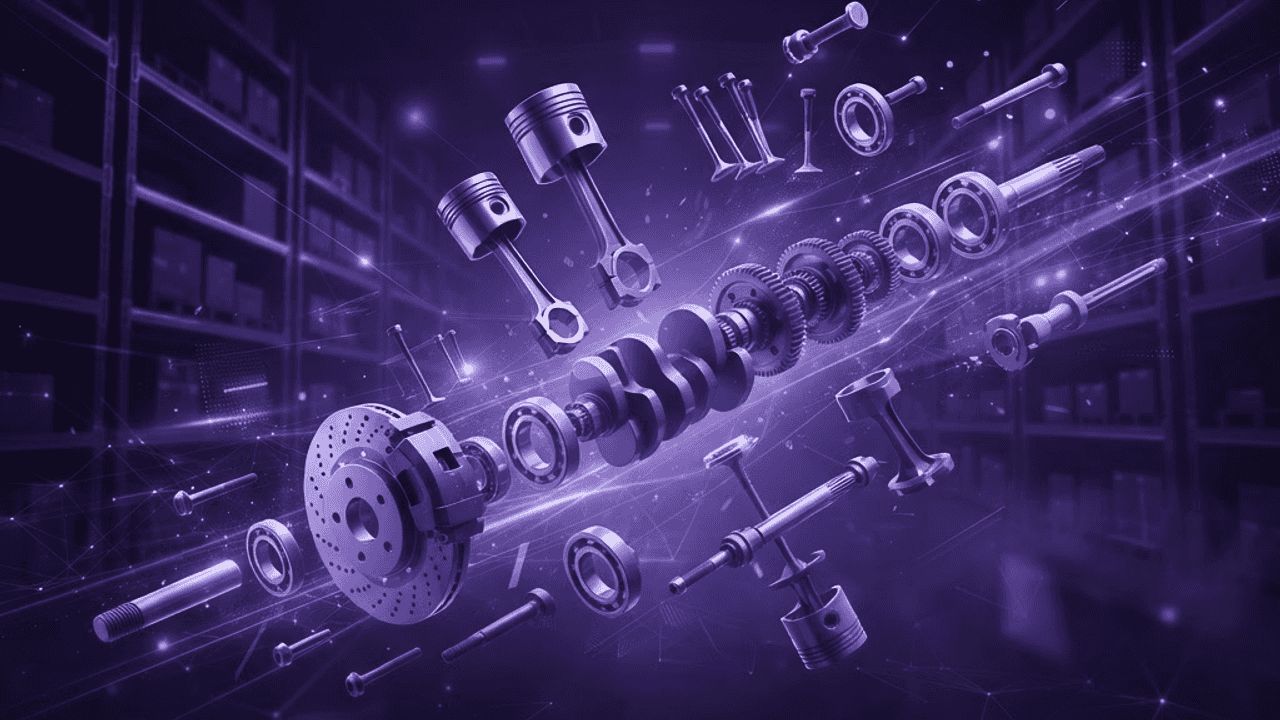
The Parts Landscape in a Dense Urban County
Arlington's auto parts market reflects its geography. Because storefront space is expensive and few residents have workshop room, the county leans heavily on quick-turn retail counters, hub-and-spoke distribution from larger warehouses in Alexandria, Springfield, and Fairfax, and increasingly on same-day delivery. Professional shops rely on wholesale accounts with multiple daily deliveries rather than holding inventory, because square footage in an Arlington service bay is far too valuable to fill with shelving.
The result is a market where availability speed often matters more than headline price. A part that costs slightly more but arrives within two hours can save a full day of vehicle downtime, and for commercial operators that arithmetic is decisive.
Understanding Part Categories
Before comparing suppliers, it helps to understand what you are buying.
Original equipment parts are sold in manufacturer packaging through dealer parts counters. They guarantee fitment and typically carry a factory warranty. For electronics, sensors, safety systems, body panels, and anything requiring calibration, original equipment is frequently the correct choice.
Original equipment supplier parts are made by the same company that supplied the automaker, sold in the supplier's own box, usually at a lower price. Bosch, Denso, Aisin, NGK, Continental, Sachs, Lemförder, and Gates fall into this category depending on the vehicle. This is often the smartest value in the market.
Quality aftermarket parts come from established manufacturers who design their own components. Moog for steering and suspension, Brembo and Akebono for brakes, Monroe and Bilstein for dampers, and Mahle and Wix for filtration are widely respected examples.
Economy aftermarket parts are the lowest tier, and they are appropriate for a vehicle nearing the end of its life or for non-critical components. They are a poor choice for brakes, suspension, cooling, or anything whose failure has safety consequences.
Remanufactured parts such as alternators, starters, calipers, steering racks, and transmissions are rebuilt to specification and generally represent excellent value, particularly when they carry a lifetime warranty.
Used and salvage parts are the sensible answer for body panels, mirrors, interior trim, wheels, and glass, where new pricing is disproportionate to function.
Retail Chains Serving Arlington Drivers
The national chains dominate walk-in retail, and each has a distinct character. AutoZone is strong on lifetime-warranty replacement parts, free battery and alternator testing, code reading, and tool loaner programs. Advance Auto Parts competes aggressively on online ordering with in-store pickup and frequently carries broader European coverage. O'Reilly Auto Parts has built a reputation for a knowledgeable counter and strong professional-installer support. NAPA Auto Parts is typically the preference of independent shops because of parts quality tiering and depth in older applications. Genuine Parts distribution and Carquest serve the wholesale side of that same network.
Pep Boys combines retail with installation, useful for buyers who do not want to source and fit separately. Warehouse retailers such as Costco and Sam's Club are competitive on tires and batteries specifically. Online specialists including RockAuto, FCP Euro, and Tire Rack win on selection and price for planned repairs where shipping time is acceptable, and FCP Euro's lifetime replacement policy on consumables is genuinely unusual in the industry.
Dealer Parts Counters
Every major franchise in the Washington region operates a parts department, and many offer wholesale discount pricing to the public if you ask. For a European or Japanese vehicle with a model-specific bracket, clip, or electronic module, the dealer counter is often the only reliable source, and the time saved avoiding an incorrect aftermarket order justifies the premium. Provide your vehicle identification number, which eliminates nearly all fitment error.
Salvage and Recycled Sources
Regional automotive recyclers and self-service yards around Northern Virginia and into Maryland are excellent for body and trim components. Many participate in networked inventory systems, so a yard can locate a part across dozens of partner facilities. Ask about interchange numbers, warranty period, and whether the part is graded for damage. For a ten-year-old vehicle needing a door mirror, this route can cut cost by eighty percent or more.
How to Buy Correctly
Always order by vehicle identification number rather than year, make, and model alone, because mid-year production changes are common. Compare warranty terms, since a lifetime warranty on a wear item changes the real cost calculation. Confirm core charges and the return process for remanufactured components. Verify return policies on electrical parts, which are frequently non-returnable once installed. And check whether a component requires calibration, programming, or relearn procedures, because a correctly sourced part installed without calibration is still a failed repair on modern vehicles with advanced driver assistance systems.
Trends Reshaping Parts Supply
Several forces are changing this industry. Electrification is shrinking demand for exhaust, ignition, and fuel system components while creating new demand for high-voltage cabling, thermal management, and battery service parts. Advanced driver assistance systems have made windshield and bumper replacement into calibration jobs. Supply chain volatility has pushed suppliers toward regional stocking and predictive inventory. And the right-to-repair movement continues to shape how much diagnostic and parts data independent shops can access.
Choosing Your Supplier
For urgent repairs, prioritize local availability. For planned work, prioritize part quality and warranty. For older vehicles and cosmetic needs, prioritize salvage. Most Arlington owners end up using three sources in rotation rather than one, and that is the correct approach. Keep a record of what brand you installed and when, because that history is what allows you to distinguish a bad part from a bad diagnosis the next time something fails.