
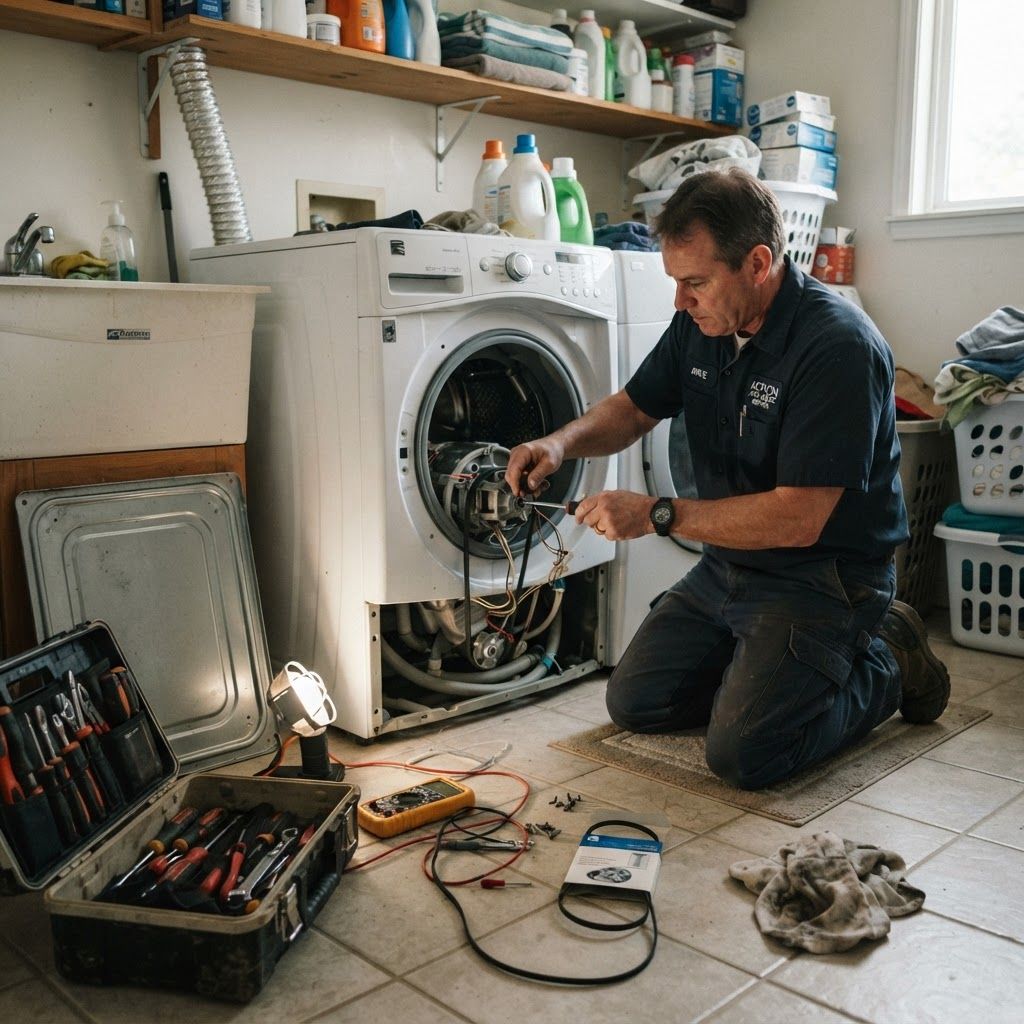
The Case for Repair Over Replacement
Appliance replacement has become expensive, and modern units are not necessarily more durable than the ones they replace. A failed control board, worn door seal, defective water inlet valve, or clogged drain pump can often be fixed for a fraction of a new appliance cost. The challenge is finding a technician who diagnoses accurately rather than replacing parts by elimination and billing for each attempt.
A reasonable framework is the fifty percent rule. If repair cost approaches half the price of an equivalent new appliance and the unit is past the midpoint of its expected lifespan, replacement usually makes sense. Below that threshold, repair typically wins. Expected lifespans vary, with refrigerators generally lasting twelve to fifteen years, dishwashers ten to twelve, clothes washers ten to thirteen, dryers twelve to fifteen, and ranges fifteen or more.
Common Failures and What They Indicate
Refrigerators most often fail through condenser coil restriction from dust and pet hair, evaporator fan motors, defrost system components, or door gaskets that no longer seal. Ice maker problems are frequent and usually involve water inlet valves or the icemaker module rather than the sealed refrigeration system.
Dishwashers commonly suffer from drain restrictions, worn door seals, failed wash pumps, or heating element issues. Poor cleaning performance is often a water temperature or detergent problem rather than a mechanical failure.
Washing machines fail at drain pumps, door locks on front loading models, shock absorbers causing excessive vibration, and control boards. Front loaders in the region frequently develop odor issues from residue buildup, which is a maintenance matter addressed through gasket cleaning and proper detergent dosing.
Dryers overwhelmingly suffer from restricted venting. Long duct runs, crushed flexible transition hose, and lint accumulation cause extended drying times, overheating, and genuine fire risk. Heating elements, thermal fuses, and drive belts round out common dryer repairs.
Ranges and ovens fail at igniters on gas models, bake elements on electric models, temperature sensors, and control boards. Induction cooktops introduce different electronics-driven failure modes.
Ten Appliance Repair Services Serving St. Paul
Capital City Appliance Repair services all major brands with factory-authorized status on several manufacturers and a large parts inventory on trucks.
Northern Home Appliance Service focuses on refrigeration including sealed system work requiring refrigerant certification.
Summit Laundry Appliance Experts concentrates on washers and dryers including stacked units and combination machines in compact urban spaces.
Great River Kitchen Appliance Repair handles ranges, ovens, cooktops, and dishwashers with strong gas appliance experience.
Heritage Vintage Appliance Restoration serves owners of older and collectible appliances that modern service companies decline to touch.
Frostline Refrigeration Services covers refrigerators, freezers, and ice machines for both residential and light commercial clients.
Eastside Appliance Technicians provides general repair with same-day and next-day availability across the east metro.
Union Park Appliance Service operates as a small independent shop known for honest repair-versus-replace guidance.
Landmark Luxury Appliance Repair specializes in high-end and imported brands requiring specialized parts and training.
Riverfront Dryer Vent and Appliance Care completes the list combining appliance repair with dryer vent cleaning and inspection.
Pricing Structure and What to Expect
Most companies charge a diagnostic or service call fee, frequently applied toward repair cost if you proceed. Repairs are usually quoted as flat rates covering labor plus parts. Ask whether the quote is firm before authorizing work, and whether additional diagnosis could change it.
Parts availability varies significantly by brand. Mainstream manufacturers have broad parts distribution, while some imported and luxury brands require ordering with longer lead times. Discontinued models may have obsolete parts, which effectively forces replacement regardless of the mechanical merits of repair.
Ask about warranty on the repair. Reputable services warranty both parts and labor for a defined period, commonly ninety days to one year, and will return without a second service fee if the same failure recurs.
Maintenance That Extends Appliance Life
Simple habits substantially reduce failures. Clean refrigerator condenser coils annually, more often in homes with pets. Clean dryer lint traps every load and have the full vent run cleaned periodically. Run dishwasher cleaning cycles and clear the filter. Leave front loading washer doors ajar between uses to allow drying. Level appliances properly, since vibration accelerates wear. Replace water supply hoses on washers with braided stainless lines before they fail.
Water quality plays a role too. Hard water accelerates scale buildup in dishwashers, washing machines, and ice makers, making softening a genuine appliance longevity investment in this region.
Choosing a Repair Service
Ask which brands the company is authorized to service and whether the technician has manufacturer training on your specific appliance. Confirm the diagnostic fee and whether it applies to repair. Ask about parts sourcing and typical wait times. Request the warranty terms in writing.
Be cautious with services that recommend replacement immediately without diagnosis, or that quote major component replacement without explaining the test results that led there. A technician who shows you the failed part and explains the failure mode is demonstrating competence.
Conclusion
Appliance repair delivers strong value when performed by a technician who diagnoses accurately and advises honestly about repair economics. The ten St. Paul services above cover general repair, refrigeration, laundry, cooking appliances, luxury brands, and vintage restoration. Verify brand authorization, understand the fee structure, and pair repair with the maintenance habits that prevent the next failure.