
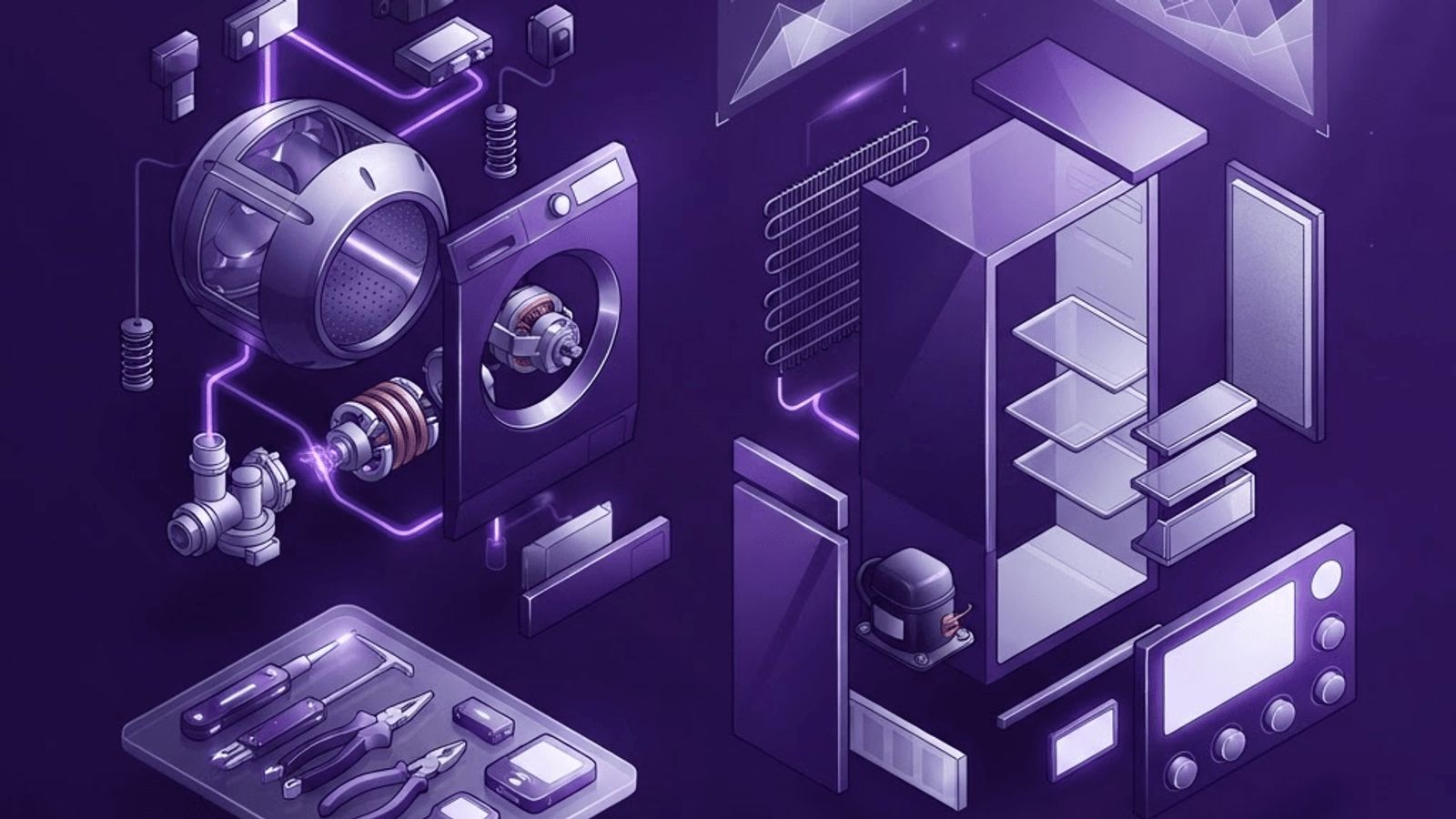
Repair Has Become the Smarter Default
Appliance economics have shifted. A decade of price increases means a mid-range refrigerator, front-load laundry pair, or wall oven now represents a significant purchase, and replacement often involves weeks of lead time for specific configurations. Meanwhile many failures are single-component problems: a control board, a drain pump, an igniter, a compressor start relay, a door latch, or a thermistor. When a competent technician can diagnose accurately and source the correct part, repair frequently costs a fraction of replacement and keeps a functioning appliance out of the landfill.
The catch is that modern appliances are electronically controlled, and accurate diagnosis requires manufacturer service documentation, diagnostic modes, and part-specific knowledge. Guess-and-replace troubleshooting on a machine with a five hundred dollar control board is expensive for everyone. That is why technician competence, not hourly rate, determines whether appliance repair delivers value.
Local Conditions That Cause Failures
Amarillo homes present a specific failure profile. Hard water is the primary culprit. Mineral scale coats dishwasher heating elements and spray arms, blocks water inlet valves and ice maker lines, builds up in washing machine components, and prematurely destroys water heater elements. Homes without softening see substantially shorter appliance life, and technicians who point this out are giving you the most valuable advice in the visit.
Dust is the second factor. Fine airborne particulate accumulates on refrigerator condenser coils and dryer lint pathways. A dust-blanketed condenser forces the compressor to run longer and hotter, driving up energy use and shortening compressor life, while restricted dryer venting causes long dry times, thermal cutoff failures, and genuine fire risk. Temperature extremes matter too: refrigerators and freezers installed in uninsulated garages struggle when ambient temperatures fall below their design range in winter or spike in summer, causing erratic cycling and frozen or thawed contents.
What Full-Service Repair Companies Cover
Comprehensive shops service refrigerators and freezers including ice makers and water dispensers, ranges, cooktops, wall ovens, and range hoods in both gas and electric configurations, dishwashers, washers and dryers in top load, front load, and stacked formats, microwaves including built-in and over-range units, garbage disposals, and increasingly wine coolers, beverage centers, and outdoor grills. Some companies also handle commercial equipment for restaurants and laundromats, which requires different parts channels and faster response commitments.
Brand authorization is an important differentiator. Manufacturer-authorized servicers can perform in-warranty repairs at no cost to you, access factory technical support and service bulletins, and order genuine parts through official channels. If your appliance is still under warranty or an extended service plan, going to an unauthorized shop may void coverage. For premium and built-in brands, authorization matters even more because parts are proprietary and rarely available from generic suppliers.
Understanding Diagnostic and Labor Charges
Nearly all reputable companies charge a diagnostic or service call fee for the trip and evaluation, typically credited toward the repair if you proceed. That fee is legitimate: the technician spends time and fuel and applies expertise. Be suspicious of free diagnosis offers that are recovered through inflated part markups. Ask three questions when booking: what is the diagnostic fee, is it applied to the repair, and is labor quoted flat-rate per job or hourly.
Also confirm part sourcing and warranty. Original equipment parts cost more than aftermarket alternatives but fit and last better, particularly for electronic components. A solid shop warranties parts and labor for a defined period, commonly ninety days to one year. Ask whether a return visit for the same failure is covered without another diagnostic fee. Finally, ask about parts availability timelines, because a repair requiring a special-order board from a manufacturer may take a week or more, which affects your repair-versus-replace decision.
Deciding Between Repair and Replacement
A practical framework helps. Consider the appliance's age against typical service life: refrigerators and ranges commonly last thirteen to seventeen years, dishwashers and washers about ten to thirteen, dryers slightly longer. If the appliance is past roughly seventy-five percent of expected life and the repair costs more than half of replacement, replacement usually wins. If it is younger and the failure is a discrete component, repair is almost always the better economics.
Other considerations tilt the decision. Built-in and paneled units are expensive to replace because cabinetry and dimensions constrain options, so repair is often strongly favored. Compressor and sealed-system failures on refrigerators are costly and may justify replacement unless the unit is premium or under a sealed-system warranty, which many manufacturers extend beyond the general warranty period. Efficiency gains matter for very old units, where a modern replacement can meaningfully reduce electricity and water consumption. And repeated failures on the same appliance signal a machine that will keep costing money.
Choosing a Repair Company
Verify that the business is established locally with a real service address and insurance. Ask which brands they service most and whether they hold factory authorizations relevant to your appliance. Check whether they carry common parts on the truck, which determines first-visit completion rates. Read reviews with attention to communication, arrival windows, and whether repairs held up.
Prefer companies that provide a narrow arrival window with text notification rather than an all-day wait, document the diagnosis in writing with the failed part identified, and photograph findings. Technicians should protect flooring, pull and reset appliances carefully, and reconnect water and gas lines with proper testing. For gas appliances, confirm the technician is qualified to work on gas connections and checks for leaks after service.
Extending Appliance Life
Maintenance is straightforward and neglected. Vacuum refrigerator condenser coils twice a year, more often in dusty conditions or with pets. Clean the dryer lint filter every load and have the vent duct professionally cleaned annually, checking that the exterior damper opens freely. Run a dishwasher cleaner monthly in hard water and clear the filter of debris. Leave front-load washer doors ajar to prevent gasket mildew and clean the gasket regularly. Level all appliances properly, since vibration destroys bearings and suspension components. Address hard water at the source with a softener, which pays for itself across the entire appliance inventory.
Final Perspective
Appliance repair in Amarillo rewards choosing a technician who diagnoses rather than guesses, sources correct parts, and explains the underlying cause including hard water and dust factors that drive local failures. Ask about diagnostic fees, brand authorization, and warranty up front, use the age-and-cost framework to decide between repair and replacement, and keep up basic maintenance. That combination reliably converts a stressful breakdown into a routine, affordable service call.